

Audio By Carbonatix
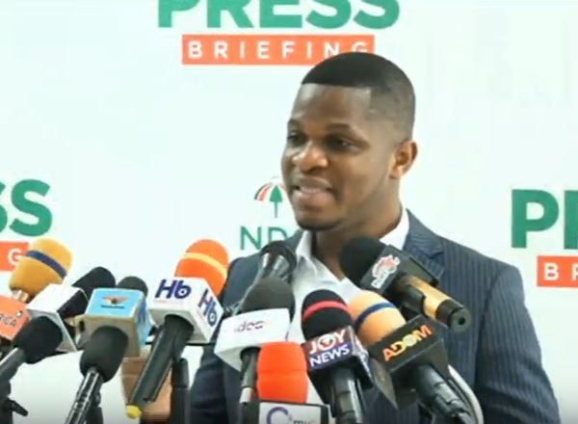
Communications Director of the NDC, Sammy Gyamfi, has denied allegations levelled against the party’s flagbearer, John Dramani Mahama concerning comments made about the country’s debt position.
John Mahama, during a speech at a Professionals Dialogue series in Accra on Monday, said the International Monetary Fund (IMF) forecasts Ghana’s current rate of borrowing and debt at 76.7% debt to GDP ratio and thus had relapsed the country into a Highly Indebted Poor Country (HIPC) status.
This, he said, is due to what he believes is economic mismanagement by the governing NPP.
“The IMF in its Sub-Saharan African Regional Economic Outlook forecast the current rate of borrowing and debt at a frightening 76.7% debt to GDP ratio.
“Unfortunately, Ghana is back to HIPC status under Nana Akufo-Addo and Ken Ofori-Atta administration,” Mahama said.
In a rebuttal, the IMF has denied the claim based on data on its website. It said in an e-mail to Joy News that any interpretation to that effect “may be deceptive.”
The Fund argued that the list on its website is for all countries that have been on the HIPC program since 1996 and is regularly updated.
Information Minister, Kojo Oppong Nkrumah also debunked the claims during the Nation Building Updates on Tuesday in Accra, labelling them as deliberate attempts to discredit governments efforts at reviving the economy since assuming office in 2017.
But reacting to IMF’s response and Mr. Oppong Nkrumah’s news conference Tuesday, Sammy Gyamfi maintains that the former President never said Ghana has been declared HIPC.
“The response doesn't negate any concerns or statement that President John Mahama or the NDC has made relative to our debt position. He said we are back to HIPC, and that is different from saying we have been declared as a HIPC by the IMF.
"What President Mahama was saying is factual, and that basically is that Ghana is back to the same debt unsustainable position that we were at the time we were declared as a HIPC country by the IMF and World Bank and we joined that Ghana’s debt sustainability ratio now is not anything to celebrate,” he said.
He maintained, however, that the economy under the current administration is in a much worse position.
“Our debt position is unsustainable, the IMF has made that clear. There are independent analysis experts and economists who have also confirmed that indeed our debt position is not sustainable, because we have a position where the percentage of our debt to the total value of goods produced and services provided in Ghana, which is our GDP, is projected to hit 76.7%.
If your debt to GDP ratio crosses the 70% threshold, it means that it is not sustainable, which takes us back to the same place we were at the time we joined the HIPC debt release programme,” he noted.
Latest Stories
-
Ghana lose Morocco friendly as Atlas Lions turn to Mali
1 hour -
2026/2027 GPL: Kelvin Nkrumah strike sends Medeama top of league table
1 hour -
Emmanuel City crowned champions of maiden Global Game Scouting Tournament
2 hours -
Thomas Partey loses father Jacob Teye Partey
2 hours -
Martin Kpebu explains when EOCO can arrest Manhyia South MP after securing court warrant
2 hours -
EOCO’s reasons for seeking Manhyia South MP arrest warrant not justified – Kpebu
2 hours -
MTN Ghana warns SMEs against sharing PINs amid digital fraud risks
2 hours -
Yendi nursing students warn restricted access to skills lab could affect their training
2 hours -
Minority awaits formal notice of arrest warrant for Manhyia South MP – Annoh-Dompreh
2 hours -
LTIF announces 2026 Pan-African edition in Accra from October 6-7
2 hours -
Mfantsipim needs broader funding partnerships to bridge infrastructure gap – Prof Baiden
2 hours -
MP status must not shield anyone from law enforcement – Kwakye Ofosu
2 hours -
EOCO had tactical team ready to arrest Baffour Awuah – Felix Kwakye Ofosu
3 hours -
Afoko can unite NPP’s factions, says Charles Owusu Juanah
3 hours -
Guardiola backing Man City after guilty verdicts
3 hours