

Audio By Carbonatix
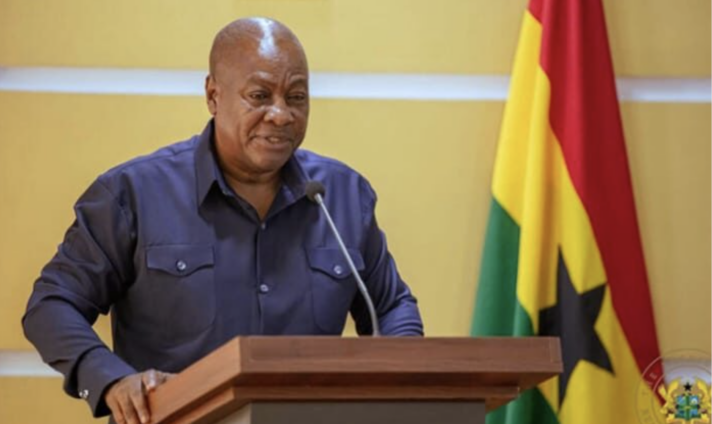
President John Mahama has unveiled a long-term strategy to ease the mounting pressure on Accra by developing a new city outside the capital and relocating major government institutions, describing the move as a critical step towards addressing the capital's recurring flooding and uncontrolled urban expansion.
The President announced the proposal after conducting an aerial inspection of communities devastated by Monday's torrential rains, which left at least nine people dead, displaced hundreds of residents and caused extensive destruction to homes, businesses and public infrastructure across the Greater Accra Region.
Speaking after surveying the flood-hit areas, President Mahama said while immediate interventions would focus on improving drainage infrastructure and responding to the humanitarian needs of affected residents, Ghana must also pursue a bold long-term solution by reducing the intense population and development pressure on the capital.
"But ultimately, the other solution will be to decongest Accra," the President said.
"And that's why we're planning that we move some of the city out, that is, the major government departments, and then also create a new centre of growth so that our people will start building outside Accra in a new city instead of everybody looking for some space in Accra."
Twenty-year transformation plan
President Mahama explained that the proposed development would be implemented as a long-term national project spanning about two decades.
He disclosed that technical experts were currently preparing the design and master plan for the proposed city, after which land would be demarcated for residential, commercial and institutional development.
"That's a long-term solution. Like I said, it's a 20-year project. They are still working on the designs," he stated.
"Once they do that, we'll demarcate. People can start buying plots if they like, and can start building houses. We'll do the roads and bring the water and electricity so that it eases the pressure on Accra as a city."
Flood disaster exposes urban challenges
The President's comments came against the backdrop of one of the most destructive flood events to hit the capital in recent years.
Hours of relentless rainfall submerged several communities, including Circle, Alajo, Kaneshie, Adabraka, Achimota, Weija, Madina, Adenta, Lapaz and parts of Spintex, leaving thousands stranded and disrupting transport, business and academic activities.
At the Circle transport terminal, commercial drivers and their mates were forced to climb onto the roofs of tro-tro buses after floodwaters engulfed the station, while emergency services rescued residents trapped in submerged homes and vehicles.
The floods also compelled the University of Ghana to suspend lectures and the Ghana School of Law to postpone examinations due to dangerous travel conditions.
Building a resilient capital
Urban planners have long argued that Accra's rapid population growth, unplanned development, encroachment on waterways and overstretched infrastructure have significantly increased the city's vulnerability to flooding.
Government officials believe establishing a new administrative and economic growth centre, supported by modern infrastructure, could encourage businesses, institutions and residents to relocate, thereby reducing congestion within the capital.
The proposal also aligns with broader efforts to improve urban planning, expand housing opportunities and stimulate economic development beyond the existing metropolitan area.
Immediate interventions continue
Even as government pursues the long-term vision, emergency agencies, including the National Disaster Management Organisation (NADMO), the Ghana National Fire Service and the Ghana Police Service, continue rescue, relief and damage assessment operations across affected communities.
Authorities have urged residents to stay away from flood-prone areas, comply with safety directives and support ongoing efforts to assist victims as the nation recovers from the disaster.
For many residents, however, the latest floods have once again reinforced the urgent need for sustained investment in drainage systems, stricter enforcement against illegal construction on waterways and comprehensive urban planning reforms to prevent similar tragedies in the future.
Latest Stories
-
“NSA did not tell us of any embassy arrangement” – Kofi Adams
10 minutes -
Glasner suffers loss on Selhurst return as Palace beat Forest
2 hours -
WAFU B U17: ‘We won but I expected more from my boys’ – Kassim Ocansey
2 hours -
Man City cruise to statement win over 10-man Liverpool
2 hours -
Be careful with cross-border lending, foreign currency exposures – BoG to financial institutions
4 hours -
GPL 2026/27: Medeama go three clear as Hearts of Oak recover and Bechem stage stunning comeback
4 hours -
Ntiamoah Foundation launches “BEYOND 20” anniversary campaign
5 hours -
Credit Risk Management Directive: BoG to begin implementation for banks, others from July 1, 2027
5 hours -
Ghana Brands Awards 2026: Leading brands, business trailblazers to shine on November 20
5 hours -
T-bills auction: Demand improves as government exceeds target by about 76%; interest rates soften
5 hours -
Ziope undertakes initiative to build a technologically inclined community, commissions self-help ICT lab
6 hours -
ECG announces power outage in parts of Tema, Central Region due to network fault, maintenance
6 hours -
When the Gospel Becomes a Weapon: The church, blackmail and the abuse of faith
7 hours -
JoyNews’ Jacqueline Ansomah Yeboah selected for UK Media Excellence for Emerging Technologies Fellowship
7 hours -
Mental Health Alliance urges government to operationalise Mental Health Fund
7 hours