

Audio By Carbonatix
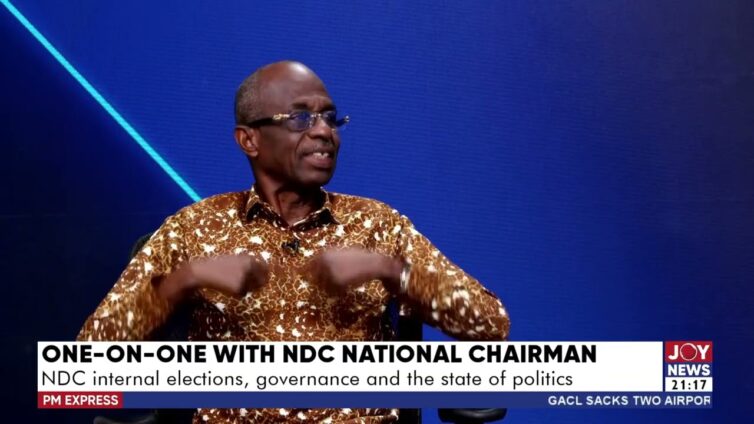
National Chairman of the National Democratic Congress (NDC), Johnson Asiedu Nketia, has called for reforms to strengthen public confidence in the judiciary, arguing that judicial independence must be matched by accessible, timely and credible justice.
He said courts play a critical role in resolving political disputes and protecting constitutional rights but cannot effectively defend democracy if citizens perceive them as inaccessible, inconsistent or vulnerable to political influence.
Mr Asiedu Nketia made the remarks on Tuesday, August 11, 2026, at the 2026 Goodluck Jonathan Foundation Democracy Dialogue in Bauchi, Nigeria.
The dialogue was held under the theme "Beyond Elections: Can Political Parties and the Judiciary Save African Democracy?"
Speaking on a panel on political parties and the judiciary, Mr Asiedu Nketia said courts are indispensable because political competition inevitably generates disputes over elections, rights and constitutional boundaries.
"The judiciary is indispensable because political competition inevitably produces disputes over elections, rights and constitutional boundaries," he said.
Ghana's election petitions
Mr Asiedu Nketia cited Ghana's presidential election petitions following the 2012 and 2020 elections as examples of how major political disputes can transfer from the streets to the courtroom.
The 2012 presidential election petition was dismissed by a five-to-four majority after an extended hearing, while the Supreme Court unanimously dismissed the 2020 petition.
He said the parties complied with both decisions despite disagreements over aspects of the proceedings and the reasoning of the court.
According to him, such compliance demonstrated the importance of allowing courts to resolve political disputes within the constitutional framework.
Criticism of courts is legitimate
Mr Asiedu Nketia, however, stressed that respect for judicial authority should not prevent political actors and citizens from criticising judicial decisions.
"Legitimate criticism is part of constitutional democracy; intimidation, threats and personal attacks are not," he said.
He said judicial independence should mean freedom from political, financial and personal influence, but should not be interpreted as freedom from ethical standards, transparency, consistency or public accountability.
"Judicial independence means freedom from political, financial and personal influence, but it does not mean freedom from ethical standards, transparency, consistency or public accountability," he said.
Public trust concerns
Mr Asiedu Nketia cited findings from Afrobarometer's Round 10 survey to highlight concerns about public confidence in Ghana's courts.
He said only 35 per cent of Ghanaians surveyed trusted the courts "somewhat" or "a lot".
He further said half of respondents were not confident that an ordinary person who had been wronged could obtain justice.
Only 37 per cent believed they could afford to take a legal problem to court, while 38 per cent believed that a case would be resolved within a reasonable period.
Mr Asiedu Nketia stressed that the findings reflected public perceptions rather than judicial findings but said they should not be ignored.
"Judicial authority cannot depend only on constitutional text; it must also rest on citizens' confidence that justice is accessible, impartial and timely," he said.
Accessibility and legal aid
He called for measures to improve access to justice, including strengthening legal aid and making reliable information about court performance available to the public.
He also called for transparent criteria for judicial appointments and promotions and the prompt publication of constitutional judgments.
According to him, these measures would help improve confidence in the judiciary and strengthen its role as a check on political power.
Strong but restrained judiciary
Mr Asiedu Nketia said Africa needed judiciaries that were strong enough to restrain governments, protect opposition parties, defend fundamental rights and enforce constitutional limits.
At the same time, he cautioned courts against becoming "alternative political chambers" or substituting judicial preferences for decisions that should properly be made by elected institutions and citizens.
He said courts must therefore combine courage with restraint.
Dialogue before crisis
Mr Asiedu Nketia also called for political parties, courts, electoral bodies, civil society, the media and academic institutions to engage regularly rather than waiting for political disputes to escalate into crises.
"Dialogue should not begin only when an election dispute threatens national stability," he said.
He argued that strengthening judicial institutions was not simply a matter for judges and lawyers but a shared responsibility involving political actors and citizens.
'Confidence is the judiciary's strongest protection'
Concluding his remarks, Mr Asiedu Nketia said the judiciary's long-term protection lay in public confidence rather than political goodwill.
"The judiciary must remain independent of political power while providing remedies that are impartial, accessible, timely and convincingly reasoned," he said.
He added that the judiciary's strongest protection was not the goodwill of political leaders but citizens' confidence in its independence and integrity.
Mr Asiedu Nketia said African democracy would become more durable when courts administered justice without fear or favour, political parties respected constitutional limits, governments remained accountable and citizens stayed engaged beyond election day.
Latest Stories
-
Trade Ministry commends Prisons Service for using art to drive inmate rehabilitation
9 minutes -
Books, brushes and second chances: Dr Abena Asomaning launches three titles to support prison outreach
16 minutes -
Treasury bill auction oversubscribed by 53.5% as yields fall across maturities
18 minutes -
NPP warns aspirants premature campaigning could jeopardise eligibility for primaries
24 minutes -
Ghana courts investors in Bangkok after exit from $3bn IMF bailout
29 minutes -
8 arrested over alleged internet fraud initiation assault in Bono Region
33 minutes -
BoG proposes 30-day liquidity buffer requirement for banks
40 minutes -
BoG plans reviews of banks’ cybersecurity compliance
46 minutes -
GRA cautions taxpayers against attacking tax officials
53 minutes -
Invest Ghana Summit to drive value addition, industrialisation
58 minutes -
Sports Ministry denies involvement in World Cup visa scandal, calls for probe
1 hour -
Ghana earns top US ranking in fight against human trafficking
1 hour -
Education Minister commends teacher unions for suspending nationwide strike
1 hour -
‘Farmers Services Centres to be game changer for Ghana’s agriculture’ – Mahama
1 hour -
WIWIK launches new leadership development pathway for Ghanaian university students
1 hour