

Audio By Carbonatix
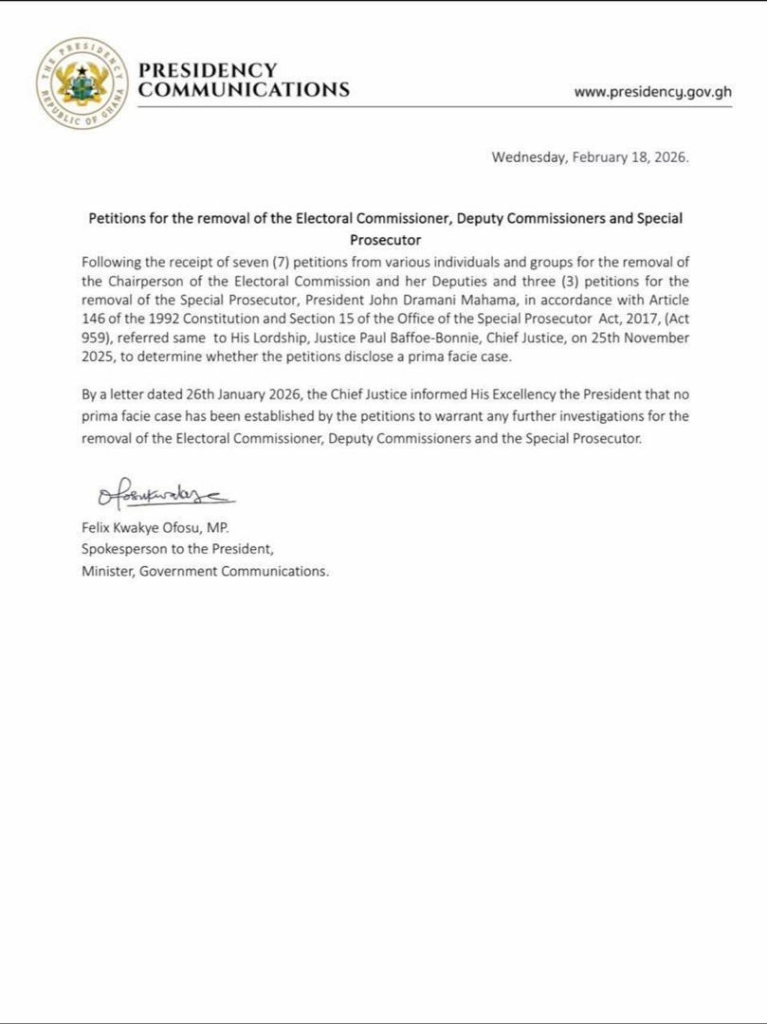
The Chief Justice, Paul Baffoe-Bonnie, has ruled that there is no prima facie evidence to justify further investigation into petitions calling for the removal of the Electoral Commissioner, her deputies, and the Special Prosecutor.
This was confirmed by the Minister of Government Communications in a statement issued on Wednesday, February 18.
The petitions were received by Jubilee House in late 2025, with the Minister of State in charge of Government Communications, Felix Kwakye Ofosu, confirming that ten separate petitions had been filed under the constitutional removal process.
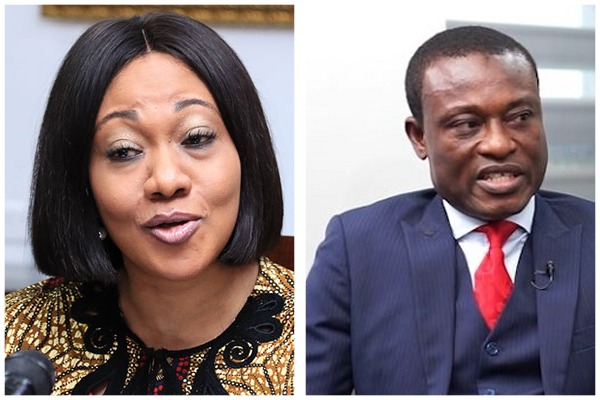
Seven of these targeted EC Chair Jean Mensa and her two deputies, Dr Bossman Eric Asare and Samuel Tettey, while three sought the removal of Special Prosecutor Kissi Agyebeng. These petitions were duly referred to Chief Justice Paul Baffoe-Bonnie for preliminary constitutional scrutiny as required under Article 146 of the 1992 Constitution.
The grounds cited by petitioners, including some lodged by an EC staff member, alleged misconduct ranging from cronyism and abuse of office to gross incompetence that, in their view, had eroded public confidence in the institutions being targeted.
The petitioner against the EC leadership, Joseph Blankson Adumadzie, outlined a series of concerns about administration and integrity, although his exact complaints remain legally confined due to constitutional confidentiality provisions.
However, after reviewing the petitions, the Chief Justice determined that no prima facie case existed to justify further investigation or the establishment of a formal inquiry committee. This constitutional threshold must be met before a five-member tribunal can be constituted to investigate allegations of stated misbehaviour, incompetence or incapacity — the only grounds on which such office-holders can be removed. Since that test was not met, the process effectively ends with the Chief Justice’s decision. (Common constitutional procedure under Article 146.
The petitions drew attention not only to the targeted officials but to broader public debate over accountability and institutional independence. Critics had argued that the processes around high-level removal petitions should be handled with care and confidentiality until formal thresholds are met, to protect institutional integrity and reputations.
Latest Stories
-
US, Iran fail to reach peace agreement after marathon talks in Pakistan
59 minutes -
Port crises loom as 11,000 drivers threaten four-day strike
2 hours -
A source of excellence across generations – Vice President Opoku-Agyemang lauds Mfantsipim
2 hours -
(Photos) Mfantsipim School launches historic 150th anniversary
3 hours -
Knights and Ladies of Marshall group backs Catholic Bishops’ stance on anti-LGBTQ+
4 hours -
Bright Simons writes: All the Filla in the Ibrahim Mahama/E&P – Gold Fields Saga
4 hours -
Monetise Idiocy In Ghana
4 hours -
ECG kicks off Phase Two of transformer upgrades at Lashibi; brief outages expected
5 hours -
The Ghanaian prophet and the mysterious death of his scottish wife Charmain Speirs
5 hours -
Nearly 400 sentenced in Nigeria for links to militant Islamists
5 hours -
Ghana’s recovery supported by gold strength despite global oil price pressures – Standard Bank Research
5 hours -
Methodist Church hails Mfantsipim@150; calls for “fresh consecration” to excellence
6 hours -
‘Excellence is our inheritance’ – Nana Sam Brew-Butler hails Mfantsipim’s 150-year reign in leadership
6 hours -
Kwaku Azar writes: A-G vs OSP
6 hours -
Mfantsipim–Adisadel rivalry built excellence, not division – Sam Jonah
6 hours