

Audio By Carbonatix
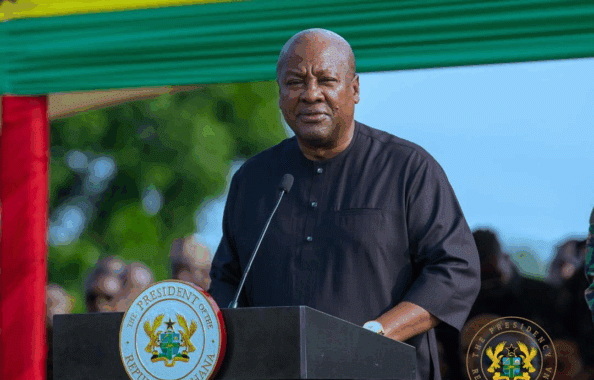
President John Mahama will, on Saturday, September 6, relaunch the National Sanitation Day (NSD) programme in a renewed effort to rally all stakeholders to rid the country of filth.
The initiative, which is under the Clean-up Ghana Agenda, comes more than 10 years after it was first launched in 2014, and seeks to put metropolitan, municipal and district chief executive (MMDCEs) at the core of implementing environmental and sanitation policies.
Subsequently, the Minister of Local Government, Chieftaincy and Religious Affairs, Ahmed Ibrahim, has directed all metropolitan, municipal and district assemblies (MMDAs) to immediately gird their loins and take immediate steps to clean up all public spaces, ceremonial streets and choked drains.
"In exercising the supervisory authority of the Ministry of Local Government, Chieftaincy and Religious Affairs, I hereby direct all MMDAs to ensure that all public spaces, ceremonial streets, and visible nuisances within your jurisdiction must be cleared by 8:00 a.m. every day, beginning tomorrow, September 4, 2025," he stressed.
At a media briefing held in Accra yesterday, Mr Ibrahim stressed that no MMDCE would keep their position if they failed to enforce sanitation laws to rid their jurisdiction of filth.
The event was attended by the Deputy Minister of Food and Agriculture, John Dumelo, some Members of Parliament (MPs), MMDCEs in the Greater Accra Region, and other actors in the environment and sanitation sector.
The NSD was introduced during President Mahama's first tenure in 2014, setting aside the last Saturday of every month for clean-up exercises across the country.
However, the initiative was abandoned after he lost power in 2016.
Now, under the Clean Ghana initiative, which forms part of the comprehensive Reset Ghana Agenda of the government, the NSD is being reintroduced to restore discipline at public spaces; empower and mobilise local government structures to clean up the cities; and foster citizens' participation and accountability in the management of sanitation.
The minister said the reintroduction of the NSD was a defining moment in the national journey towards environmental sanctity, "and a test of our seriousness as a people, our commitment to public health, and our sense of national pride."
He added that the reintroduction of the NSD was a renewed social contract between the government and citizens, anchored on accountability, enforcement and sustainability.
Mr Ibrahim said the first six months after the launch of the NSD would serve as a performance benchmark during which assemblies were required to progressively shorten the time frame for removal of waste.
"By the end of this period, assemblies must sustainably demonstrate that unsightly scenes of filth have been eliminated. Your performance as Chief Executive will be judged directly on your results in the cleanliness of your cities and towns," he said.
Again, he urged the assemblies to mobilise and deploy their environmental health officers, waste management officers, private waste service providers, community volunteers and the citizens to sustain the compliance of this directive.
He stressed that having received 80 per cent allocation of the District Assembly Common Fund (DACF) from the central government, the MMDAs had no reason to use lack of resources as an excuse to renege on their responsibility to keep their towns and cities clean.
"I am fully aware that lack of funds has often been cited as an excuse for non-performance, especially in the sanitation space. That is why the President has ensured that 80 per cent of the District Assemblies Common Fund has been released to the assemblies.”
"With this, I am convinced that districts will now have the required resources to undertake their critical environmental sanitation functions, to keep our cities and towns clean at all times," he said.
Mr Ibrahim said in support of the directive on clean-up, the Local Government Ministry was introducing additional accountability measures, including a dedicated sanitation hotline that would enable citizens to report public cleansing nuisances directly to the ministry.
He also said the assemblies would be required to submit monthly reports on their sanitation activities to their respective Regional Coordinating Councils (RCCs), including the status of public cleansing nuisances and progress made in implementing this directive, for onward submission to the ministry.
Latest Stories
-
EOCO declares Dr Gabriel Tanko Kwamigah-Atokple a fugitive over alleged gold fraud
9 minutes -
GSE records GH¢1.09bn trade in equity market; 10 stocks register gains
24 minutes -
Fuel prices: Ghana places 15th in Africa
30 minutes -
Africa must look inward: Reframing resilience in a shifting global economy
46 minutes -
7 dead, 2 missing after boat capsizes on Volta Lake
56 minutes -
Miss Diaspora Ghana 2026 launched to deepen diaspora ties and drive development
1 hour -
US warns citizens to reconsider Nigeria travel on safety grounds
1 hour -
Ivan Toney questions refereeing in Saudi Pro League title race after Al-Ahli draw
1 hour -
Angola appoint Aliou Cissé as new head coach
2 hours -
Virtual Security Africa showcases digital security vision at Kwahu Business Forum
2 hours -
EBID strengthens regional integration role amid global economic uncertainty
2 hours -
Two assault rifles, ammunition retrieved in Police probe of Tamale gang attack
2 hours -
EBID records strong financial growth with $722m disbursements in 2025 – President, Dr George Donkor
2 hours -
EBID to mobilise $2.69bn under new 2026–2030 growth strategy – Dr George Donkor
2 hours -
An open letter to telcos, regulators and security agencies on mobile money fraud in Ghana
2 hours