

Audio By Carbonatix
Ghana’s battle with illegal mining, popularly known as galamsey, has become a defining issue of governance. Rivers once used for drinking and irrigation are now poisoned with mercury, forests are cleared in the dead of night, and communities are left struggling with the health consequences of toxic metals in their food and water.
President John Dramani Mahama, who returned to office on the promise of restoring the nation’s environment, is finding himself at the center of this fight. His record so far presents a mixed bag - a blend of progress, missed opportunities, and outright failures.
WATCH FULL ANALYSIS HERE:
The Good
Mahama’s administration has made some noteworthy strides in the war against galamsey. The reintroduction of the anti-illegal mining secretariat has created a central body to coordinate policy and enforcement. Equally significant was the reclamation of nine forest reserves that had been overrun by illegal miners. Although miners later returned to some of the forests, these efforts showed a political will to confront the menace.
Security reforms were also bold. Police commanders in mining areas were reassigned to strengthen accountability, while nearly 1,000 river guards were recruited to protect Ghana’s water bodies. In a bid to formalize artisanal mining, the government launched the Responsible Cooperative Mining Initiative, though the launch was tragically overshadowed by a helicopter crash that killed eight officers, including two ministers of state, on their way to the event.
Perhaps the most striking step was political accountability within Mahama’s own party. Two NDC officials, Joseph Yamin and Abanga, were referred to EOCO for alleged galamsey-related offenses, a rarity in Ghana’s partisan landscape. On the regulatory front, new rules required importers to secure pre-shipment permits before bringing excavators into Ghana, a move designed to choke off the supply of heavy equipment to illegal miners.
The Bad
Despite these gains, significant weaknesses remain. The government’s “Gold Board” initiative, meant to boost the economy through gold purchases, faces criticism for failing to guarantee that only legally mined gold is traded. Without strong checks, the state risks buying what environmentalists describe as “galamsey gold.”
Another misstep lies in the deportation of 107 foreign illegal miners. Instead of prosecuting offenders to serve as a deterrent, the government repeated the “Aisha Huang mistake,” sending them home without punishment. Meanwhile, the controversial L.I. 2462 regulation, which many believe entrenches galamsey, has not been repealed. This is despite Mahama’s promise and the NDC’s comfortable majority in Parliament.
Even good policies suffer from poor enforcement. Excavators still find their way into the country without proper certification, raising questions about the seriousness of customs and border enforcement.
The Ugly
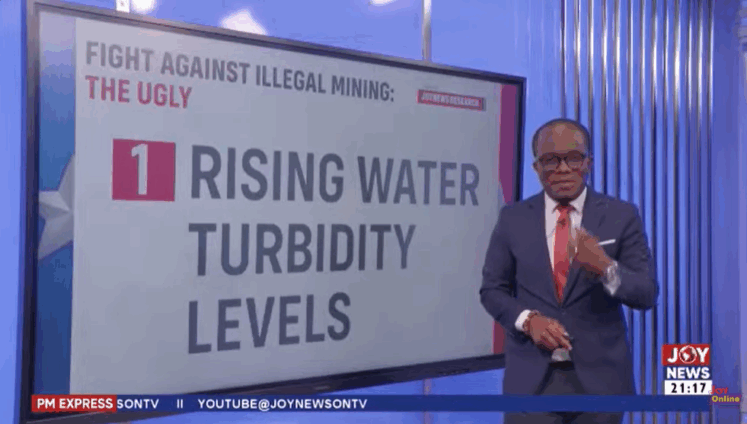
The most devastating reality lies in the environment itself. Ghana’s rivers, especially in the Central Region, have reached alarming turbidity levels - as high as 94,800 NTU, when the acceptable limit is between 30 and 500. Some treatment plants have shut down completely, leaving districts without potable water.
Calls for a state of emergency have been loud, with even the Central Regional Minister, Ekow Panyin Okyere Eduamoah, backing the idea. Yet Mahama insists that existing powers must first be exhausted. Critics see this as a lack of urgency in the face of ecological collapse.
Equally troubling was the withdrawal of the police task force by the IGP, who argued that distinguishing licensed miners from illegal ones was difficult. The Minerals Commission, which has the records, disagrees. This decision has left communities vulnerable to unchecked destruction.
Perhaps the most haunting legacy is the poisoning of the food chain. Mercury and other heavy metals have seeped into fish, vegetables, and fruits, exposing millions to long-term health risks. Add to this the earlier campaign promise of amnesty for galamseyers, and Mahama’s credibility on the issue takes a hit.
Latest Stories
-
Agrotech Fair to spotlight local agric machinery, agro-processing equipment and cutting-edge technologies – EXIM BanK CEO
21 minutes -
Ghana unlikely to face immediate fuel shortage despite Middle East tensions – Senyo Hosi
36 minutes -
SSNIT ends 2025 with over GH₵25bn asset value, investments – Director-General
39 minutes -
Tema Oil Refinery plans capacity boost to 45,000 barrels per day
50 minutes -
NCA Chief highlights 5G’s potential for mining and agriculture in Ghana
50 minutes -
Invest in sports infrastructure, not World Cup fan sponsorship – Edem Agbana to gov’t
52 minutes -
Private sector support vital for STEM growth
54 minutes -
Police crack down on ECG cable theft, arrest 10 suspects
1 hour -
Local mining firms face discrimination under new royalty regime – Steve Manteaw
1 hour -
Telcos risk sanctions over poor call quality as NCA tightens standards
1 hour -
Star Oil refuses to apologise over ICUMS fuel disruption claims
1 hour -
Labour Minister appeals to CLOGSAG to call off strike amid ongoing talks
1 hour -
IGP explains withdrawal of Special Operations Taskforce from Tamale
1 hour -
Ketu North MP Edem Agbana urges strategic investment in youth development
1 hour -
MPs, advocates renew pressure on government to pass Anti-Witchcraft Bill
1 hour