

Audio By Carbonatix
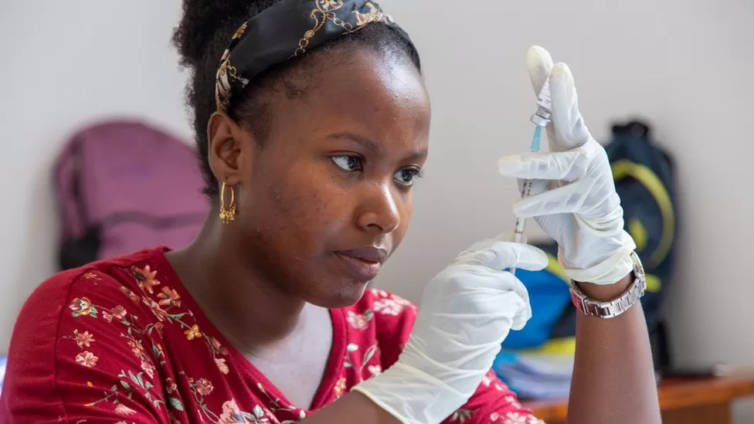
A cheap malaria vaccine that can be produced on a massive scale has been recommended for use by the World Health Organization (WHO).
The vaccine has been developed by the University of Oxford and is only the second malaria vaccine to be developed.
Malaria kills mostly babies and infants and has been one of the biggest scourges on humanity.
There are already agreements in place to manufacture more than 100 million doses a year.
It has taken more than a century of scientific effort to develop effective vaccines against malaria.
The disease is caused by a complex parasite, which is spread by the bite of blood-sucking mosquitoes. It is far more sophisticated than a virus as it hides from our immune system by constantly shape-shifting inside the human body.
That makes it hard to build up immunity naturally through catching malaria, and difficult to develop a vaccine against it.
It is almost two years to the day since the first vaccine - called RTS,S and developed by GSK - was backed by the WHO.
Two similar vaccines
Dr Tedros Adhanom Ghebreyesus, director-general of the WHO, said It was a moment of "great pleasure".
"I used to dream of the day we would have a safe and effective vaccine against malaria, now we have two," he said.
The WHO said the effectiveness of the two vaccines was "very similar" and there was no evidence one was better than the other.
However, the key difference is the ability to manufacture the University of Oxford vaccine - called R21 - at scale.
The world's largest vaccine manufacturer - the Serum Institute of India - is already lined up to make more than 100 million doses a year and plans to scale up to 200 million doses a year.
So far there are only 18 million doses of RTS,S.
The WHO said the new R21 vaccine would be a "vital additional tool". Each dose costs $2-4 (£1.65 to £3.30) and four doses are needed per person. That is about half the price of RTS,S.
The two vaccines use similar technologies and target the same stage of the malaria parasite's lifecycle. However, the newer vaccine is easier to manufacture as it requires a smaller dose and uses a simpler adjuvant (a chemical given in the vaccine that jolts the immune system into action).
In 2021, there were 247 million cases of malaria and 619,000 people died, most of them children under the age of five. More than 95% of malaria is found in Africa.
Life-saving potential
Dr Matshidiso Moeti, the WHO regional director for Africa, said: "This second vaccine holds real potential to close the huge demand-and-supply gap.
"Delivered to scale and rolled out widely, the two vaccines can help bolster malaria prevention, control efforts and save hundreds of thousands of young lives."
Data that has been published online, but has not been through the usual process of scientific review, shows the R21 vaccine is 75% effective at preventing the disease in areas where malaria is a seasonal.
The WHO's strategic advisory group of experts said that figure was comparable to the first vaccine (RTS,S) in seasonal areas.
The effectiveness of malaria vaccines is lower in areas where the parasite is present all year round.
Prof Sir Adrian Hill, director of the Jenner Institute in Oxford where R21 was developed, said: "The vaccine is easily deployable, cost effective and affordable, ready for distribution in areas where it is needed most, with the potential to save hundreds of thousands of lives a year."
Gareth Jenkins, from Malaria No More UK, said: "The reality is that malaria financing globally is far from where it needs to be and annual deaths from malaria rose during the pandemic and are still above pre-pandemic levels, so we cannot afford to be complacent as new tools are developed."
Latest Stories
-
UniMAC-IF holds workshop on Vertical Revolution: Mastering micro-dramas for African digital economy
2 minutes -
Pan-African Progressive Front hosts landmark online conference ahead of Geneva Forum
7 minutes -
Civil society is not an adversary of gov’t, but partners in nation-building – Mahama
16 minutes -
Defeamekpor calls for interdiction of Land Ministry’s director of finance
19 minutes -
Atebubu Paramount Chief visits NPA boss to strengthen ties
19 minutes -
TGMA Group of the Year nominees to be announced this week – Robert Klah
24 minutes -
Ex-Effia MP writes: Big Push for infrastructure, Small Push for people
25 minutes -
Interior Minister demands probe into GH¢3m payments made outside GIFMIS
28 minutes -
Ex-Defence Ministry procurement director to face prosecution over GH¢4.8m scandal
44 minutes -
Gov’t committed to finishing Tema Motorway by 2027, says Agbodza
50 minutes -
OSP under threat from political interference — Kissi Agyebeng calls for constitutional protection
54 minutes -
T.I. Ahmadiyya SHS, Kumasi, celebrates 75 years of excellence
1 hour -
Court orders SHS students to pay compensation for assault on teacher
1 hour -
Mahama assents to 5 bills, including key amendments on security, education and finance
1 hour -
Students of Nkwantanang M.A 6 Basic School benefit from ‘Break the Silence’ Menstrual Awareness Initiative
1 hour