

Audio By Carbonatix
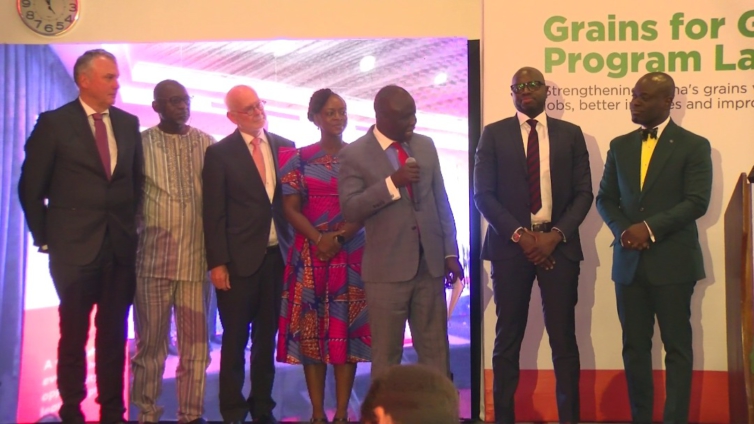
Mastercard Foundation and IDH - The Sustainable Trade Initiative, have announced the launch of an innovative partnership, dubbed Grains for Growth, to transform Ghana’s grains market.
The Programme aims to develop inclusive, and economically viable grain-supply chains that will offer employment and entrepreneurship opportunities, contribute to better incomes, and improve livelihoods of farmers, especially women and youth.
Over the next three-and-a-half-years, the Grains for Growth programme will partner with a dozen small and medium-sized enterprises (SMEs) in northern Ghana, high-profile off-takers, and other supply chain actors, to create 103,000 work opportunities across the maize, rice, millet, fonio, and sorghum supply chains with majority of these, targeting young Ghanaian women and men.
The programme will also support the inclusion of 20,000 smallholder farmers through optimized sourcing and service delivery structures, whilst aiming to significantly increase incomes for participating farmers.
Grain Production in Ghana
Grain production in the northern part of Ghana is largely characterized by informal supply chains, where actors have limited access to affordable financing solutions, mechanized services, and quality agro-inputs.
These constraints negatively affect the quality and volumes of grain production and the ability of SMEs in the value chain, to attract and maintain premium-paying buyers resulting in limited commercial investments.
With increasing local demand for grains in Ghana, a rising import dependency, and local raw-material sourcing interests, there is significant opportunity for the grains sector to facilitate economic growth and create social impact through job creation and improving the livelihoods of smallholder farmers.
Speaking at the launch of the programme, Director for Inclusive Business Development at IDH, Kebba Colley, said, “we have witnessed the transformation of local SMEs, and their farmers, into competitive businesses that meet global standards, attract competitive prices for their products ,and create sustainable jobs, particularly for women and youth. IDH is delighted to extend our work to the grains sector. We look forward to learning and improving the grains sector through this partnership with the Mastercard Foundation.”
Grains grown sustainably
The Grains for Growth programme is part of IDH’s Grown Sustainably in Africa (GSA) programme.
Under this programme, IDH works with multinationals, including Nestlé, Unilever, Dutch State Mines/Africa Improved Foods, Dangote, throughout Africa to incorporate smallholder farmers and SMEs into their supply chains through close capacity building, business development support, and facilitating market linkages.
The programme also aligns with the Mastercard Foundation’s Young Africa Works strategy in Ghana, which focuses on deepening efforts in the agriculture and agriculture adjacent sector, to unlock work opportunities for young Ghanaian women and men.
Rosy Fynn, Ghana Country Head at the Mastercard Foundation said, “the grains value chain holds enormous potential to unlock growth, improve the livelihoods of value chain operators and catalyze work opportunities for young Ghanaian women and men. By building the capacity of value chain actors, providing ready access to markets through off-taker arrangements and access to affordable financial services, we are collectively enabling smallholder farmers and SMEs to scale up and to lead the transformation of the sector to become a major contributor to Ghana’s economic growth.”
To build the commercial viability of value chain operators, the programme will also enable SMEs to improve their operational capacity, meet the quality and procurement standards of multinationals, and to optimize their smallholder farmer sourcing and service delivery structures.
Nestlé Central and West Africa, one of the first off-takers in the programme will leverage their technical expertise and establish backward integration systems to help build capacity of SMEs in the value chain. Olivier Marchand, Head of Nestle’s Agricultural Services commented “this program will not only impact livelihood and improve local sourcing of grains but will leverage on the successful work already done by Nestlé to incorporate regenerative agriculture practices, build our farm ecosystem and reduce our environmental footprint”.
Nestlé is committed to sourcing 20% of its produce from regenerative agriculture farms by 2025, 50% by 2030, and 100% beyond 2050.
Latest Stories
-
GPL 2025/26: Late Kwartemaa strike downs Hearts in Tema
3 minutes -
Ghana Faces Sierra Leone Moment as Prosecutorial Powers come under strain
13 minutes -
Don’t consume fish or seafood from Tema Shipyard until further notice – FDA warns
18 minutes -
Why volunteering might be Africa’s most underrated career accelerator
24 minutes -
ActionAid Ghana raises concern over gender gaps in Feed Ghana Programme
26 minutes -
Windstorm wreaks havoc in Gushegu, displacing nearly 2,000 residents and damaging schools
28 minutes -
Friends of Bridget Bonnie Marks her 35th birthday with donation to Kasseh Model Health Centre
1 hour -
From Ekumfi Kokodo to the Pulpit Stage: Essi Donkor’s gospel journey takes shape
1 hour -
Landfilling waste management creates no value, it’s an economic waste
2 hours -
Photos: Speaker Bagbin Commissions MPs constituency office under parliamentary decentralisation programme
2 hours -
Black Stars technical advisor Winfried Schäfer sacked as GFA shakes up backroom staff
2 hours -
Wenchi water project almost complete, critical to gov’t agenda – GWL MD
2 hours -
Anti-LGBTQ+ bill not part of government’s legislative agenda – Inusah Fuseini
2 hours -
Anti-LGBTQ Bill: Forget the rumour mongers, I’m a man of action, and will pass the bill – Speaker
3 hours -
Women and children among those killed in Sudanese army shelling of wedding celebration
3 hours