

Audio By Carbonatix
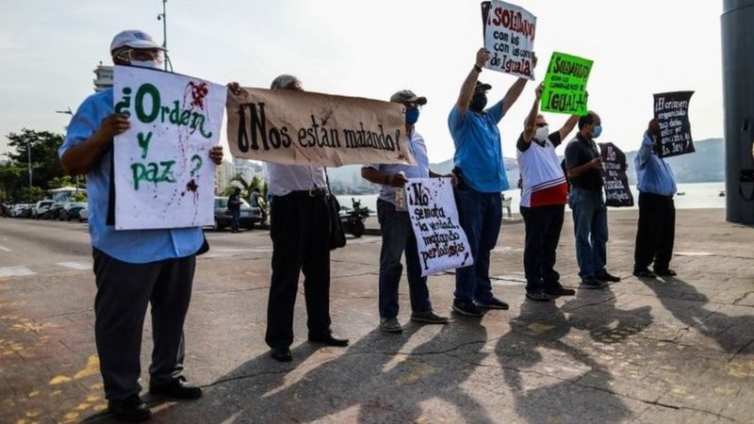
A 31-year-old journalist was shot dead on Monday in the central state of Guanajuato while he was reporting on the discovery of human remains dumped on a road in the city of Salamanca.
Israel Vázquez Rangel worked for the news web site El Salmantino.
Mexico is among the most dangerous countries for journalists.
More than 100 journalists have been killed in Mexico since 2000. Many of them were reporting on corruption or the country's powerful drug cartels.
Vázquez went to investigate reports of human remains found in the city of Salamanca early on Monday, the attorney-general's office of Guanajuato said.
He appears to have arrived at the scene of the find before the security forces.
By the time the police arrived, they found Vázquez seriously injured with several bullet wounds. He died hours later in hospital.
The website he worked for said he had been the victim of a "cowardly and atrocious attack... while he was carrying out his honourable work as a journalist".
Other news outlets also expressed their outrage at his killing.
El periodista Israel Vázquez cubría hallazgo de restos humanos en Salamanca; fue asesinado a balazos https://t.co/GApeJOKK3N pic.twitter.com/h2wA3nGmEk
— Sin Embargo MX (@SinEmbargoMX) November 10, 2020
El Salmantino pointed out that Vázquez had travelled to the location in a car clearly marked with the logo of the website and should therefore have been recognisable as a reporter.
The governor of Guanajuato urged the attorney-general's office to investigate the killing and said the state of Guanajuato would support and protect the murdered journalist's family.
The discovery of human remains and mass graves is not unusual in Guanajuato.
Less than two weeks ago, the remains of 59 bodies - belonging mostly to young people - were found in unmarked graves in Salvatierra, just over an hour's drive from Salamanca.
Guanajuato has seen a rise in violence as two rival criminal gangs, the Santa Rosa de Lima Cartel and the powerful Jalisco New Generation Cartel, have engaged in a violent turf war.
The cartels mainly engage in fuel theft from major oil pipelines located in the state as well as selling drugs to locals and extorting businesses.
Latest Stories
-
Edmond Boateng takes up secretary role at Honorary Consular Corps of Ghana
3 hours -
Gambia appoints British barrister to prosecute gruesome Jammeh-era crimes
3 hours -
Girl group Flo on entering into their ‘bombastic, confident, strong’ era
3 hours -
Germany suspends military approval for long stays abroad for men under 45
4 hours -
Liverpool face uphill Champions League task after PSG thrashing in Paris
4 hours -
‘Ketamine Queen’ sentenced to 15 years in Matthew Perry overdose death
4 hours -
Nigeria begins mass trial of 500 terrorism suspects
4 hours -
Atletico Madrid stun 10-man Barcelona to seize Champions League semi-final advantage
4 hours -
Black Stars coach to be announced by next week – Sports Minister
5 hours -
Chiefs, queen mothers and principal elders of Odau group denounce ‘rebellious Etweresohene’, pledges allegiance to Okyenhene
5 hours -
KNUST library dress code sparks online backlash over strict rules
5 hours -
Cultural Diplomacy in Action: Ghanaian youth leaders present symbolic smock to U.S. Chargé d’Affaires
5 hours -
Ghana Card payment activation under review – NIA breaks silence on financial integration
5 hours -
Ofori-Atta’s ICE release on bail positive; he poses no risk – Amanda Clinton
5 hours -
Ken Ofori-Atta’s passport seized after bail, set to reappear in US Court on April 27
5 hours