

Audio By Carbonatix
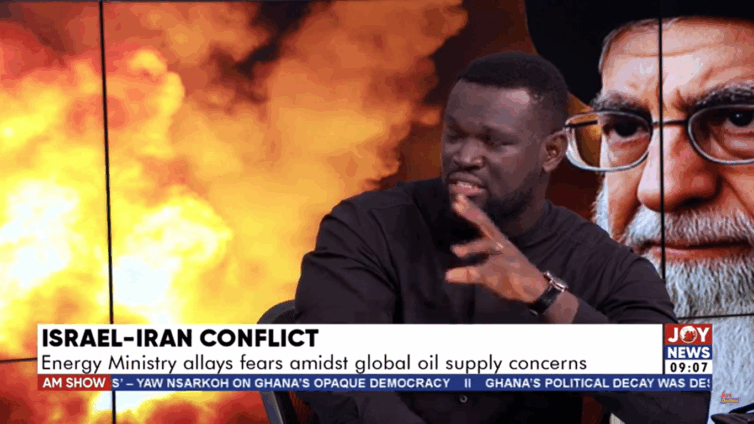
African and International Relations Analyst, Nana Yaw Mireku, has expressed confidence that Ghana’s diplomatic relations with countries in the Middle East will remain intact despite ongoing regional tensions.
Speaking on the JoyNews AM Show on Tuesday, June 24, Mireku dismissed fears that Ghana’s diplomatic arrangements in the Middle East could be significantly affected.
“I don’t think it’s going to affect our diplomatic arrangements,” he stated. “In my opinion, I don’t think so because it was a response to what was happening in Tehran.”
Mireku drew comparisons with previous flashpoints in the region, citing the example of Qatar.
During heightened tensions, Qatar was forced to close its airspace as a precautionary measure, disrupting flights and movement temporarily.
However, once the hostilities subsided, the country swiftly returned to operational normalcy.
“If we take Qatar, within a moment that Iran was seeking to strike Qatar, Qatar closed up its airspace which directed all airplanes coming to Qatar. But right after the hostilities and everything was normalised, the country has come back to normalcy,” he explained.
According to Mireku, the temporary suspension or downgrading of diplomatic activities in times of crisis is not uncommon, especially in volatile regions.
However, he emphasised that these pauses are typically short-lived and dependent on the pace of de-escalation.
“What it means is that, once there is cessation of hostilities in Iran and Tel Aviv and things begin to take their rightful shape, most of these embassies will begin to work,” Mireku said.
He added “And what it means is that the diplomatic connections Ghana has in the Middle East will begin to function normally, but it will take a number of days for us to see how events turn out.”
Ghana, like many nations with embassies and missions in the Middle East, maintains a delicate balance in the region—focused on cooperation in areas such as energy, trade, labour, and security.
While some embassies may limit activities for safety reasons during conflict, Mireku stressed that this should not be interpreted as a breakdown in relations.
Mr Mireku asserted that the current hostilities in the region do not pose a long-term threat to Ghana’s foreign policy posture.
“So, I don’t think it’s going to affect our diplomatic arrangements,” he concluded.
Latest Stories
-
US, Iran fail to reach peace agreement after marathon talks in Pakistan
58 minutes -
Port crises loom as 11,000 drivers threaten four-day strike
2 hours -
A source of excellence across generations – Vice President Opoku-Agyemang lauds Mfantsipim
2 hours -
(Photos) Mfantsipim School launches historic 150th anniversary
3 hours -
Knights and Ladies of Marshall group backs Catholic Bishops’ stance on anti-LGBTQ+
4 hours -
Bright Simons writes: All the Filla in the Ibrahim Mahama/E&P – Gold Fields Saga
4 hours -
Monetise Idiocy In Ghana
4 hours -
ECG kicks off Phase Two of transformer upgrades at Lashibi; brief outages expected
5 hours -
The Ghanaian prophet and the mysterious death of his scottish wife Charmain Speirs
5 hours -
Nearly 400 sentenced in Nigeria for links to militant Islamists
5 hours -
Ghana’s recovery supported by gold strength despite global oil price pressures – Standard Bank Research
5 hours -
Methodist Church hails Mfantsipim@150; calls for “fresh consecration” to excellence
6 hours -
‘Excellence is our inheritance’ – Nana Sam Brew-Butler hails Mfantsipim’s 150-year reign in leadership
6 hours -
Kwaku Azar writes: A-G vs OSP
6 hours -
Mfantsipim–Adisadel rivalry built excellence, not division – Sam Jonah
6 hours