

Audio By Carbonatix
The Ghana Chamber of Mines has welcomed the government’s decision to implement a sliding scale royalty regime in Ghana’s mining sector, but called for further discussions on the specific percentages and other key elements of the regime.
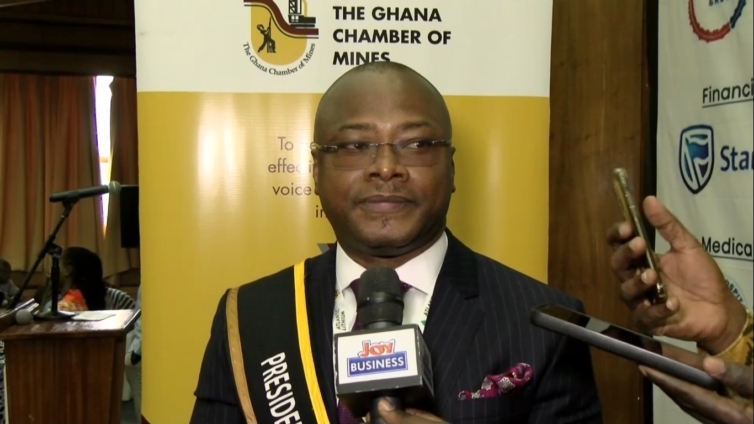
Speaking to journalists at the Africa Extractives Media Fellowship, Michael Edem Akafia, President of the Chamber of Mines, said that while the Chamber supports the introduction of a sliding scale regime, it has reservations about the proposed percentages and the underlying premise for the new regime.
He stated that the Chamber holds a divergent view on the percentages, noting that a rise in global gold market prices does not automatically translate into profit for mining companies.
He said the Chamber is proposing a base rate of 4% and a top-end rate of 8%.
He explained that this proposal was developed following detailed research into other mining jurisdictions, and the Chamber believes its recommendation fairly reflects trends across the continent.
“We are not against a sliding scale, but we believe the range should be between 4% and 8%. In the paper we presented to the Minister, we compared mature mining jurisdictions. In Africa, the only outlier is Mali, which recently introduced 10.5% at the higher end of its scale under a military regime—so we know they don’t listen to industry concerns.
“In virtually every jurisdiction you examine, especially for gold, no country reaches 12%. We therefore believe 4–8% is the most reasonable range. Another proposal we made was the dedication of one percent of profits to community development,” he said.
Michael Edem Akafia also dispelled the widely held perception that a rise in gold prices automatically translates into profit for mining companies.
He explained that while higher prices do enhance revenue generation for mining firms, this does not necessarily translate into profit due to a number of factors.
He noted that during periods of increased revenue, companies often channel funds into other operations to improve efficiency.
He stated that the additional revenue is typically directed toward activities such as in-pit exploration, the purchase of new equipment, the adoption of advanced technology, and other initiatives to ensure the sustainability of the company.
He therefore called for nuanced, non-sentimental discussions around the royalty regime to ensure that companies can fulfill their regulatory obligations without operating at a loss.
Latest Stories
-
Gender Minister oversees safe discharge of rescued baby, settles bills and engages police on probe
17 minutes -
Bawumia receives Christian Council goodwill visit after NPP flagbearer win
44 minutes -
Afenyo-Markin urges Bagbin to summon Korle-Bu, Police, Ridge Hospitals over alleged denial of care to hit-and-run victim
50 minutes -
Police reject GH₵100k bribe, arrest drug suspects with 209 slabs
51 minutes -
Declare galamsey child health emergency – Pediatric Society to President Mahama
60 minutes -
Finance minister lays Value for Money Office Bill before parliament
1 hour -
Stop illegal mining before treating the water – Awula Serwaa tells government
2 hours -
Christian Council warns prophets against fear-mongering, cites criminal liability
2 hours -
‘How can the same God reveal different outcomes?’ – Christian Council questions conflicting prophecies after NPP primaries
2 hours -
Japan-Ghana bilateral relationship evolving into co-creation partnership with JDS Scholarship
3 hours -
Oti Region police bust suspected drug truck, seize over 7,000 marijuana parcels
3 hours -
‘No country can fight terrorism alone’ – US AFRICOM Commander
3 hours -
HealthTech Ghana donates $132k Dialysis equipment to GMTF Under ‘Kyɛrɛ Wo Dɔ’ Drive
3 hours -
US Africa Command ready to support West Africa combat terrorism
3 hours -
Hit-and-run case: Parliament will take ‘drastic action’ if probe falls short – Mahama Ayariga
3 hours