

Audio By Carbonatix
The Majority Chief Whip, Frank Annoh-Dompreh, says the Minority Leader’s comments about the Supreme Court’s ruling that Deputy Speakers can vote while presiding is strange and must be disregarded.
He says Haruna Iddrisu “could have spoken more responsibly, knowing him for his intelligence and experience in governance.”
The Minority Leader hours after the ruling criticised the Supreme Court stating that it has set aside portions of Parliament’s Standing Orders and allowed Deputy Speakers to vote or form quorum while presiding.
In an interview on Joy FM’s Midday News after the Court’s verdict, Mr Iddrisu noted that the decision is an indication that the judiciary has failed the parliamentary democracy.
“This ruling of the Supreme Court, we are not surprised, but we are utterly disappointed in the Supreme Court which is determined to support a struggling President with an ailing economy.”
“This ruling of the Supreme Court can as best be described as judicial support for e-levy…to set aside Parliament standing orders, is a serious travesty of parliamentary justice,” he said.
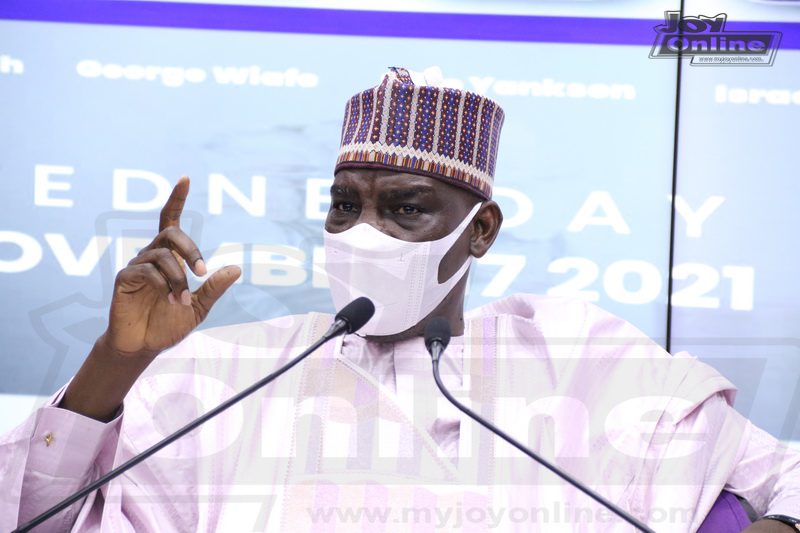
But the Nsawam-Adoagyiri MP says the comments from the Tamale South lawmaker are unfounded.
“The commentary coming from the Minority Leader in the wake of the Supreme Court’s ruling is unfortunate and misguided. He and people who think like him should spare us the ill-intentioned complaints and respect due process.”
The commentary coming from the Minority Leader in the wake of the Supreme Court's ruling is unfortunate and misguided. I believe he could have spoken more responsibly, knowing him for his intelligence & experience in governance.
He & people who think like him should spare us 1/2 pic.twitter.com/bMIhVB9Iz8— Hon. Frank Annoh-Dompreh (@FAnnohDompreh) March 9, 2022
“Where were these comments from him when the same Supreme Court ruled to uphold Mr Mahama's election as President?” Annoh-Dompreh quizzed.
Meanwhile, the Builsa North MP, James Agalga, is dismayed by the ruling of the Supreme Court.
In an interview with JoyNews, the NDC lawmaker said based on his understanding of the relevant provisions, he disagreed with the verdict of the apex court.
According to him, the First and Second Deputy Speakers’ role comes with some privileges and responsibilities, which may require a Deputy Speaker to lose his rights as a people’s representative while acting in the stead of the Speaker.
“I am indeed shocked and surprised because I thought that for purposes of fairness, persons who assume the chair under normal circumstances should not be part of the decision-making process because you sit there as an umpire. And if you assume the role of an umpire, why should you be allowed to vote?
“Never mind that the First and Second Deputy Speakers are Members of Parliament. They represent their people, but they have assumed an additional responsibility. And so whenever they sit in that chair, they’re expected to be fair and unbiased”, he explained.
However, the former Deputy Minister of Interior stated that he and his colleagues on the Minority will comply with the ruling, despite his sentiments.
Background
On Wednesday, March 9, the Supreme Court presided over by Justice Jones Dotse affirmed the approval of the 2022 budget without NDC MPs’ participation.
Private Legal Practitioner Justice Abdulai filed the case against the Attorney General.
He had asked the Supreme Court to interpret Articles 102 and 104 of the 1992 Constitution and declare the action of Mr Osei-Owusu as unconstitutional.
He also wanted the Supreme Court to declare the whole proceedings in Parliament on November 30, 2021, which led to the passage of the 2022 budget as unconstitutional insisting the Deputy Speaker should not have counted himself as an MP when he presided over proceedings.
However, in defence on behalf of the state, the Attorney-General (A-G), Godfred Yeboah Dame, argued that no express provision in the 1992 Constitution stops a Deputy Speaker presiding over proceedings from voting or counting himself as part of MPs present to form the right quorum.
He argued that the quorum in Parliament formed under Article 102 is different from the quorum formed under Article 104 of the 1992 Constitution.
He stated that the quorum under Article 102 is for the conduct of business in Parliament, and that is why Article 102 provides that it should be one-third of members.
“Given that Parliament presently is made up of 275 members, the quorum under Article 102 for the conduct of its business is 92 MPs,” the A-G submitted.
According to the A-G, based on the clear provision of Article 102, any person presiding, either the Speaker or Deputy Speakers, is precluded from being part of that quorum.
On the other hand, the A-G believed that the quorum under Article 104 (1), which deals with the determination of matters through voting in Parliament, requires at least half of all MPs, and such a quorum is not the same as the one in Article 102.
Mr Dame contended that unlike Article 102, which precludes a “person presiding” from being part of the quorum, Article 104 (2) precludes explicitly “The Speaker”.
The A-G, therefore, held the position that only the person elected as “The Speaker” of Parliament is barred from forming part of the quorum under Article 104 when presiding, and not the Deputy Speakers who preside over proceedings.
The Apex Court comprising Justices Jones Dotse, Nene Amegatcher, Prof Ashie Kotey, Mariama Owusu, Lovelace Johnson, Clemence Honyenuga, and Emmanuel Kulendi affirmed the arguments of the Attorney General.
The court also struck out portions of the standing orders of parliament which read: “A Deputy Speaker or any other member presiding shall not retain his original vote while presiding.”
Latest Stories
-
Gov’t targets recruitment of 16,500 health professionals in 2026
6 minutes -
Two-week strike will not derail academic calendar – GNAT President
21 minutes -
Headmaster detained after BBC investigation into alleged sexual abuse of students
30 minutes -
GNAT pushes for clear implementation procedures of teachers’ conditions of service
50 minutes -
Recurrent strikes threaten quality of education and academic calendars – Prof Bokpin
53 minutes -
‘Cockroach’ group leaders among hundreds detained in Delhi protest
57 minutes -
Don’t let speed of information become your judgement – CJ tells new lawyers
2 hours -
World Cup visa scandal: People have leveraged public office to facilitate fraud – Senyo Hosi
2 hours -
Glut! Farmers count losses as prices crash, customers happy
2 hours -
GSA postpones auction of unserviceable vehicles
2 hours -
Man charged with attempted murder after stabbing
2 hours -
World Cup visa scandal: Senyo Hosi says issue goes beyond calls for Sports Minister’s resignation
2 hours -
Yaw Ampofo Ankrah hasn’t taken or received any money to facilitate visas – Lawyer insists
3 hours -
World Cup visa scandal: Senyo Hosi urges focus on constitutional accountability
3 hours -
La Beach demolition: Senyo Hosi condemns lack of consultation
3 hours