

Audio By Carbonatix
William Antiaye Addy, Deputy Director of Finance, Ghana Statistical Service (GSS), has urged Metropolitan, Municipal and District Assemblies (MMDAs) to utilise the district-level Multidimensional Poverty Index (MPI) reports to accelerate development at the local level.
He said the universal adherence to the principle of evidence-based decision-making has generated increased demand for timely, credible, and relevant statistical data.
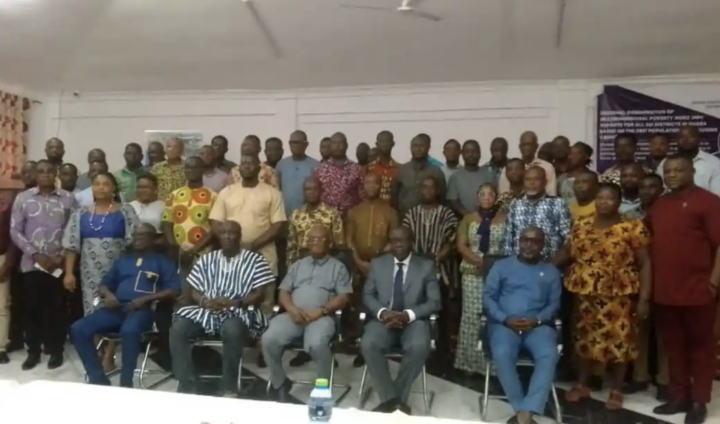
Mr Addy was addressing a workshop in Ho, in the Volta Region on behalf of the Government Statistician on Regional Dissemination of the MPI Reports and training on StatsBank for the 18 Municipal and District Assemblies in the Volta Region.
The Deputy Director said to meet this demand, the GSS had continually produced and disseminated crucial statistical information to the public, fostering a culture of evidence-based decision-making.
He said the MPI was a testament to their commitment to making comprehensive data readily available to users, and the computation of the MPI also provided users with relevant information to address challenges that confront the country.
“The targeted users of the report include the Municipal Planning and Coordination Unit, Development Partners, Civil Society Organisations (CSOs), the private sector, research institutions, academia, religious organisations, traditional rulers, and the general public,” he said.
Mr Addy said the report provided relevant and timely data to support the implementation and monitoring of the Medium-Term National Development Policy Framework (MTNDPF) 2022-2025.
“The disaggregated statistics will also support the monitoring of progress towards several Sustainable Development Goals (SDGs), including SDG 1, SDG 3, SDG 4, SDG 10, and SDG 11.
These SDGs aimed to end poverty in all its forms everywhere, ensuring healthy lives and promoting well-being for all at all ages, ensuring inclusive and equitable quality education and promoting lifelong learning opportunities for all, reducing inequality within and among countries, and making cities and human settlements inclusive, safe, resilient, and sustainable,” he said.
Mr Addy emphasised the importance of the report in the provision of targeted interventions for the allocation of resources, monitoring and evaluating local government development programmes, thereby enhancing their effectiveness.
He said the report was also relevant in tracking trends in multidimensional poverty over time, providing insights into the progress being made, and assessing progress across a range of interlinked SDGs and targets at the sub-national level, in line with the national development frameworks.
Mr Addy thanked the Ministry of Local Government, Decentralization and Rural Development, MMDAs for their cooperation and support, which he said greatly contributed to the successful completion of the reports.
“We gratefully acknowledge the expertise and resources provided by the World Bank through the Harmonising and Improving Statistics in West Africa Project (HISWAP), and the German Agency for International Cooperation (GIZ) for its funding support,” he added.
Dr Archibald Yao Letsa, Volta Regional Minister, said poverty was not merely a lack of income as it encompassed various deprivations that people faced in their daily lives.
He said the MPI was a powerful tool that captured the multifaceted nature of poverty by examining factors such as education, health, and living standards and provided a deeper understanding of the poverty dynamics in the various municipalities and districts.
The Minister stated that the region, with its rich cultural heritage and agricultural potential, had made significant strides in development, however, the MPI reports identified some critical challenges that must be addressed to ensure inclusive and sustainable growth.
Dr Letsa charged the District Chief Executives and Coordinating Directors to develop comprehensive measures to translate the findings of the report into actionable policies and implement strategies that would alleviate the multidimensional aspects of poverty in their jurisdictions.
“I urge you to take these findings seriously and work collaboratively with your teams to develop targeted interventions that address the specific needs highlighted in the reports,” he said.
Latest Stories
-
John Boadu can appeal across Ghana’s social groups – Prof Mike Oquaye
5 minutes -
‘Electing Kojo Bamba is backward politics’ – Mustapha Gbande
19 minutes -
Government must order payment of promoted teachers’ salaries – GNAT
29 minutes -
Meet Sethina Edem Sunu, the healthcare professional eyeing the NDC UK & Ireland deputy organiser role
33 minutes -
The myth of ‘sophisticated customer experience’ in the digital age
37 minutes -
What happened to lands reserved for sanitary sites? -WasteCare CEO calls for audit
37 minutes -
Manasseh Writes: The shift in the NPP
53 minutes -
The price of a seat: Financial barriers and the structural quality of Ghana’s Parliament
58 minutes -
Government targets October 16 for first tranche of teacher arrears – Haruna Iddrisu
1 hour -
Daily Insight for CEOs: The CEO’s role in driving innovation
1 hour -
Audit existing sanitary sites to address waste management land shortages – WasteCare CEO urges assemblies
1 hour -
Two-bin household waste system could support waste-to-energy in Ghana – Waste Care Associates CEO
1 hour -
Dealing with political and social media insults
1 hour -
Essi Donkor urges stronger support for girls’ education, announces GH¢2,000 BECE reward
1 hour -
Ghana still needs landfills but Accra should prioritise waste-to-energy – Waste Care Associates CEO
1 hour