

Audio By Carbonatix
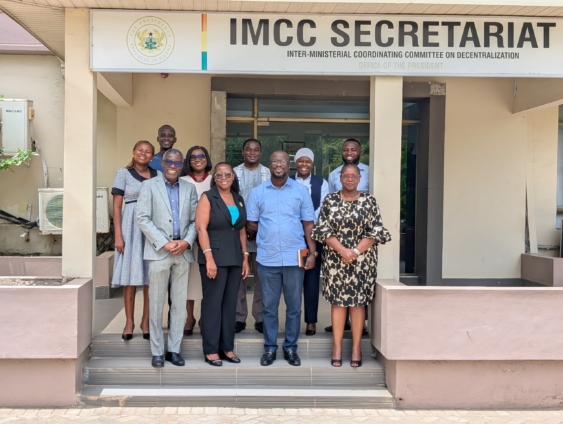
The Executive Secretary of the Inter-Ministerial Coordinating Committee (IMCC) on Decentralisation, Dr. Gameli Kewuribe Hoedoafia, welcomed a high-powered delegation from the National Development Planning Commission (NDPC) for a strategic dialogue at the IMCC Secretariat in Accra.
The meeting, themed “Mainstreaming Decentralisation Reforms into the Planning Guidelines,” brought together top technical experts and decision-makers from both institutions.
Leading the NDPC team was its Acting Director General, Dr. Audery Smock Amoah, who was joined by key staff, including Dr. Felix Addo-Yobo, Director of the Development Policy Division, and Dr. Sandra Kesse-Amankwa, Acting Head of the Plan Coordinating Division.
On the part of the IMCC, several core team members contributed to the discussions, including Dr. George Laryea (Director of Policy & Research Division), Tracy Cudjoe Edumadze (Finance), and Louis Ntem Adzato (Director of Administration).
In his welcome address, Dr. Hoedoafia emphasized the IMCC’s commitment to embedding decentralisation not just as a policy requirement, but as a working reality that enhances service delivery at the sub-national level.
He stressed that aligning decentralisation with national development plans is key to ensuring that every Ghanaian, no matter where they live, benefits from good governance and effective public services.
Dr. Amoah, on her part, reiterated the NDPC’s readiness to work closely with the IMCC to ensure that the 2026–2029 Medium-Term National Development Policy Framework (MTNDPF) reflects decentralisation more prominently, either as a standalone development area or a cross-cutting theme. “It’s time to close the gap between national policy and local impact,” she noted.
The team explored a range of practical options, including issuing clear directives to Ministries, Departments, and Agencies (MDAs) to prioritise decentralised service delivery in their planning and budgeting, as well as strengthening the role of Metropolitan, Municipal, and District Assemblies (MMDAs) in the implementation of national development policy at the local level.
There was a shared understanding that these reforms would not only improve coordination across governance levels but also enhance ownership, accountability, and results.
The meeting ended on a high note with a commitment to undertake further technical consultations and the development of a joint roadmap to mainstream decentralisation in all future national and local planning efforts.
Latest Stories
-
OnlyFans owner Leonid Radvinsky dies at 43
2 hours -
Nigerian police arrest 15 after viral videos of alleged sexual assault at festival
2 hours -
Ethnic, political exclusion, not theology alone drives Muslim sectarian violence in Ghana, KNUST study finds
2 hours -
Semenyo reports to Black Stars camp after Carabao Cup win
3 hours -
Journalism out loud: Defending truth in a divided world
8 hours -
Heath Goldfields partners local firm, receives new mining fleet to revive Bogoso-Prestea mine
8 hours -
Korle-Bu overcrowding driven by broken referral system, not just bed shortage – Doctors
8 hours -
MC Portfolio named red carpet host for 2026 Ghana Music Awards USA
8 hours -
Oda-Akyem Swedru road develops dangerous potholes
8 hours -
U.S. Embassy explains Visa process for Ghanaians ahead of World Cup
9 hours -
Viral video on emergency care at Korle-Bu Teaching Hospital is ‘authentic’ – Emergency Medicine Residents
9 hours -
Ahmad Abdul-Samad, Rachael Quarcoo dominate 1st quarter All Ghana Badminton Championship
9 hours -
ActionAid calls for strong partnerships to advance water, gender, and climate justice
9 hours -
DVLA begins nationwide clampdown on expired DV plates from March 24
9 hours -
Ghanaian Commonwealth Youth Leader meets King Charles III, pushes for youth economic empowerment
10 hours