

Audio By Carbonatix
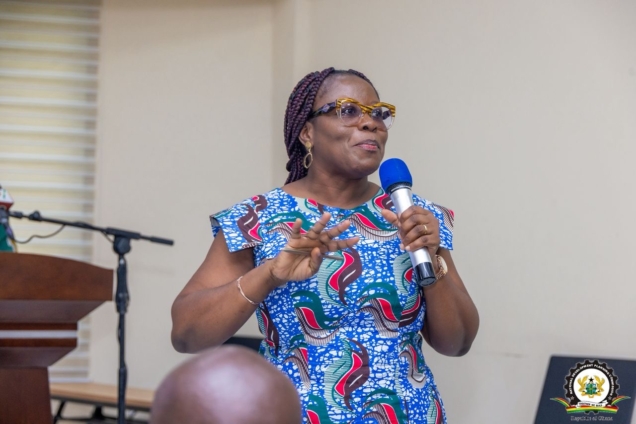
The Director-General of the National Development Planning Commission (NDPC), Dr Audrey Smock Amoah, has emphasised the need for strict compliance with planning guidelines and improved performance standards to ensure that development plans translate into tangible results.
Delivering a presentation on Plan Preparation, Annual Progress Reports (APRs), and the Regional Integrated Plan, on Thursday, 19th February 2026, Dr Amoah highlighted L.I. 2232, which governs the preparation of APRs. She commended the Eastern Region for its strong performance, noting that most APRs submitted last year were rated excellent, very good, or good.
However, she stressed that rankings alone are not enough.
“We want to get to a point where, apart from the rankings, when we step into the districts or the regions, we see actual development,” she stated, explaining that APRs must comprehensively capture annual activities, financial performance, implementation challenges, and recommendations for improvement.
Dr Amoah further announced that several districts had successfully secured certification of their development plans, while others were yet to address outstanding review comments.
“We are still waiting for you to address your comments so that you receive your certificates,” she urged, applauding compliant districts and noting that the Regional Coordinating Council had also attained certification.
On her part, the Eastern Regional Minister, Rita Akosua Adjei Awatey, underscored the importance of coherent and well-aligned development planning, cautioning against the persistent challenge of abandoned projects.
“Where there is one consolidated, comprehensive, and collectively owned development plan, the likelihood of project abandonment significantly reduces,” she said.
Earlier, the NDPC team paid a courtesy call on the President of the Eastern Regional House of Chiefs, who underscored the critical need for a long-term, sustainable approach to development. Reflecting on agricultural practices, he observed that while farmers may sell their produce to the highest bidder today, such short-term gains could prove costly in the future.
“In ten years, the farmers could be the poorest,” he cautioned, stressing that true growth must safeguard future livelihoods rather than focus solely on immediate profits.
He emphasised that sustainable development remains key to ensuring lasting economic progress for communities across the region.
Latest Stories
-
We own the strategy, its not head office decision – GCB MD positions bank as engine of Ghana’s economy
14 minutes -
No more waiting for head office – GCB boss pushes Ghana-first banking
35 minutes -
Mahama lauds Julius Debrah for shaping Kwahu Business Forum
49 minutes -
Why actors beg in difficulty – Patience Ozokwor on Nollywood financial struggles
1 hour -
Any man who apologises to woman deserves to suffer – Brymo
1 hour -
Nigerian artistes no longer put effort into making music – Omah Lay claims
1 hour -
‘I’m now skeptical about going into politics’ – Davido
2 hours -
Nigeria’s Seplat Energy resumes operations as oil workers halt strike action
2 hours -
Nigeria launches manhunt after abductions by bandits in northwest Zamfara
2 hours -
Kenya fuel executives resign as state probes supply chain irregularities
2 hours -
Senegal bans ministers from foreign travel as oil price rise bites
2 hours -
Nigerian army rescues 31 hostages after church attack
2 hours -
Spain’s huge pork industry seeks salvation from swine fever threat
3 hours -
Trump declares victory after rescue but threats to US operation in Iran still loom
3 hours -
US Secret Service investigates reports of gunfire near White House
3 hours