

Audio By Carbonatix
This season would feel different, barely any summer break, no fans in stadiums, an elongated transfer window and Covid-19 still lurking around.
Well, the season won't feel so different considering the conclusion of last season previewed what to expect in terms of football during Covid-19.
Due to the pandemic, decisions have been made on how best football can possibly go on during these trying times. Here are some new rule changes in the Premier League ahead of the new season.
Substitutes and drinks breaks
Two major rule changes introduced for the return of the Premier League after the three-month postponement have been scrapped for the start of the new season.
FIFA and IFAB permitted teams to use five substitutes from a matchday squad of 20 this season but the Premier League voted against the continuation of that rule in a summit last month.
Premier League teams will no longer be allowed five substitutes per game from a substitutes’ bench of nine. Instead the 2020/21 season will see a return to a maximum of three substitutes permitted from a bench of seven in pre-coronavirus times.
Despite FIFA and IFAB also permitting mandatory one-minute stoppages for drinks breaks in each half for the coming season, the Premier League have decided to scrap that rule also.
The drinks breaks were used from Project Restart until the end of the season and were often used by managers as opportunities to impart tactical advice to their players.
Start and end dates
Originally scheduled for August 8, the start of the season has been pushed back more than a month to the weekend of September 12-13.
A finish date of May 23 has been confirmed which means the season will last just over eight months, almost four months shorter than the previous campaign which ran from early August to late July.
Given how condensed the fixture list has become the mini winter break – a staggered fortnight of matches for Matchday 26 – that was introduced last season has been scrapped.
Changes to VAR
The 2019/20 Premier League season saw the introduction of VAR which undoubtedly split opinion among players, fans, managers and pundits alike.
This season there will be five main differences in the use of VAR aimed at improving the accuracy of decisions and minimise the disruption to the match.
Encroachment on penalties
Officials will be stricter in penalising goalkeepers for having their foot off the line when a penalty is taken. If there is encroachment from the goalkeeper, a penalty which is saved will be retaken. If that penalty misses the target, it will not be retaken.
Outfield players will now also be deemed as encroaching if they have a direct impact on the ball – a defender clearing or an attacker scoring with a rebound. It is judged on a player’s foot alone.
Offside
Marginal offside calls, such as an armpit or a toe being offside, will continue after the Premier League stated: “The protocol does not allow for tolerance levels”.
If an immediate goalscoring opportunity occurs, assistant referees will refrain from raising their flag until the passage of play is completed. The decision will then be checked at Stockley Park.
Referee Review Area (RRA)
Increased use of the RRA – the area where TV monitors are available to the referee to check VAR calls - will be encouraged on decisions regarding goals, red cards and penalty kicks.
Handball
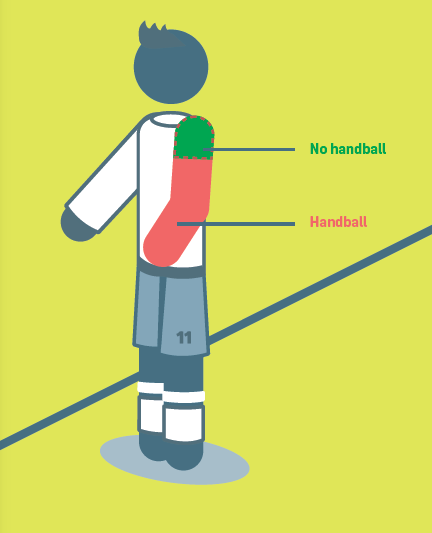
IFAB have amended the handball law to ensure an accidental handball will only be punished if it occurs “immediately” before a goal is scored.
“It is not an offence if, after an accidental handball, the ball travels some distance (pass or dribble) and/or there are several passes before the goal or goal-scoring opportunity,” read a statement from IFAB.
The handball rule was clarified last season to state that any goal scored or created with the use of the hand or arm will be disallowed – even if it is accidental. It does not consider intent by a player.
If the ball hits a player who has made their body "unnaturally bigger" then a foul will be awarded. IFAB determine that a hand/arm above shoulder height is rarely a “natural position” with some exceptions such as when a player is falling permitted.
IFAB says that having the hand/arm above shoulder height is rarely a "natural" position and a player is "taking a risk" by having the hand/arm in that position.
Extra leeway will be permitted when it comes to ricocheted handballs when it comes off a nearby player of if they cannot see the ball.
Latest Stories
-
Sahara Group urges journalists to look beyond fuel prices in energy reporting
5 minutes -
Today’s front pages: Friday, October 16, 2026
9 minutes -
Ashanti Region: ECG urges customer cooperation with franchise officers
15 minutes -
Ghana’s research fund faces a test of turning funding promises into scientific breakthroughs
26 minutes -
Dîner en Blanc Accra returns on December 28 for second edition
30 minutes -
20% digital tax: Government hiding behind technicalities to cheat Ghanaians – Dr Boako
1 hour -
David Selassie Anthony declares bid for NDC Deputy National Organiser
2 hours -
Amin Adam proposes 13 measures to strengthen Ghana’s debt transparency and market confidence
2 hours -
Mahama announces $2bn annual investment to accelerate industrialisation
2 hours -
Amin Adam urges monthly disclosure of Sinking Fund as Ghana prepares for DDEP repayments
3 hours -
Stronger banks will fuel business growth and jobs – ADB MD
3 hours -
Galamsey: ‘Rivers that fed our grandparents now run the colour of chocolate milk’ – Sam Jonah
3 hours -
We have been scammed by NDC, government is only doing PR – Abanga Fuseini
3 hours -
Republic Bank–JoyNews Habitat Fair opens in Ho today
3 hours -
Dr Boako challenges government over new digital tax
3 hours