

Audio By Carbonatix
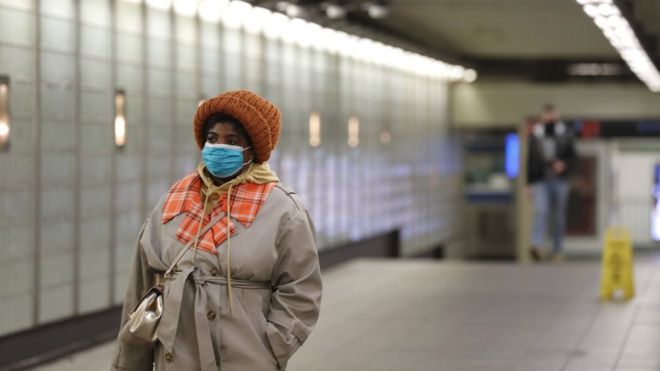
The state of New York has ordered staff at all "non-essential" businesses to remain at home as the number of coronavirus cases continues to rise.
The move expands earlier restrictions and comes as California on the west coast said its nearly 40 million residents should "shelter in place".
The US has confirmed more than 14,000 cases of the coronavirus, including more than 7,000 in New York.
The surge has started to strain its health care system.
"This is the most drastic action we can take," New York Governor Andrew Cuomo said,
New York said pharmacies, grocery stores, banks and shipping firms were among those exempt from the order, which goes into effect on Sunday.
Many places have already been forced to shut, including schools, shopping centres, and theatres.
Mr Cuomo also issued additional rules for the state's 8.6 million citizens, saying healthy people who are not at risk may go outside for exercise and to go grocery shopping, but should otherwise remain at home.
Dr Anthony Fauci, the director of the National Institute of Allergy and Infectious Disease, who has been a leader of the national response, said he supported the move.
"Please co-operate with your governor," he said at the White House's daily coronavirus briefing.
The US also said it would bar non-essential travel between the US and Canada, from midnight.
However, US President Donald Trump said he did not think shelter in place orders needed to be expanded nationally, noting that many states have far lower infection rates.
"They're watching it on television but they don't have the same problems," he said.
Restrictions aimed at reducing the spread of the coronavirus have expanded rapidly this week and are already having a devastating economic effect, with the number of Americans seeking unemployment benefits surging more than 30% this week.
Economists are predicting a sharp contraction in economic growth in coming months, and have warned that millions of jobs are at risk.
Congress is working on a more than $1tn relief bill, that is expected to include direct payments of more than $1,000 for each American who earns less than a certain amount. It would also include millions for businesses affected by the pandemic, such as airlines and hotels.
Latest Stories
-
Ghana Health Service responds to dead fish incident at Tema Port
8 minutes -
David Vondee lauds Mahama for emergency Cabinet meeting and key resolutions
15 minutes -
Universities should focus on churning out impactful graduates rather than merely adding new programmes — UEW VC
18 minutes -
Publican AI system is speeding up trade, not slowing it — GRA Boss
21 minutes -
Government to construct a FIFA category 2 stadium in the Volta Region – James Gunu
30 minutes -
CAF to introduce reforms to fix AFCON final controversies – Patrice Motsepe
31 minutes -
EOCO defends probe into Kwamigah-Atokple
33 minutes -
Fuel tanker accident at Breku Forest spills thousands of litres of diesel
39 minutes -
IEAG backs Publican AI system after concerns addressed
42 minutes -
No new taxes or charges- GRA boss assures importers over rollout of Publican AI system
42 minutes -
Egypt goalkeeper banned for striking referee
43 minutes -
Police restore calm following clashes between Asisiriwa and Brodekwano
44 minutes -
Education sector job seekers must submit certificates for verification – GTEC
46 minutes -
Volta Lake accident highlights lax safety regulations — Savannah Regional Minister
46 minutes -
UEW Vice-Chancellor calls for rethink of Ghana’s education system at 2026 Public Lecture
53 minutes