

Audio By Carbonatix
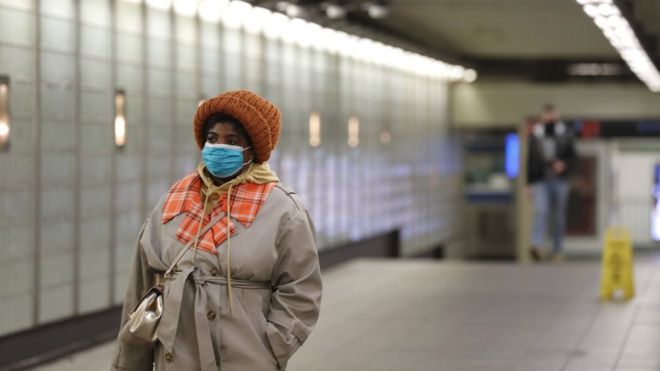
The state of New York has ordered staff at all "non-essential" businesses to remain at home as the number of coronavirus cases continues to rise.
The move expands earlier restrictions and comes as California on the west coast said its nearly 40 million residents should "shelter in place".
The US has confirmed more than 14,000 cases of the coronavirus, including more than 7,000 in New York.
The surge has started to strain its health care system.
"This is the most drastic action we can take," New York Governor Andrew Cuomo said,
New York said pharmacies, grocery stores, banks and shipping firms were among those exempt from the order, which goes into effect on Sunday.
Many places have already been forced to shut, including schools, shopping centres, and theatres.
Mr Cuomo also issued additional rules for the state's 8.6 million citizens, saying healthy people who are not at risk may go outside for exercise and to go grocery shopping, but should otherwise remain at home.
Dr Anthony Fauci, the director of the National Institute of Allergy and Infectious Disease, who has been a leader of the national response, said he supported the move.
"Please co-operate with your governor," he said at the White House's daily coronavirus briefing.
The US also said it would bar non-essential travel between the US and Canada, from midnight.
However, US President Donald Trump said he did not think shelter in place orders needed to be expanded nationally, noting that many states have far lower infection rates.
"They're watching it on television but they don't have the same problems," he said.
Restrictions aimed at reducing the spread of the coronavirus have expanded rapidly this week and are already having a devastating economic effect, with the number of Americans seeking unemployment benefits surging more than 30% this week.
Economists are predicting a sharp contraction in economic growth in coming months, and have warned that millions of jobs are at risk.
Congress is working on a more than $1tn relief bill, that is expected to include direct payments of more than $1,000 for each American who earns less than a certain amount. It would also include millions for businesses affected by the pandemic, such as airlines and hotels.
Latest Stories
-
Mr President, Ghana was mentioned at the UN; why aren’t we talking about it?
4 hours -
Accra to convene Africa’s regulators and markets on tokenisation at AVAS 2026
4 hours -
The Paradox of Plenty — When every smartphone becomes a newsroom
4 hours -
GTA sensitises taxi drivers in ‘Know Ghana’ tourism campaign
5 hours -
Archbishop Agyinasare calls for responsible speech amid growing social media abuse
6 hours -
‘It will be inexcusable for gov’t not to honour payment of teachers’ arrears by 30th October’ – Haruna Iddrisu
6 hours -
Forbes’ World’s Best Employers 2026: No Ghanaian firm ranked among 900 companies
6 hours -
Electronic processing of teachers’ data: ‘The decision is the Controller’s’ – GES boss
6 hours -
Teachers’ Strike: Haruna Iddrisu questions paper-based processing of promoted teachers’ data
6 hours -
Savannah Region: Kunfusi bridge collapses again, leaving nearly 4,000 residents cut off
6 hours -
Teachers’ strike: GES targets Monday deadline to submit promotion data to Controller
6 hours -
Inflation to average 11.3% in 2027 – Fitch Solutions
7 hours -
‘I didn’t campaign for NDC to come and do this nonsense’ – Kpebu on EOCO’s conduct
7 hours -
Fitch Solutions maintains policy rate forecast of 14% by December 2026
7 hours -
Diaspora Nasara Caucus congratulates Mohammed Ali Suraj, new NPP executives
8 hours