

Audio By Carbonatix
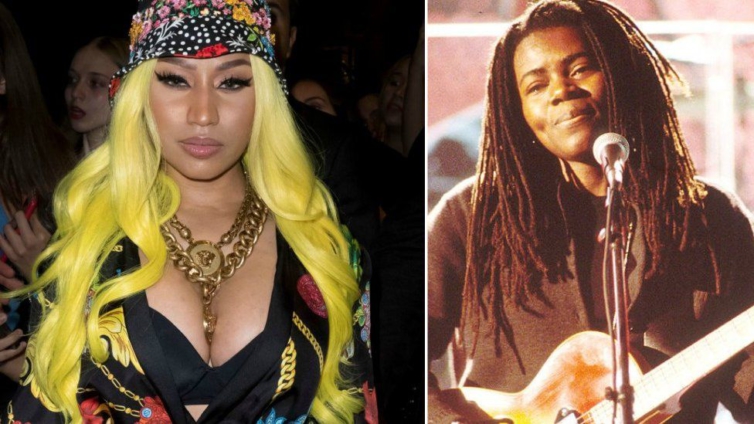
Rapper Nicki Minaj will pay singer Tracy Chapman $450,000 (£332,000) to settle a copyright dispute after sampling one of her songs.
Chapman sued Minaj in 2018, saying she had used portions of Baby, Can I Hold You Tonight in her song Sorry.
Although the song was never released, a leaked version made its way to radio DJ Funkmaster Flex and went viral online.
Nicki Minaj settles her copyright case with Tracy Chapman by paying $450,000. https://t.co/UFn1S4VrJP
— BBC News Entertainment (@BBCNewsEnts) January 8, 2021
Chapman accused Minaj of sharing the song with Flex, although both have denied that version of events.
Minaj wrote Sorry with fellow rapper Nas while recording her fourth album Queen in 2018.
It was based on a sample of the dancehall track Sorry by Jamaican artist Shelly Thunder. Unbeknownst to Minaj, that song was based on Baby, Can I Hold You Tonight, from Chapman's Grammy-winning 1988 debut album.
After discovering the connection, Minaj and her record label sought permission to use Chapman's composition, but the singer-songwriter repeatedly refused.
The singer's lawyer said she has a blanket policy against granting such permission. One of the clearance specialists working for Minaj was also said to have known Chapman was on an unofficial "do not sample" list.
In an earlier judgement, US District Judge Virginia A Phillips ruled that Minaj's experimentation with Chapman's song in the studio constituted "fair use".
In doing so, she sided with the rapper's lawyers, who argued that artists need to be free to sample music while writing and recording, without worrying about being sued once they approach the rights-holder for a licence.
"Such free-flowing creativity is important to all recording artists, but particularly in hip-hop," Minaj's team argued.
"With that category of music, a recording artist typically goes into the studio and experiments with dozens of different 'beats' or snippets of melodies, before hitting upon a pleasing combination."
Judge Phillips agreed that "a ruling uprooting these common practices would limit creativity and stifle innovation within the music industry".
She added that there was "no evidence" that Minaj's song "usurps any potential market for Chapman" and her original song, a searingly personal guitar ballad.
However, the judge set up a trial to explore how Sorry came to be leaked and distributed, and whether that constituted copyright infringement.
That trial will no longer take place after Chapman accepted Minaj's offer. The settlement includes Chapman's costs and legal fees to date, according to documents made public by the California Central District Court.
Latest Stories
-
‘I am disappointed’ – Yaw Ampofo Ankrah breaks silence after NSA suspension
11 minutes -
Douglas Boateng receives IMM Institute Supply Chain Lifetime Achievement Award
25 minutes -
Pentecost University to host international sustainability conference
56 minutes -
Ampofo Ankrah did not collect World Cup visa money – Lawyer
1 hour -
Baffour Awuah to spend night in EOCO custody – Atta Akyea
1 hour -
Torgbiga Wenya III opposes proposed elevation of 36 Anlo chiefs to Paramount status
1 hour -
The strengthening El Niño and what it could mean for Ghana
1 hour -
Baffour Awuah formally charged with money laundering, loss of public funds – Lawyer
1 hour -
Drone flight over EOCO building could attract 30-year jail term – Security consultant
1 hour -
Flying drone over EOCO premises is strictly prohibited – Security consultant
1 hour -
SIC file was surrendered to client, EOCO has no reason to search Manhyia South MP’s firm – Atta Akyea
1 hour -
EOCO search of Baffour Awuah’s law firm raises confidentiality concerns – Atta Akyea
1 hour -
“I will never ignore an invitation from EOCO if I had received one” — Manhyia MP
2 hours -
Baffour Awuah ready to cooperate fully with EOCO investigation – Bosome Freho MP
2 hours -
How a Ghanaian technology is helping fish farmers detect hidden threats before fish die
2 hours