

Audio By Carbonatix
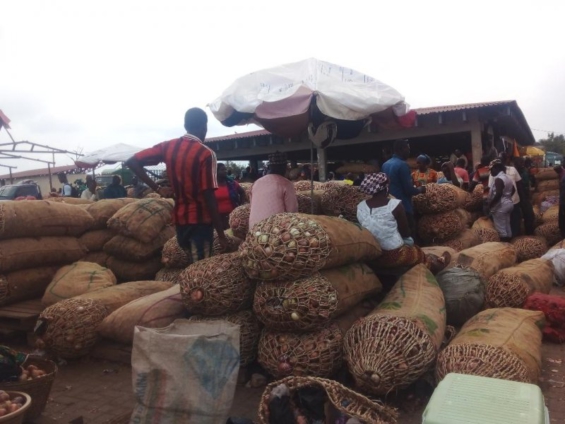
The Programme Officer of the Peasant Farmers Association of Ghana (PFAG) says no attention is given to how farmers can produce onions on a large scale because that aspect of farming has not been prioritised by government.
Dr Charles Nyaaba said as a result, Ghana would have to continue depending on Niger for onions despite its borders being closed.
"When you come to onions, I doubt if any research is done to improve the varieties that we're using. So attention has not been there and government itself has not actually invested in onion production," he said on the AM show on Monday.
Speaking on whether some of the universities could help conduct research into how the country can produce the variety of onion seeds that are high-yielding, Dr Nyaaba expressed that that could be done but given that it would take some time, the country can only depend on Niger for now.
"In a very short term, I think we still have to rely on Niger for the seed. The variety that we need usually takes five to six years before they'll be able to come out with the variety that they want. So that will take some time," he explained.
Reports have indicated that some onion trucks are stranded in Niger due to the closure of its borders in the wake of the coup.
Ghana depends highly on onion importation from Niger. The situation will affect the country and might even result in prices of onions shooting up.
The coup in Niger has spanned at least two weeks now. The ECOWAS, after giving the leadership of the coup a week's ultimatum, will now send its Standby force.
But the directive of the African bloc has since been met with criticisms from various experts.
According to some, the bloc has not exhausted all available options before jumping to the option of military intervention.
The Director of the Faculty of Academic Affairs and Research at the Kofi Annan International Peacekeeping Training Centre (KAIPTC) says the ECOWAS' Standby force was instituted to respond to civil wars and not to be engaged in eras of constitutional changes within its member states as it seeks to do presently in the wake of the coup in Niger.
Professor Kwesi Aning says there is no conflict or civil war in Niger, therefore, the bloc should rather consider using "a graduated set of responses" to resolve the situation.
"The standby force idea was also to respond first and foremost to civil wars and not to constitutional changes or internal political misunderstandings where there is massive bye-in as to what is happening. I mean there's no conflict in Niger per se.
"There rather ought to be a graduated set of responses as an internal crisis escalates," he said on Newsfile.
Latest Stories
-
Evangelism or Collection in God’s Name? The plight of Ghana’s captive passengers
2 minutes -
‘I don’t expect preferential treatment for me, my party or gov’t’ – Mahama to new EC deputies
19 minutes -
Mahama tasks new EC Deputy Chairpersons to protect electoral integrity
20 minutes -
Police arrest officer after shooting injures 2 at Ritz Junction
21 minutes -
‘Delete, retract, apologise’ – Agyinasare urges Ghanaians to take responsibility for misinformation
21 minutes -
Saudi minister vows ‘serious response’ to Houthi attacks on airports
44 minutes -
When dialogue fails and strikes speak: Is industrial action the only language government understands?
50 minutes -
Ghana launches Social Protection Act regulations and Affirmative Action Gender Equity Regulations
51 minutes -
Mahama swears in Emelia Afi Agbenyo, Joseph Kwaku Asamoah as EC Deputy Commissioners
1 hour -
Wetland communities in Northern Ghana face a hotter, flood-prone future as climate risks intensif
1 hour -
Sam George tasks KNUST to develop Twi AI model as Ghana plans local-language artificial intelligence
1 hour -
Poor roads choking eco-tourism potential – Avatime Paramount Chief cries out
1 hour -
DVLA records GH¢25 million surplus in 2025 as contributions to state funds reach GH¢98.1 million
1 hour -
Over 10 suspected scam centre kingpins arrested and remanded – CSA
1 hour -
Ministers, CEOs, policymakers to grace 7th Africa Public Sector Conference in Accra
1 hour