

Audio By Carbonatix
Nigeria's government has rejected a media report alleging that it paid a "huge" ransom to Islamist militant group Boko Haram to secure the release of more than 200 pupils and staff abducted from a Catholic boarding school in November.
Information Minister Mohammed Idris described the allegation, made by the AFP news agency quoting intelligence sources, as "completely false and baseless" and a "disservice to the professionalism and integrity" of the security forces.
He also denied that two Boko Haram commanders were freed as part of the deal.
In a separate announcement, a presidential spokesman has said police chief Kayode Egbetokun, a close ally of President Bola Tinubu, has resigned.
The spokesman, Bayo Onanuga, said the resignation - a year ahead of the end of Egbetokun's term - was for "pressing family considerations".
His deputy, Tunji Disu, has been appointed acting chief amid mounting security pressures.
This includes kidnap for ransom, which is big business in parts of Nigeria - with the culprits ranging from Islamists militants, members of gangs known as "bandits" and separatists.
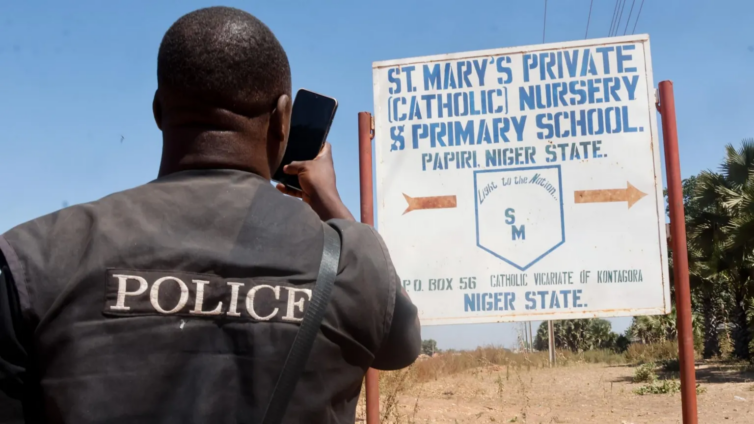
Some analysts cited by AFP believe that the kidnapping from St Mary's School in Papiri in the western state of Niger was led by a notorious Boko Haram militant commander known as "Sadiku", who had previously been linked to other high-profile kidnappings and attacks.
While Boko Haram remains most active in the north-eastern state of Borno, where the group started its insurgency in 2009, splinter factions and other criminal networks operate across large parts of Nigeria's north-west and north-central regions.
It was announced a few days before Christmas that the security forces had rescued all the remaining pupils and staff who had been taken from St Mary's by gunmen on 21 November.
In an angry rebuttal to the AFP report, the information minister said the news agency's allegations relied entirely on "shadowy, unnamed sources" and contradicted official statements issued by intelligence agencies and senior lawmakers.
One source quoted by AFP alleged that the ransom amounted to around 40m naira (about $30,000, £22,000) per captive, while another source suggested a total payout of 2bn naira (about $1.5m) had been made.
The report also alleged that the money was transported by air to Boko Haram's Gwoza enclave in Borno state and handed over to a local commander.
"The assertion that ransom was delivered by helicopter to insurgents, with cross-border confirmation of receipt, is fiction," Idris said in the statement.
The domestic spy agency, the Department of State Services (DSS), had "dismissed this claim as fake and laughable", he said.
The minister went on to say that Nigeria was "confronting a structured, profit-driven criminal enterprise".
"The successful rescue of the pupils, without casualty, was the result of professional intelligence and operational precision," he added.
Boko Haram gained notoriety in 2014 for kidnapping more than 200 schoolgirls from the village of Chibok.
Since then the country has faced a surge in mass abductions, with analysts saying that ransom payments - by families, intermediaries or, in some cases, state authorities - have helped fuel what some describe as a "kidnap-for-profit industry".
A 2022 law criminalised the payment of ransoms, but enforcement is difficult and families often resort to paying to secure the release of relatives.
Security experts quoted in local reports have long argued that official denials do not necessarily reflect the complexity of behind-the-scenes negotiations.
The controversy comes at a sensitive time for Abuja as the government is under diplomatic scrutiny, particularly from the US.
On Monday, a report by a US congressional delegation made sweeping recommendations aimed at tackling what it described as the long-running persecution of Christians in Nigeria.
The proposals were presented at the White House by Republican Riley Moore, who said the report followed months of fieldwork, hearings with expert witnesses, consultations with religious leaders and discussions with displaced communities in central Nigeria.
"I travelled on a bipartisan delegation to Nigeria and saw with my own eyes the horrific atrocities Christians face, and the instability the Nigerian government must combat," he said.
The report called for a new bilateral security pact, sanctions and other reforms including banning Nigeria's beef exports to compel armed herder groups to disarm.
It also suggested legal reforms to safeguard religious freedom in Nigeria.
The Nigerian government is yet to react to the recommendations, which stem from concerns the administration of US President Donald Trump raised late last year about the treatment of Christians in Nigeria.
Trump has said there was a "Christian genocide" underway in the country - an allegation strongly rejected by Nigeria's government, which said Muslims, Christians and people of no faith were victims of attacks.
Latest Stories
-
Third force not the answer – Yaw Nsarkoh questions Ghana’s political fix
15 minutes -
Prudential Bank champions tree crop investment at TCDA anniversary dialogue
15 minutes -
Roc Nation Sports International kicks off inaugural youth football tournament in Ghana
23 minutes -
‘Ghanaians are not genetically disorderly’ – Yaw Nsarkoh says consequences create order
46 minutes -
Electoral Cost Efficiency in Emerging Democracies: A Comparative Analysis of Cost per Voter in Ghana’s 2020 and 2024 General Elections
52 minutes -
BBC edited a second racial slur out of Bafta ceremony
1 hour -
Nigeria denies report it paid ‘huge’ ransom to free pupils in mass abduction
1 hour -
Gender Minister oversees safe discharge of rescued baby, settles bills and engages police on probe
2 hours -
Bawumia receives Christian Council goodwill visit after NPP flagbearer win
2 hours -
Afenyo-Markin urges Bagbin to summon Korle-Bu, Police, Ridge Hospitals over alleged denial of care to hit-and-run victim
2 hours -
Police reject GH₵100k bribe, arrest drug suspects with 209 slabs
2 hours -
Declare galamsey child health emergency – Pediatric Society to President Mahama
3 hours -
Finance minister lays Value for Money Office Bill before parliament
3 hours -
Stop illegal mining before treating the water – Awula Serwaa tells government
3 hours -
Christian Council warns prophets against fear-mongering, cites criminal liability
3 hours