

Audio By Carbonatix
"I want to give people inspiration to protect the environment; plant trees, and make it a pleasure to maintain them."
Those are the words of Catholic priest at Damongo Archdiocese in the Savannah region, Father Dr. Clement Aapengnuo, who seeks to supply finest noni fruit trees to Ghanaians.
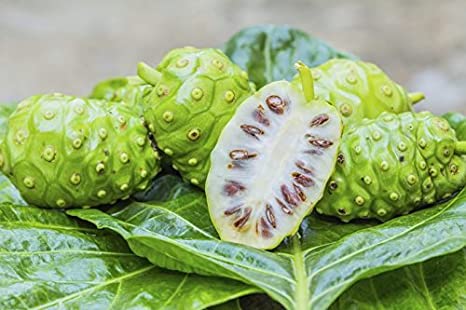
Noni tree - native to Southeast Asia and Australasia, is a source of phytonutrients, known to boost the immune system as well as repair cellular damage.
They have anti-inflammatory, anti-viral, and anti-bacterial compounds.
Fr. Aapengnuo says the tree is a potential income generator that can give cultivators in rural areas, at least, 300 cedis in a month.
"If you have three of the trees and every month you fill ten bottles at 10 cedis that's 300 cedis. That is basic salary for some people," he says.
In just a few years of planting the tree, he says it is only appropriate to share what is good with Ghanaians.
The Noni tree, known scientifically as Morinda citrifolia grows in shady forests, as well as on open rocky or sandy shores of rivers.
It matures in about 18 months, and begins to bear between 4 and 8 kg of fruits every month.
"The amazing thing about this tree, it fruits all year round even in the dry season. So pluck and pluck the fruits."
The oval-shaped of 10-18 centimeters in size, is also known as cheese fruit or even vomit fruit, due to its pungent smell when ripening.
"Just on the same branch, you would have some flowering while others are fruiting. So there is a constant supply."
The tree is tolerant of saline soils, drought conditions, and secondary soils.
It can grow up to 9m tall, with large, simple, dark green, shiny and deeply veined leaves.
Besides its ability to beautify the environment and provide oxygen, a variety of products from the fruit can be found on the consumer market.
"Now we have got an outlet. When you do you package it nicely and put it in a small bottle."
They come in the form of beverage, powder and other cosmetics as well as oil.
But in Damongo people know it in bevergare.
"I was surprised to see that a lot of people in Damongo know the noni and buy it" adding that, it has economic values.
Morinda citrifolia is attractive to weaver ants, which make nests from its leaves.
These ants protect the plant from some parasitic insects.
The smell of the fruit attracts fruit bats, which aid in seed dispersal.
A type of fly, Drosophila sechellia, feeds exclusively on the fruits.
Fr Aapengnuo says his work as a catholic priest puts him in a better position to protect the environment and change lives.
He wants to grow more seedlings and distribute to interested Ghanaians to also rape the benefit.
Beyond that, the sustainable environmental activist wants to see a world of great opportunity in safety for all.
Latest Stories
-
Minister Jinapor highlights importance of accurate energy meters during GSA visit
1 minute -
Nexans unveils anti-counterfeit cable to tackle fakes and improve fire safety
3 minutes -
Pink Ladies Cup: Black Queens hold first training session ahead of opening game
5 minutes -
Glowing Gloria Gone!
9 minutes -
Stephen Quaye Writes: Harsh realities facing Ghanaians in Canada
14 minutes -
Pink Ladies Cup: Abigail Kim to miss tournament due to injury
15 minutes -
Ghana in talks with Wales over pre-World Cup friendly
17 minutes -
Gender Ministry monitors 100th cycle of LEAP payments nationwide
29 minutes -
Eduwatch demands accountability on education spending and teacher deployment in SONA 2026
33 minutes -
Black Stars Management Committee to receive $310k honorarium for World Cup – Sports Minister
37 minutes -
2026 World Cup: Ghana budget $13.7m for tournament
54 minutes -
Ablakwa secures rare access to Ghana’s 2 prisoners of war in Ukraine, pushes for their release
1 hour -
Today’s Front pages: Friday, February 27, 2026
2 hours -
Premier League: Arsenal v Chelsea preview
2 hours -
Ghana loses over GHS 6.2bn annually to poor sanitation – ISSER study warns
2 hours