

Audio By Carbonatix
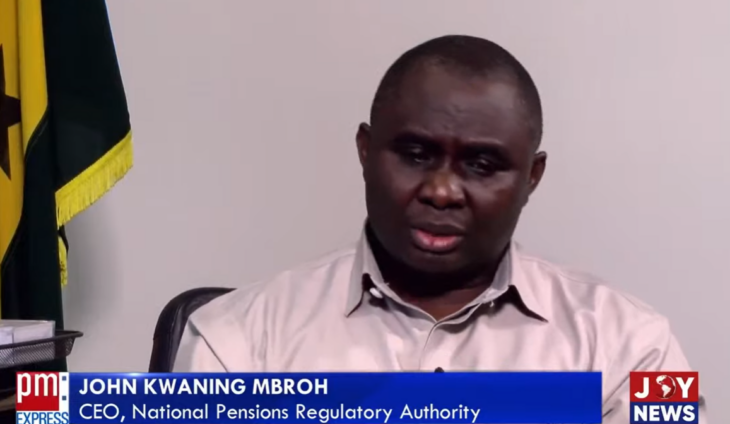
The CEO of the National Pensions Regulatory Authority (NPRA) has assured contributors that despite projections in the recent International Labour Organisation (ILO) report on the Social Security and National Insurance Trust (SSNIT), the trust will remain secure in the upcoming years.
Assuring contributors that the outlook for the scheme is safe, John Kwaning Mbroh explained that the ILO reports are designed to forecast future scenarios to ensure proactive measures are in place to sustain the scheme.
Speaking on PM Express on JoyNews, he indicated that “the report is forward-looking…ILO, they've always projected on all those lines that if you don't do A, B, C, D, this way or that way. What it means is that we need to keep improving…it's all about the financial sustainability of the scheme over a long period.”
Mr Mbroh highlighted some of the measures already in place to ensure the scheme's financial health including administration expenses and an investment policy, that helps SSNIT have a guideline about how they invest contributions.
“They review the existing investment asset classes to make sure they are economically viable, to unleash some kind of life into the scheme. That is very important.
"The next thing has to do with how they look at the admin expenses among others. I know they've done a whole lot of expenditure rationalisation there, trust me, they've done that,” the NPRA CEO said.
Additionally, he said that SSNIt is stepping up its enforcement actions to ensure that companies are paying their contributions among other things.
“Also the government, you know, as in this case the biggest employer in their space, or of course in the pension space as well, to also pay, as in when they need to pay.”
“So I hope you're aware, recently there was about 2.6 billion that has been injected, in addition to the private sector enforcement that is going on. So as for sustainability, I would say we are home and dry,” Mr Mbroh said.
This comes after the International Labour Organisation (ILO) projected a complete depletion of SSNIT’s reserve by 2036 in an actuarial valuation study of the Social Security and National Insurance Trusts (SSNIT) viability.
According to ILO, total income including contributions, investment income and other income, will no longer be sufficient to pay for annual expenditures including benefit payments to pensioners by 2029.
“Starting in 2029, total income (contributions, investment income and other income) is no longer sufficient to pay for annual expenditures. The reserve starts to decrease. During the year 2036, the reserve drops to zero” the research emphasised.
SSNIT having no other means of payment will depend on the reserves it has to meet the payment demand leading to the start of the depletion process.
This is likely to continue till 2036 when the reserve will drop to zero as stated by the valuation report.
Details of the valuation report indicated that the critical cause of this development is the delay in payment by the government.
Of the GH¢9.35 billion total indebtedness to SSNIT as of December 31, 2021, 73.7% translating to GH¢6.9 billion was due to late payments of contributions by the government.
This leads to a 1.3 per cent drop in expected returns on investment made by SSNIT, the report emphasised.
According to the study, “Past experience suggests that, by not paying on time and not paying the interest income on delayed contributions, the Government shifts an important part of the cost to the private sector”.
But SSNIT, in an earlier press conference, said the ILO report was only a prediction.
According to the SSNIT's Chief Actuary Joseph Poku, the study, done every three years as required by law, gives an overview of the scheme's status, assets and liabilities.
Mr Poku recounted several cases where similar projections were made, including a 2011 report that predicted SSNIT would be unable to pay funds by 2019.
"The report (2011) says, among other things, that if contribution rates were not increased in the future, the annual expenditure on benefits and registration would exceed income from contributions and the funds from 2019 would just tank," he said.
“What it said was that by 2019, we're not going to have enough money to pay benefits. We are in 2024 and we have never defaulted in payments or benefits from 2019 up to date. So in this report, it's not different from the reports that we've obtained over the years. Like I said, it gives you an idea of where you are going as a scheme, and then you take proactive measures to steer off, if there is any danger ahead of you,” Mr Poku explained.
Latest Stories
-
2026 U17 WWC: Black Maidens to begin qualifiers next month against Togo
22 minutes -
Sammy Gyamfi defends sole-sourcing for Big Push projects, rejects claims of irregularities
24 minutes -
Gender Minister intervenes in Bulemi family case, supports Down Syndrome awareness walk
24 minutes -
See the areas that will be affected by ECG’s planned maintenance today
28 minutes -
Weight-based bullying as a cause of recurrent headaches, chest pain, and abdominal symptoms in children
30 minutes -
NPP base declining untrue; I doubt findings—Kwadwo Poku
30 minutes -
Al Sharpton backs Ghana’s UN push to declare slave trade gravest crime against humanity
31 minutes -
Ghana’s hospital bed ratio stands at 0.9 per 1,000, below WHO standard- Titus Beyuo
44 minutes -
Fitch Solutions revises Ghana’s GDP growth to 5.5% due to Middle-East conflict
54 minutes -
Over 7,000 Korle Bu staff must be trained before new national patient system begins — Board Chair
57 minutes -
Korle-Bu Board Chairman cites under-investment as cause of ‘no bed syndrome’
1 hour -
Ghana to establish national command centre for real-time emergency patient redirection
1 hour -
New bed allocation system coming to Korle Bu but rollout will be gradual – Prof Beyuo
1 hour -
Sammy Gyamfi rebuts claims of inflated contracts, accuses critics of misrepresentation
2 hours -
‘Celebratory, unapologetic, and built to stand out’ – PUMA on Black Stars World Cup kits
2 hours