

Audio By Carbonatix
The Administrator of the Ghana Education Trust Fund (GETFund), Dr Richard Ampofo Boadu, has debunked claims that the fund gives out scholarships on political considerations.
He said they awarded scholarships to applicants on merit, adding that, their system of offering scholarships was “very” transparent and open.
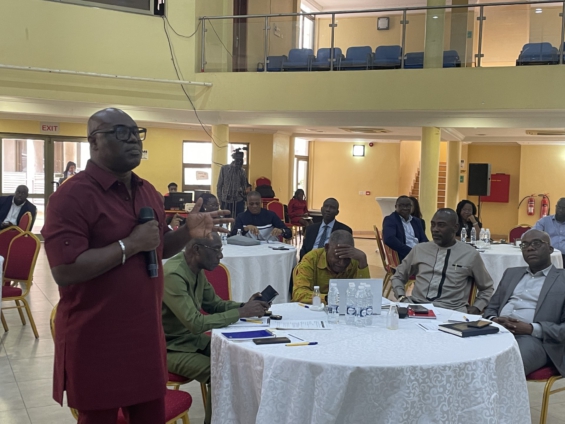
Dr Boadu said this in reaction to a comment during an open forum discussion on “Financing Higher Education in Ghana: Implications for Equity and Sustainability" organised by the Ghana Academy of Arts and Sciences (GAAS) in Accra.
The policy dialogue was the second of seven policy dialogues the Academy was organising under the project “Motivating Higher Education Reforms in Ghana - Towards Equity and Sustainability, funded by a grant from Carnegie Corporation of New York.”
The goal of the Academy's Higher Education Project is to provide a platform for independent people and groups to reflect on the challenges of the higher education sector on a regular and sustained basis.

The GETFund Administrator urged tertiary institutions to find innovative ways to raise funds to augment the support they received from the government.
He said the government alone could not entirely fund the running of those institutions, hence, they needed to devise alternative sources of funds.
Mr Kofi Asare, Executive Director of Africa Education Watch, an education policy think tank, called for the creation of a scholarship authority to merge all scholarship-providing entities in the country.
“The reason we are not meeting our tertiary enrollment target is due to actual needy students not gaining scholarships into tertiary institutions. The scholarship system and rollouts should be reviewed.”

“We need a scholarship authority to manage all scholarships in the country and make scholarship rollouts more efficient and effective to help needy students and even prospective students enroll in tertiary institutions,” he added.
Professor Emeritus Takyiwaa Manuh, Chairperson, of GAAS’ Higher Education Project Management Committee, said funding for higher education in Ghana had suffered perennial challenges of inadequate government subventions, insufficient student loans, inadequate tuition fees, infrastructural and equipment deficits, and unreliable revenue streams.
She said these had been compounded by the increase in the number of public institutions in the higher education subsector, and the conversion of polytechnics into technical universities, with the attendant increases in faculties and other professionals and educational workers in that space.
Latest Stories
-
GCB Bank surges GH¢0.45, ETI gains GH¢0.06 as GSE ends week higher
21 minutes -
Two teens jailed 55 years for robbery
48 minutes -
UDS demands apology for MPhil student wrongly branded as Tamale robber
1 hour -
“We don’t sell fish!” – Tema Shipyard CEO hits back over dead fish discovery
2 hours -
Sam George defends anti-LGBTQ+ Bill as ‘national priority’ amid debate over gov’t focus
3 hours -
Sam George unveils massive 1,150-cell site rollout to end network woes
3 hours -
This Saturday on Prime Insight: Fuel levy suspension, LGBTQ+ legislation, and Damang Mine controversy
4 hours -
Struggling Real suffer title blow with Girona draw
4 hours -
Mahama nominates Pamela Graham as Auditor-General
5 hours -
The five big sticking points in US-Iran talks
5 hours -
Melania Trump’s speech propels Epstein crisis back to forefront
6 hours -
What everyone should know about C-sections
6 hours -
Gunmen kill at least four people at Afghanistan picnic spot
7 hours -
Health Ministry engages Ga Mantse ahead of Free Primary Healthcare launch
7 hours -
We can tackle multiple priorities – Sam George defends Anti-LGBTQ Bill push
7 hours