

Audio By Carbonatix
Energy Minister John Jinapor has revealed that Ghana’s energy sector is grappling with outstanding liabilities of approximately GH₵80 billion, with the debt continuing to rise.
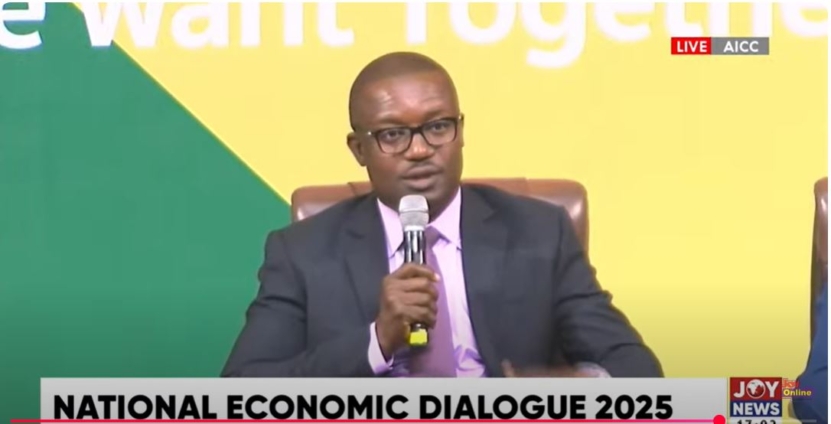
Speaking during Day 2 of the National Economic Dialogue, the minister warned that restoring the sector to stability would require clearing this massive debt burden.
“Today, the outstanding liabilities stand at about GH₵80 billion, and it keeps increasing. If we were to fully revive the energy sector, we would need to flush out this debt. Clearly, this situation is unsustainable,” he stated on Tuesday, March 4.
Beyond the existing liabilities, Mr Jinapor highlighted an even more concerning issue—the sector's monthly financial shortfall. According to him, “Our total bill, especially in the power sector, is about $170 million per month, but collections are less than $100 million. This means we are accumulating an additional $70 million in liabilities every month."
Mr Jinapor highlighted inefficiencies within the energy sector, citing financial indiscipline as a major concern. He noted that in 2023, the Public Utilities Regulatory Commission (PURC) approved $200 million as a capital expenditure cap for the Electricity Company of Ghana (ECG), but ECG ended up incurring $700 million, exceeding the approved amount by $500 million.
This excess spending, he explained, was not factored into the tariff structure, worsening the sector’s financial crisis.
The minister further emphasised the need for private sector involvement in managing the energy sector, warning that failure to do so could lead to its collapse.
He disclosed that some power producers have already shut down their plants due to non-payment of their bills, stressing that tough decisions must be made to prevent a total breakdown.
Mr Jinapor also called for an urgent transition from liquid fuel to gas for power generation, arguing that Ghana has stranded gas that is not being utilized, while the country continues to spend heavily on liquid fuel.
He revealed that the cost of liquid fuel this year alone is projected to reach $1 billion, whereas half of that amount could build a gas processing plant that would save the country $600 million annually. He maintained that constructing the plant is non-negotiable, as it would not only cut costs but also reduce corruption and waste in the sector.
Latest Stories
-
2026 is the ‘Year of Action’ for Petroleum Hub project – Dr Toni Aubynn
37 minutes -
Sedina Tamakloe set for January 21 US court hearing – Victor Smith
58 minutes -
‘Ministerial signature is not ceremonial ink’ – CDM questions Education Minister’s role in curriculum saga
1 hour -
Multimedia Group Kumasi staff gathers to celebrate 31 years of broadcasting and community service
1 hour -
Bryan Acheampong is our ‘Kivo gari’, a ready leader for NPP – Pious Hadzie insists
1 hour -
I dismissed the former ‘Ayalolo’ boss for failing to expand fleet – Local Gov’t Minister
1 hour -
“Our PC candidates beat our presidential candidate” – Bryan Acheampong calls for unifying candidate to lead NPP
1 hour -
Gov’t seeks €1m spanish grant to expand ‘Ayalolo’ bus fleet – Local Gov’t Minister
1 hour -
Little Angels Trust donates to children admitted at Cape Coast Metropolitan Hospital
1 hour -
Victor Smith refutes claims Sedina Tamakloe is not in Nevada Detention Centre in US
2 hours -
“Let our boast be in Him ”alone”—Multimedia CEO to staff at thanksgiving service
2 hours -
US tightens border security as immigrant visa freeze hits 75 nations, including African allies
2 hours -
The invisible wall between Ghana’s economic gains, household reality
2 hours -
Hannah Affum: Breaking Barriers with Radiotracers and Resilience
2 hours -
CDM calls out institutional failures over controversial SHS curriculum
2 hours