

Audio By Carbonatix
A lecturer and Data Analyst at the Department of Statistics at the University of Cape Coast, Dr Irene Kafui Vorsah Amponsah, has advised women to break through the glass ceiling that limits female representation in the study of Science, Technology, Engineering and Mathematics (STEM).
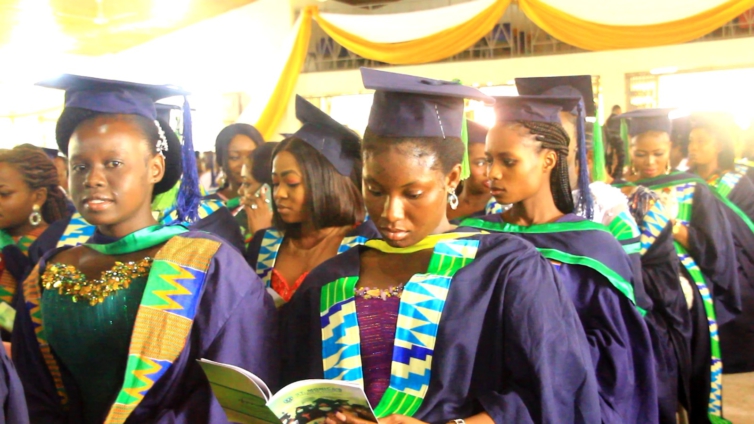
She gave the advice to graduating students of the St. Monica's College of Education.
Dr Amponsah encouraged the graduates to find support networks and connect with other educators who share their goals in order to multiply their impact and make a bigger difference.
"Persevere and break through the glass ceilings that limit female representation in STEM. You have the opportunity to be advocates for change and catalysts for progress. Use your voices to challenge systemic barriers that hinder girls' access to quality STEM education," she said.
Dr Amponsah urged the graduates to work with educational institutions, policymakers, and community organizations to create projects and programmes that support girls' STEM engagement.
"Organise workshops, mentorship programmes, and outreach activities to inspire young girls and expose them to the wonders of science, Technology, engineering and mathematics," Dr Amponsah stated.

The Data Analyst reminded the trained teachers that they will face barriers and prejudices, but added that these challenges will fuel their determination because the road ahead would be difficult.
They were also apprised of the power of their influence in shaping young minds, igniting a passion for learning, and paving the road for a more equal future.
"Embrace your role as change-makers, and let your actions inspire a generation of young girls to dream without limits, pursue their passions, and contribute to the growth and development of our beloved Ghana."
Dr. Amponsah was speaking at St. Monica's College of Education's 14th congregation ceremony, where 412 students graduated, with 16 receiving first class, 174 obtaining second class upper, 174 gaining second class lower, and 48 receiving third class.
The total student population of the college for the 2022/2023 academic year stands at 1,800 as against 1,913 for the 2021/2022 academic year.
The Principal of the College, Dr Okyere Korankye, stated that the institution received 1,063 applications from prospective applicants, and out of this figure, 310 gained admissions to pursue different courses in the 4-year Bachelor of Education (B.Ed) programme.
Dr stated that, “the current figure indicates about 38% cut down of our regular admission intake.”
According to the college, it is committed to raising teaching and learning standards, and will pursue policies and initiatives to ensure that students maintain their excellence.
The academic board has added mathematics and ICT to the JHS programme as specialised courses.
Latest Stories
-
Conflicts among care providers linked to maternal, neonatal deaths – Expert
9 minutes -
GIS marks 10th TIME conference, champions improved teaching practices
16 minutes -
BRICS Or Balance? What Ghana’s bid really means
42 minutes -
GPRTU wants full TRAFFITECH-GH implementation to start in 2027
1 hour -
Mahama announces plans to import electric wheelchairs for PWDs
1 hour -
KGL U17 Colts 2026: Western beat Prempeh Elite Academy to set up final final with Greater Accra Region
1 hour -
Late Solanke strike salvages 10-man Spurs draw at Man United
2 hours -
Gender Ministry to monitor welfare of Nana Akua Addo’s children amid domestic violence case
2 hours -
Benedict Okyere Yeboah: Ghana’s football problem goes beyond sacking a coach
2 hours -
GPL 2026/27: Darkwah Wiafe’s winner sees All Blacks beat Kotoko
2 hours -
ITF World Tour : Patel Wins Boys’ Singles Final at J100 Accra
2 hours -
Ghana must pursue BRICS partnership if it brings economic benefits – Kpebu
2 hours -
Success and Wright Claims J100 Accra Girls’ Doubles Championship
2 hours -
ITF J100: America’s Wright wins J100 Accra Girls’ Singles Title
2 hours -
Expedition hopes to find aviator Amelia Earhart’s plane on remote island
2 hours