

Audio By Carbonatix
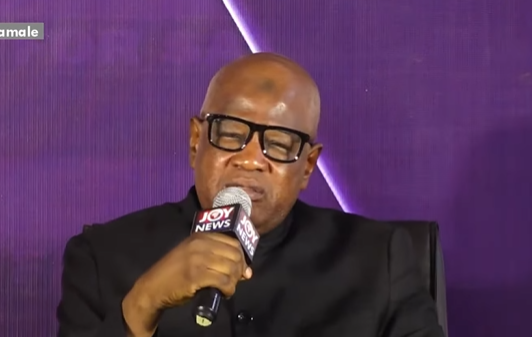
The Dean of the Faculty of Social Sciences at the University for Development Studies, Professor Eliasu Alhassan, has raised concerns over the low reporting of vote-buying incidents in Ghana, warning that the trend is undermining efforts to curb electoral malpractice.
Speaking at JoyNews’ Democracy Is Not for Sale forum held at the GNAT Hall on Friday, March 27, Prof Alhassan said the growing monetisation of politics has become a persistent challenge in the country’s democratic process.
“It is very clear that monetisation of our politics has become a canker. It’s now a canker that we don’t like, but it is with us.
"That is why I said at the beginning that in principle, democracy is not for sale, but practically, it is for sale,” he stated.
He noted that although vote buying is a criminal offence, the absence of credible evidence continues to hinder law enforcement agencies from prosecuting offenders.
According to him, the situation is worsened by the reluctance of citizens to report such incidents.
“We are all aware that buying votes is a crime, but the lack of evidence is what is actually making it difficult for the police to prosecute those involved.
"Most people don’t even report vote buying to the police. Police respond to issues that are reported, so if these incidents are not reported, how do they investigate?” he questioned.
Prof Alhassan pointed out that, unlike other crimes such as armed robbery, which are regularly captured in police statistics, vote-buying cases rarely feature in official data due to underreporting.
He cited common practices during elections, including the distribution of food and other items to voters at polling stations, as clear attempts to influence voter decisions.
According to him, such acts are often visible yet go unchallenged.
“We see people buying votes clearly during elections. Sometimes people are in a queue to vote, and a politician comes to distribute food. If you are in your right senses, you know it is to influence you,” he said.
"Sometimes even the polling agents. Every party knows its polling agent. Political parties go to a polling station and give food to everybody who is there. Clearly, it's just to influence people to vote for them."
The political scientist stressed that the failure to report these incidents allows perpetrators to operate with impunity, making it difficult for authorities to track and address the problem effectively.
He called for greater public responsibility in reporting electoral offences, noting that without citizen cooperation, efforts to tackle vote buying would remain largely ineffective.
Latest Stories
-
Teacher unions strike: Gov’t presents fresh proposals as talks end inconclusively
34 minutes -
51,000 teachers’ promotion arrears to be validated for October payment – Education Minister
1 hour -
Kwabena Boamah appointed Board Chair for Impact Investing Ghana
1 hour -
Striking teacher unions to meet Fair Wages and Salaries Commission on October 6
1 hour -
EOCO working with AG to arraign Nana Baffour Awuah before weekend court
1 hour -
Duraplast reassures customers after fire, announces October 5 reopening
2 hours -
Call off strike, gov’t will not renege on promotion arrears pledge – Haruna Iddrisu appeals to teacher unions
2 hours -
Committee set up to validate teachers eligible for 20% deprived-area allowance – Education Minister
2 hours -
Five-member committee to search for new Black Stars coach after Sports Ministry-GFA meeting
2 hours -
Pinktober: Breast cancer survival exceeds 90% when detected early – Breast Society of Ghana
2 hours -
TCDA to adopt Upper West’s MATCO mango farm as northern prototype, issues warning against felling shea trees
3 hours -
‘Fear delegates’ tag: Afoko touts genuineness among delegates ahead of NPP delegates conference
3 hours -
John Boadu: The leader our party needs at this time – Amb. Edward Akwasi Boateng
3 hours -
Baffour Awuah: EOCO arrested, detained MP after hours of waiting, questioning – Afenyo-Markin
3 hours -
EOCO court warrant authorised search of Baffour Awuah’s law firm, not residence – Afenyo-Markin
3 hours