


Audio By Carbonatix
Professor Samuel Kojo Kwofie has officially taken office as Director of the Institute of Applied Science and Technology (IAST) at the University of Ghana, effective August 1, 2025. His appointment coincides with his promotion to full Professor of Biomedical Engineering, recognizing his contributions to applied science and technology.
Previously Head of the Department of Biomedical Engineering at the School of Engineering Sciences, Prof. Kwofie’s new role aims to strengthen IAST’s mandate to translate scientific research into practical solutions supporting Ghana’s socio-economic development.
“IAST must become a hub where cutting-edge research meets industry needs to drive real-world impact. My vision is to foster strong collaborations across disciplines and sectors to create scalable solutions for Ghana and beyond,” he said.
Prof. Kwofie is known for his work in artificial intelligence, bioinformatics, and computational bioengineering, developing tools like TubPred, EBOLApred, and AICpred for drug discovery and diagnostics targeting diseases such as cancer, Ebola, and inflammation.
He also created BuDb, the first drug discovery database for Buruli ulcer. He and his team have a pending US patent on the use of mycolactone derivatives for treating microbial infections.
“Our innovations are focused on addressing critical health challenges with practical, technology-driven approaches. Translating research into products that improve lives is central to our mission,” he noted.
His academic and professional experience includes fellowships and teaching roles at institutions like the University of Cambridge and Loyola University Medical Center, USA. He is also a founding board member of the Convention of Biomedical Research Ghana.

As Director of IAST, Prof. Kwofie plans to promote interdisciplinary collaboration, enhance the commercialization of research, and boost the Institute’s public engagement and policy influence. “We want IAST to be a key player in shaping national development through science and innovation,” he stated.
IAST is a multidisciplinary institute that focuses on industry-driven research in sectors such as health, agriculture, energy, and environmental sustainability. It supports entrepreneurial activities, innovation incubation, and international partnerships to enhance the impact of academic research.
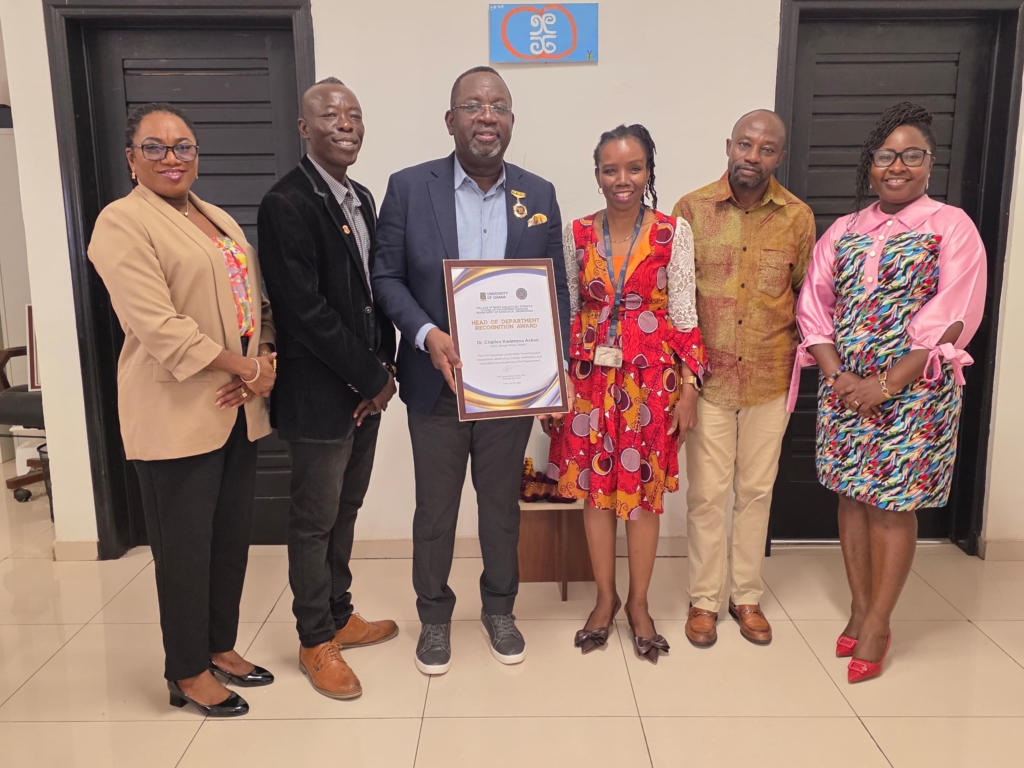
At a farewell event marking the end of his tenure as Head of Biomedical Engineering, Prof. Kwofie presented an award to Dr. Charles Kwamena Ackon, CEO of biomedical company Mangel Klicks, highlighting ongoing collaboration between academia and industry.
Dr. Ackon commended Prof. Kwofie’s leadership, saying, “His resilience and vision have strengthened the link between academia and industry. We pledge our continued support to advance innovation at the University.”
Latest Stories
-
Friends of Bridget Bonnie Marks her 35th birthday with donation to Kasseh Model Health Centre
13 minutes -
Landfilling waste management creates no value, it’s an economic waste
40 minutes -
Photos: Speaker Bagbin Commissions MPs constituency office under parliamentary decentralisation programme
56 minutes -
Black Stars technical advisor Winfried Schäfer sacked as GFA shakes up backroom staff
1 hour -
Wenchi water project almost complete, critical to gov’t agenda – GWL MD
1 hour -
Anti-LGBTQ+ bill not part of government’s legislative agenda – Inusah Fuseini
1 hour -
Anti-LGBTQ Bill: Forget the rumour mongers, I’m a man of action, and will pass the bill – Speaker
2 hours -
Women and children among those killed in Sudanese army shelling of wedding celebration
2 hours -
President Mahama is not sincere with Ghanaians on LGBTQ bill matter – Hassan Tampuli
2 hours -
Gov’t to establish Prison Industrial Hub to equip inmates with income-generating skills – Prison Service boss
3 hours -
Alhassan Tampuli donates cement, roofing sheets to support storm victims in Gushegu
3 hours -
Alhassan Tampuli appeals for urgent support for storm victims in Gushegu
3 hours -
The hypocrisy must stop; pass Anti-LGBTQ+ Bill now – Alhassan Tampuli to Mahama
3 hours -
Imprisonment should be rehabilitative, not punitive – Ghana Prisons boss at UNGA
3 hours -
Ga Adangbe traditional priests petition Mahama over McDan aviation licence revocation
3 hours