

Audio By Carbonatix
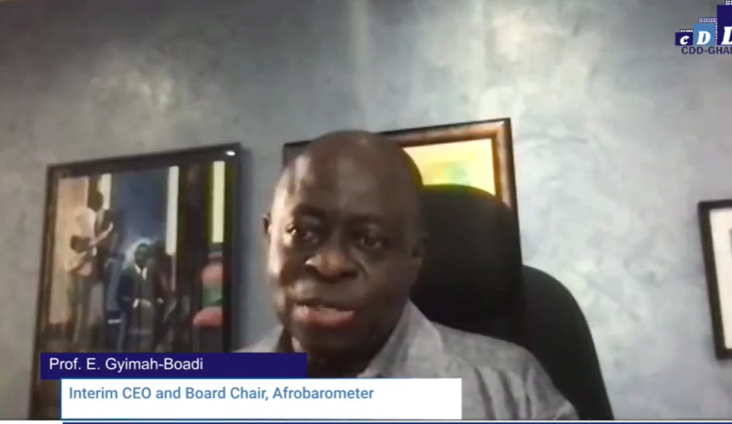
Interim CEO and Board Chair of Afrobarometer, Prof E. Gyimah-Boadi says late former President Rawlings cannot be credited as a father of Ghanaian democracy or for being a great democrat.
Speaking during CDD-Ghana’s round discussion on 'Rawlings and Democratic Development in the 4th Republic', he stated that several years into the former President’s administration he was reluctant to hand over power as leader of the PNDC government.
He said that claims Mr Rawlings was the founder of democracy in the 4th Republic false and do not do justice to the record.
“The phrase reluctant democrat is probably the most charitable way to talk about or to describe former President Rawlings with respect to democracy,” he said.
He alluded to the fact that Mr Rawlings was not entirely in favour of the idea during his rule as the leader of the PNDC.
Prof Gyimah-Boadi further indicated that there other several notable Ghanaians who fought and even went to prison because they advocated for democratic rule.
“If you are going to call him (Mr Rawlings) a hero of the Ghanaian democracy process in the 4th Republic, you also have to ask what shall we call people like Professor Adu Boahen, Kwesi Prat and Kwaku Baako who suffered imprisonment for pro-democracy activities.”
Nonetheless, Prof Gyimah-Boadi stated that although it took a while for the former late President to acquiesce to democratic rule his immense effect on the growth of the country's economy while in power cannot be discredited.
"What I do not what to give late President Rawlings credit for is the claim of being either the father of democracy the founder of Ghanaian democracy or being a great democrat that I think is false and doesn’t do justice to the record."
He said that late Mr Rawlings at the end of his elected and unelected terms helped normalise Ghana’s economic management.
He explained that governments after him did not have to deal with the troubles other previous leaders had faced while taking decisions about the economy.
“He had substantially helped to normalise economic management so that it was not nearly as politically suicidal for governments of the fourth republic to contemplate and to initiate economic rationalisation measures.”
“By the end of President Rawling’s rule, government would contemplate these things (economic decisions) if there were good reasons for doing so and I think that has contributed a lot to the stability of this republic.”
Latest Stories
-
Ga Adangbe traditional priests petition Mahama over McDan aviation licence revocation
11 minutes -
Anti-LGBTQ Bill: NDC’s arrogance is worrying – Hassan Tampuli
21 minutes -
Let’s give OSP time to mature, not to scrap it – Hassan Tampuli
25 minutes -
Nigeria convicts 386 Islamist militants in mass trials
30 minutes -
Djibouti president wins election with 97.8% of vote, state media says
35 minutes -
We don’t have mandate to deduct tax from rent allowance of security services personnel – Interior Ministry clarifies
49 minutes -
Ablakwa receives Presidential Special Envoy on Reparations to advance global agenda
1 hour -
Christina Koch becomes first woman to travel around the moon on Artemis II
1 hour -
Epstein survivors’ calls to meet King Charles and Queen harder to ignore as US visit approaches
1 hour -
UN Secretary-General names Ghana’s Anita Kiki Gbeho as South Sudan envoy
1 hour -
Mali withdraws recognition of Sahrawi Republic, backs Morocco’s autonomy plan
1 hour -
Gov’t distributes over 8,500 laptops to One Million Coders project
2 hours -
Julius Debrah, ‘man to beat’ as NDC’s James Agbey dismisses Musah Dankwah’s polls
2 hours -
GPRTU in Savannah Region to protest alleged eviction in Damongo
2 hours -
Re: Reinsurance does not replace process — A response to the SIGA–SIC defence
2 hours