

Audio By Carbonatix
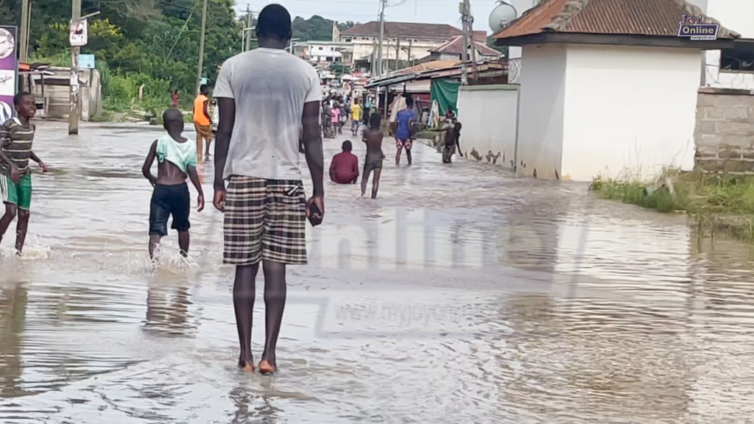
Many Ghanaians have expressed concern about recent heavy rains in some parts of the country, but the Ghana Meteorological Agency's Chief Forecaster says it is not a new phenomenon.
According to Fecility Ahafianyo, La Niña is a global weather phenomenon associated with wet seasons in Western and Eastern Africa.
La Niña refers to the periodic cooling of sea-surface temperatures across the east-central equatorial Pacific - an oceanic and atmospheric phenomenon, that is the colder counterpart of El Niño, as part of the broader El Niño–Southern Oscillation (ENSO) climate pattern.
La Niña weather is a pattern that occurs in the Pacific Ocean. In this pattern, strong winds blow warm water at the ocean's surface. As the warm water moves, cold water from the deep rises to the land surface rich in moisture suitable for rain cloud formation.
"When we have a La Niña phase, we have wet conditions in most of west and east Africa," she explained.
"According to available data," Felicity told JoyNews Mahmud Mohammed-Nurudeen, the phenomenon is not new, but "in terms of intensity, people should be concerned."
She stated that each rainy season has its own variations, and this is one of the 2022 anomalies.
According to the World Meteorological Organization, there have been 24 cases of La Niña since 1951, with the strongest being in 1982-83, 1997-98, and 2015 - 16.
The most recent La Niña occurred in 2020-21, and it was moderate, similar to the first incident in 1951-52.
According to Felicity, the La Niña strengthened in the middle of June and is expected to weaken in April 2023.
This means that the country is likely to experience frequent rainfall patterns during these times.
"This year, we have a good rainy season during the main cropping season, and the La Niña intensity is about 91-94%."
However, one major challenge is that its intensity can cause flash floods, threatening farmers' livelihoods and other activities.
Some crops that do not require a lot of rain may be harmed, according to Felicity, and "that's what we should be looking out for during the period."
Felicity also discussed El Nino, which caused drier weather conditions during the 2018-2019 major rainy season. Longer dry spells shortened the cropping season.
El Niño refers to above-average sea-surface temperatures that occur on a regular basis across the east-central equatorial Pacific. It represents the ENSO cycle's warm phase.
The 1997-1998 El Niño event was followed by a prolonged La Niña phase that lasted from mid-1998 to early 2001. El Niño/La Niña events alter the likelihood of specific climate patterns around the world, but the outcomes are never identical.
She advised Ghanaians to stay up to date on GMet weather updates in order to plan their activities.
Latest Stories
-
Every gram will be tracked – Gold Board unveils traceability push to deal with illegally-mined gold
2 minutes -
Analysis: Why the Bank of Ghana sold half its gold reserves
9 minutes -
Buy wrong gold, face prosecution – Gold Board CEO cracks down on rogue dealers
12 minutes -
Africa pushes integrated health agenda ahead of One Health Summit in Lyon
49 minutes -
We own the strategy, its not head office decision – GCB MD positions bank as engine of Ghana’s economy
59 minutes -
No more waiting for head office – GCB boss pushes Ghana-first banking
1 hour -
Mahama lauds Julius Debrah for shaping Kwahu Business Forum
2 hours -
Why actors beg in difficulty – Patience Ozokwor on Nollywood financial struggles
2 hours -
Any man who apologises to woman deserves to suffer – Brymo
2 hours -
Nigerian artistes no longer put effort into making music – Omah Lay claims
2 hours -
‘I’m now skeptical about going into politics’ – Davido
2 hours -
Nigeria’s Seplat Energy resumes operations as oil workers halt strike action
3 hours -
Nigeria launches manhunt after abductions by bandits in northwest Zamfara
3 hours -
Kenya fuel executives resign as state probes supply chain irregularities
3 hours -
Senegal bans ministers from foreign travel as oil price rise bites
3 hours