

Audio By Carbonatix
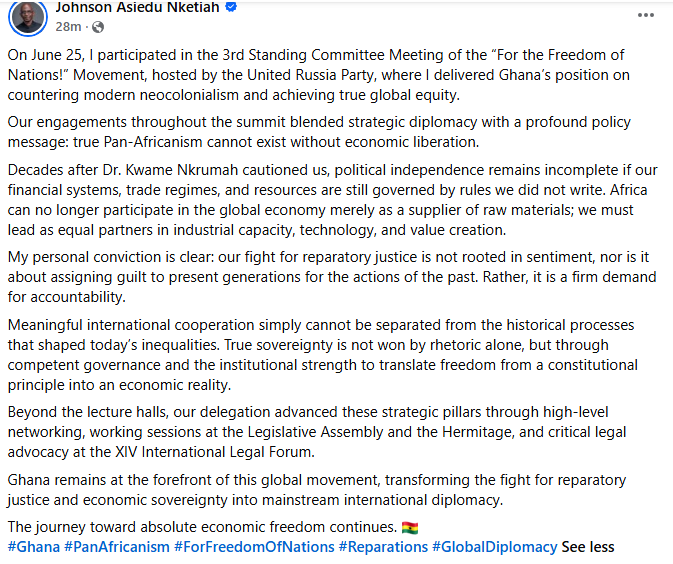
The National Chairman of the National Democratic Congress (NDC), Johnson Asiedu Nketiah, has said Africa's call for reparatory justice is driven by a demand for accountability rather than emotion, insisting that historical injustices continue to shape the global economic order.
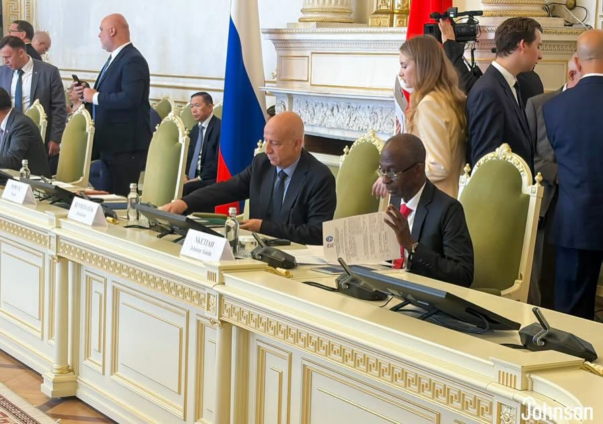
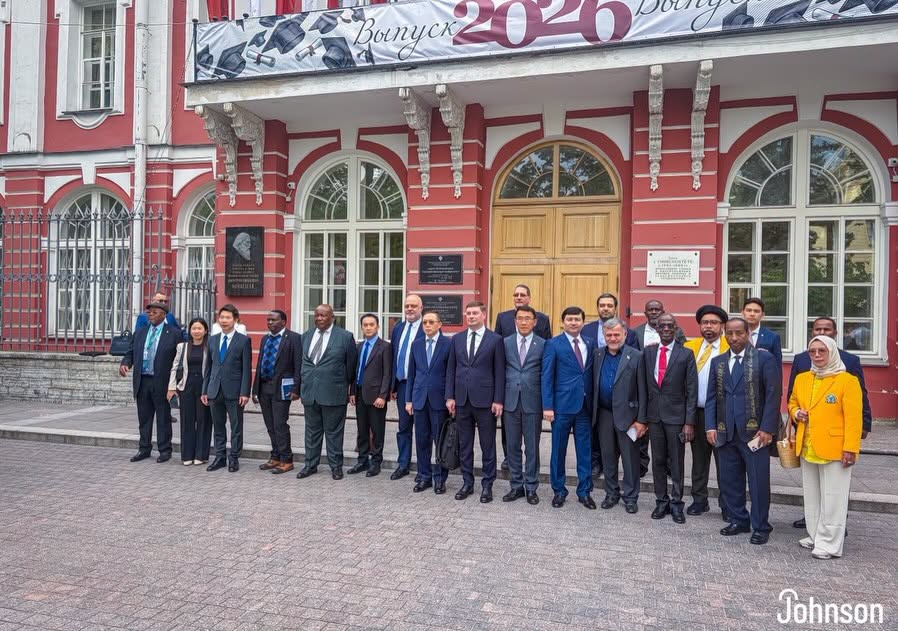
Speaking at the 3rd Standing Committee Meeting of the "For the Freedom of Nations!" Movement in Russia on June 25, Mr Asiedu Nketiah said meaningful international cooperation cannot be achieved without addressing longstanding global inequalities rooted in colonialism.
"Our fight for reparatory justice is not rooted in sentiment, nor is it about assigning guilt to present generations for the actions of the past. Rather, it is a firm demand for accountability," he said.
The NDC Chairman, who presented Ghana's position on countering modern neocolonialism, argued that Africa's political independence remains incomplete without economic sovereignty.
"True Pan-Africanism cannot exist without economic liberation," he stated.
Referencing Ghana's first President, Dr Kwame Nkrumah, Mr Asiedu Nketiah said the continent must take control of its financial systems, trade policies and natural resources to achieve genuine independence.
"Decades after Dr. Kwame Nkrumah cautioned us, political independence remains incomplete if our financial systems, trade regimes, and resources are still governed by rules we did not write," he said.
He also urged African countries to move beyond exporting raw materials and instead compete globally through industrialisation, technology and value addition.
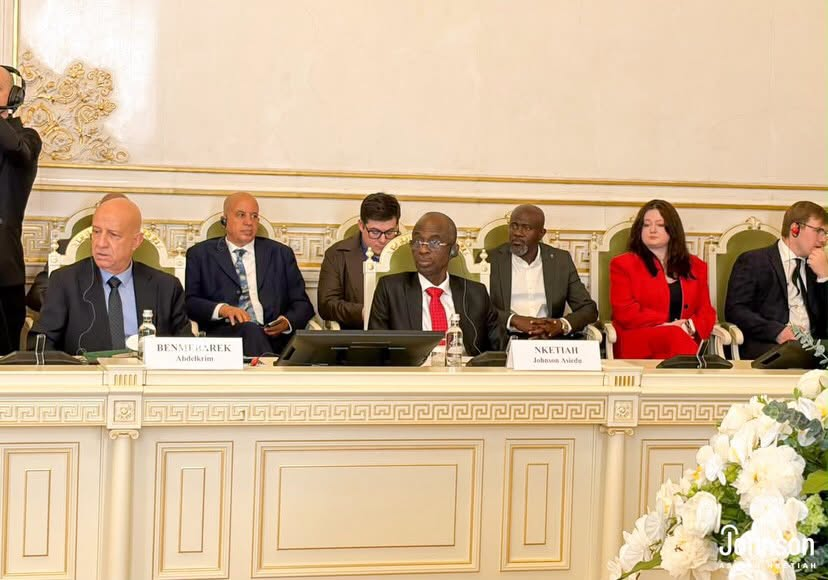
According to him, Ghana is positioning itself at the forefront of international efforts to link reparatory justice with economic sovereignty through diplomacy and global policy engagement.
Beyond the main summit, Mr Asiedu Nketiah said Ghana's delegation held discussions at the Legislative Assembly, the Hermitage Museum and the XIV International Legal Forum, where legal and policy approaches to global economic justice were explored.
His remarks come amid renewed calls by countries in the Global South for reforms to international financial and trade systems, with advocates arguing that reparatory justice is essential to achieving equitable global development.
Latest Stories
-
GNAT pushes for clear implementation procedures of teachers’ conditions of service
11 minutes -
Recurrent strikes threaten quality of education and academic calendars – Prof Bokpin
15 minutes -
‘Cockroach’ group leaders among hundreds detained in Delhi protest
18 minutes -
Don’t let speed of information become your judgement – CJ tells new lawyers
56 minutes -
World Cup visa scandal: People have leveraged public office to facilitate fraud – Senyo Hosi
1 hour -
Glut! Farmers count losses as prices crash, customers happy
2 hours -
GSA postpones auction of unserviceable vehicles
2 hours -
Man charged with attempted murder after stabbing
2 hours -
World Cup visa scandal: Senyo Hosi says issue goes beyond calls for Sports Minister’s resignation
2 hours -
Yaw Ampofo Ankrah hasn’t taken or received any money to facilitate visas – Lawyer insists
2 hours -
World Cup visa scandal: Senyo Hosi urges focus on constitutional accountability
2 hours -
La Beach demolition: Senyo Hosi condemns lack of consultation
2 hours -
Russian glide bomb attack on Zaporizhzhia kills at least 15 people
2 hours -
Jinapor warns underperforming energy sector CEOs of consequences, says no protection for failure
2 hours -
Fire destroys head of tipper truck on Lower Volta Bridge
3 hours