

Audio By Carbonatix
Ghana's journey towards sustainable economic growth hinges critically on reining in exorbitant interest rates, a feat achievable through concerted government policy and fiscal discipline.
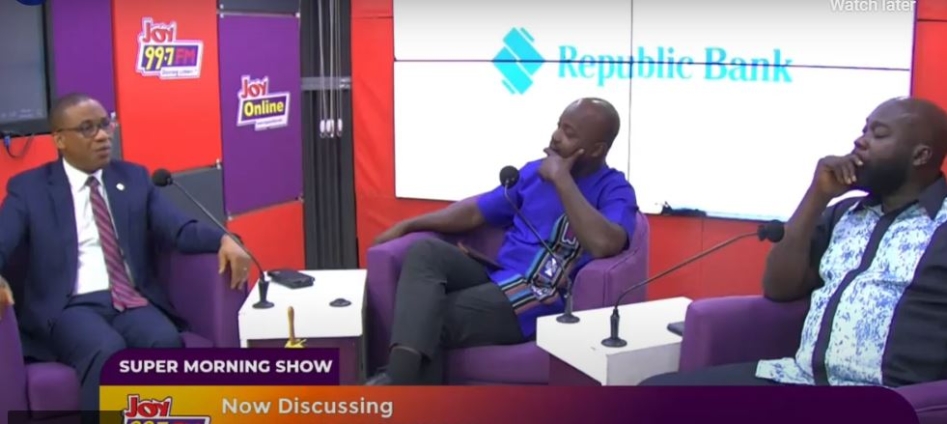
This was a key message from Dr. Benjamin Dzoboku, Managing Director of Republic Bank, during a revealing discussion on Joy FM's Super Morning Show today, Thursday, June 24.
Dr. Dzoboku drew on Republic Bank's recent success in a neighbouring West African nation to illustrate how intentional efforts can drastically alter lending landscapes.
Dr. Dzoboku highlighted the current state of Ghana's financial sector, noting the significant drop in Treasury Bill (T-bill) rates.
"If you look at the T-bill before, it was about 30%, now it has dropped to 15%," he observed.
While lower T-bill rates are generally positive, his core argument revolved around the need for lending rates to follow suit to genuinely stimulate the economy.
He emphasized, "If the cost of funds are very high, if you take the loan, it will be difficult for you to pay and that's why we want to make life so easy for Ghanaians, drop the interest rate and they'll be able to pay because you take the money to do business and that business must be able to generate a lot of income for you to pay."
"In Sierra Leone, when I went there, the interest rate was 41%. I met the Minister of Finance and the Vice President, and they were listening, so last week when we signed the agreement, they told me, Ben, the interest rate has dropped to 21%."
This dramatic 20 percentage point drop in interest rates within a short period, directly attributed to Republic Bank's presence and collaboration with the government, serves as a powerful testament to the impact of focused policy.
Sierra Leone Commercial Bank is the largest bank in that country, implying a significant market influence.
Dr. Dzoboku stressed that such transformation requires deliberate action from the government.
"You have to make a conscious effort on the part of the government that look, we need to drop this rate. Fiscal discipline is key," he asserted.
He outlined a clear causal chain: "If you discipline, you don't need to spend so much. If you are not spending so much, you don't need to go and borrow. If you are not borrowing and the people have excess money, you push them down, and then the rate will drop."
This implies that excessive government borrowing, which competes for funds and drives up interest rates, must be curtailed.
Ghana's public debt-to-GDP ratio stood at 73.5% at the end of 2023, a figure that often influences borrowing costs.
He explained how lower T-bill rates compel banks to shift focus from passive investment to active lending.
"If you are making a fortune in the government treasury bills, before you get about 30%, they drop the rate, let's say about 10%, what will you do? You have to create the loan, and that will help to drive the economy."
This forces banks back to their core mandate as financial institutions, fostering competition and innovation in the lending space.
For Ghana to truly flourish, Dr. Dzoboku pinpointed three critical economic indicators that must be meticulously managed: "Interest rates, exchange rates, and then if you discipline, inflation."
He noted that while T-bill rates have dropped to around 15%, commercial lending rates in Ghana remain significantly higher, often above 20%.
This disparity stifles business growth and consumer spending.
He expressed optimism that the current lower T-bill rates would ignite competition among banks.
"Now, pushing the banks to move, you realise that they are now looking for customers… There will be competition for rates. I give 18; somebody will come and say, 'I will give you 15,' and that is going to happen, and the government must make a conscious effort to drive the banks to do the needful."
Dr. Dzoboku concluded by inviting listeners to Republic Bank, highlighting its unique offerings, including four types of credit cards accessible even to salary workers, with interest-free periods of up to 45 days, and flexible mortgage options.
His message underscored that lower interest rates are not just an aspiration but a tangible goal achievable through collective commitment to fiscal prudence and a strategic push for a competitive lending environment.
Latest Stories
-
Julius Debrah, ‘man to beat’ as NDC’s James Agbey dismisses Musah Dankwah’s polls
6 minutes -
GPRTU in Savannah Region to protest alleged eviction in Damongo
35 minutes -
Re: Reinsurance does not replace process — A response to the SIGA–SIC defence
50 minutes -
Gender Ministry supports Harriet Amuzu in ongoing abuse case
1 hour -
AG joins plaintiff to scrap OSP ?: We should be mindful of the mischief in this – Bobby Banson
1 hour -
Samson Lardy Anyenini questions willingness of Attorneys-General to prosecute political colleagues
1 hour -
It is only fair the OSP is heard in Supreme Court case – Bobby Banson
1 hour -
Asiedu Nketia resumes Ashanti tour, second leg kicks off on Sunday
1 hour -
NLA denies salary cut claims, threatens legal action over reports
1 hour -
BoG Governor honoured for stabilising cedi, improve inflation
2 hours -
Kyebi Easter Homecoming 2026: A resounding success!
2 hours -
RNAQ divorce ruling: What the noise is hiding
2 hours -
Trade Minister applauds GUTA as a pillar of economic growth; Prez Mahama honoured
3 hours -
President’s brother’s takeover of Damang Mines is ‘untidy’ – Alhassan Tampuli
3 hours -
It’s not true that gov’t decided not to renew the lease for Gold Fields – Bobby Banson
3 hours