

Audio By Carbonatix
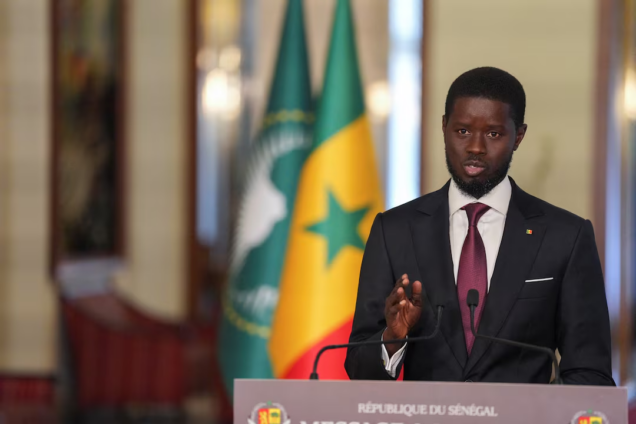
Senegal's government unveiled a 25-year development plan on Monday that it said would lay the foundations for economic sovereignty through competitiveness, sustainable resource management and good governance.
The agenda was launched seven months after President Bassirou Diomaye Faye clinched a landslide election victory on a promise to improve livelihoods in the West African nation.
"We aim to build a diversified and resilient economy," Faye said at the launch ceremony, which comes a month ahead of a snap legislative election.
"Our ... economy has been neutralised by a model of exploiting raw materials without any significant local processing or valorisation, leaving our domestic private sector too weak ... and our young talent in desperate search of opportunities," he said.
Senegal became an oil producer in June when Australia's Woodside Energy started production at its Sangomar oil and gas field. Gas production is also due to begin by the end of the year at the Greater Tortue Ahmeyim liquefied natural gas project, operated by BP.
Early in his presidency, Faye initiated an audit of oil and mining contracts, but the authorities have not shared details on its progress.
The first phase of the economic plan, which will cost $30.1 billion and run from 2025-2029, aims to reduce the budget deficit to 3% of GDP throughout that period, down from 4.9%.
It will be funded by a mix of public, private, and public-private partnership financing. It is based on an average growth rate of 6.5% and an increase in the average tax burden to 21.7%.
The International Monetary Fund reduced Senegal's growth forecast to 6.0% in September, down from a forecast of 7.1% in June, after the economy expanded at a slower-than-projected pace in the first half.
Under the new plan, the government aims to increase access to electricity to 100% from 84% and make Senegal energy self-sufficient.
The new administration will also modify Senegal's deficit financing structure in order to reprofile national debt.
Faye has been under pressure to make good on his election promises from the disenfranchised urban youth, whose support helped bring him to power.
The president has also faced resistance from the national assembly, prompting him to dissolve parliament last month, paving the way for the snap legislative election on Nov. 17.
His Pastef party had little leverage with only 26 seats in the now-dissolved 165-member parliament.
Government revenue fell significantly in the first eight months of the year, according to the IMF, and there are concerns the election could delay IMF financing.
Latest Stories
-
NTC reschedules teacher licensure exams over public holiday
7 minutes -
Ukraine faces missile shortage due to Middle East war, says Zelensky
12 minutes -
Total repression and air strikes bring unrelenting dread for Iranians
14 minutes -
Death of Ali Larijani deepens crisis at heart of Iran’s leadership
14 minutes -
Kwesi Nyantakyi: CAF Appeal Board decision on Morocco vs. Senegal AFCON final dangerous
19 minutes -
Even our own people are involved — Mahama on challenges in galamsey fight
27 minutes -
Former ‘kayayo’ Mariam Eliasu gains admission to Wisconsin University College
38 minutes -
Nkawkaw–Beposo taxi drivers threaten fare hike ahead of Kwahu Easter
38 minutes -
Average lending rate falls significantly to 19.7% in February 2026, but remains high
52 minutes -
DOSH Insurance honoured for transforming health financing and expanding affordable coverage
54 minutes -
Aduana, Medeama, Nations and Dreams storm into MTN FA Cup Semis
59 minutes -
Mahama urges organised labour to support ECG restructuring plans
60 minutes -
Ghana Month: Are funerals for the dead or the living ?
1 hour -
‘There’s too much corruption’ – Mane reacts to CAF decision to strip Senegal of Afcon 2025 title
1 hour -
Ghana’s export earnings hit $6.2bn in first two months of 2026
1 hour