

Audio By Carbonatix
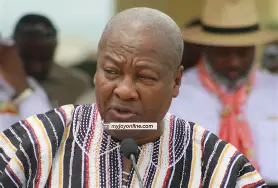
President John Mahama has urged organised labour to support the government’s plan to introduce private sector participation in billing and metering operations of the Electricity Company of Ghana (ECG).
Addressing the leadership of worker unions at the Jubilee House on Tuesday, March 17, he explained that the arrangement would not lead to job losses.
President Mahama said inefficiencies in billing and metering undermined ECG’s operations and affected its ability to improve wages, enhance working conditions, and expand social protection.
“ECG is not going to be privatised, nobody will lose jobs because of private sector participation. ECG will sell the electricity to the private sector and say, "We've given you this amount of electricity; pay us…"
“ECG will get its money and pay its employees, but the private sector would be responsible for billing and metering…for emphasis, it is not privatisation of ECG,” he said.
The president disclosed that US$1.57 billion was spent on the settlement of legacy debts in the energy sector in 2025, adding that about US$8 billion had been used over the past nine years to address financial challenges in the sector.
He called on organised labour to support the government in achieving the new “institutional architecture” of ECG, stressing:
“This reform is not designed against labour, it is designed with labour and for the long‑term stability of Ghana’s public sector compensation system,” he said.
President Mahama said pension coverage remained low, noting that pension assets stood at about GH¢100 billion, representing seven percent of Gross Domestic Product, which was below continental benchmarks.
“Less than two million workers out of the 10 million are contributing to pensions regularly… If we fail to act, the imbalance between contributors and retirees will continue to deepen, threatening the sustainability of the system and the dignity of future retirees,” he said.
The President said the Ministry of Finance had been tasked to review the pension structure, expand coverage in the informal sector, modernise contribution systems, and strengthen governance and investment management.
“Together we can build a remuneration system that is transparent and equitable, a pension system that guarantees dignity in retirement, and an economy that supports fair rewards for hard work.
“Our goal is clear—every Ghanaian worker must retire with dignity, security, and confidence in the pension system,” he said.
Latest Stories
-
GES urges government agencies to end blame game over teacher payments
2 hours -
GES sets Oct. 5 deadline to resolve teachers’ payment dispute
3 hours -
GES working around the clock to get teachers back to class, says Daniel Fenyi
3 hours -
French PM warns against escalation of school protests after 164 arrested
3 hours -
UK tries to stop Trump’s diesel export ban
3 hours -
Late Olise goal gives France win over Belgium
4 hours -
Mancini enjoys first win since return as Italy boss
4 hours -
Interest payments to average a high 20% of government revenue over next 4 years
4 hours -
Anthropic warns AI may pose ‘existential risks to humanity’ in IPO filing
4 hours -
Joe Hart trusts Man City chair Al Mubarak over ruling
4 hours -
Strategy of accumulating foreign reserves, gold carries high fiscal cost – S&P Global
4 hours -
Weak institutional arrangements, high debt servicing constrain Ghana’s rating – S&P
4 hours -
Man City CEO defiant over Premier League charges
4 hours -
Infantino makes bigger cash pledge to Fifa members
4 hours -
Bond market: Turnover declined by 28% to GH¢1.56bn
5 hours