

Audio By Carbonatix
Singing does not produce substantially more respiratory particles than speaking at a similar volume, a study suggests.
But it all depends on how loud a person is, according to the initial findings which are yet to be peer reviewed.
Study says singing is no riskier than talking for virus spread. Should congregations be allowed to sing at church without restrictions?https://t.co/4sDr82csbE
— Christian Concern (@CConcern) August 21, 2020
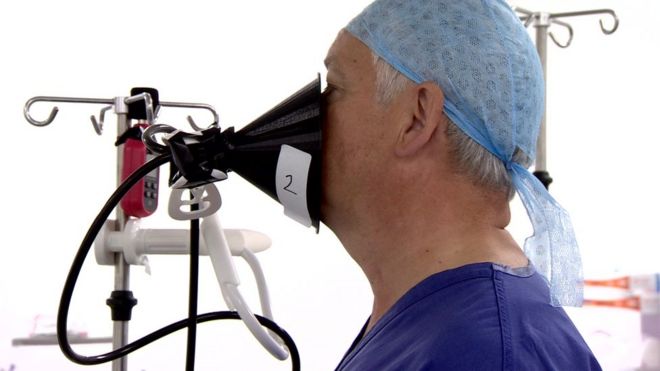
The project, called Perform, looked at the amount of aerosols and droplets generated by performers.
The findings could have implications for live indoor performances, which resumed in England this week.
They are currently only allowed to take place under strict social distancing guidelines.
Aerosols are tiny particles which are exhaled from the body and float in the air.
There is emerging evidence that coronavirus can be spread through these particles, as well in droplets which fall onto surfaces and are then touched.
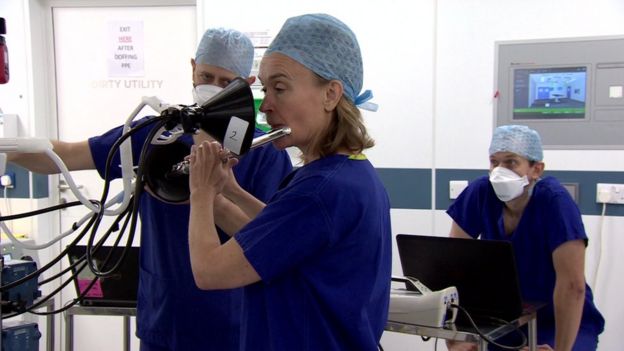
Twenty-five professional performers of different genders, ethnicities, ages and backgrounds - musical theatre, opera, gospel, jazz and pop - took part in the study that was led by scientists at the University of Bristol.
They individually completed a range of exercises, which included singing and speaking Happy Birthday at different pitches and volumes, in an operating theatre where there were no other aerosols present.
This allowed researchers to analyse the aerosols produced by specific sounds.
They found that the volume of the voice had the largest impact on the amount of aerosol produced.
For example, there was some difference - albeit not very substantial - between speaking and singing at a similar level. Whereas singing or shouting at the loudest level could generate 30 times more aerosol.
Ventilation could also have an effect on how aerosol builds up. The larger the venue and the more ventilation there is could affect how concentrated the volumes are.
Jonathan Reid, professor of physical chemistry at the University of Bristol, is one of the authors of the paper, which was supported by Public Health England.
He said: "Our research has provided a rigorous scientific basis for Covid-19 recommendations for arts venues to operate safely, for both the performers and audience, by ensuring that spaces are appropriately ventilated to reduce the risk of airborne transmission."
Culture Secretary Oliver Dowden said: "I know singing is an important passion and pastime for many people, who I'm sure will join me in welcoming the findings of this important study.
"We have worked closely with medical experts throughout this crisis to develop our understanding of Covid-19, and we have now updated our guidance in light of these findings so people can get back to performing together safely."
Dr Rupert Beale of the Francis Crick Institute, said: "This important research suggests there is no specific excess risk of transmission due to singing.
Loud speech and singing both carry excess risk however. This research supports the possibility of safe performance as long as there's appropriate social distancing and ventilation."
Dr Julian Tang, honorary associate professor in respiratory sciences at the University of Leicester, said: "The risk is amplified when a group of singers are singing together, eg singing to an audience, whether in churches or concert halls or theatres.
It is a nice study but not exactly representative of the real whole choir dynamic, which really needs further study to truly assess the risk of such large volume synchronised singing vocalisations/exhalations.
"The risks should not be overly underestimated or played down because of this - we don't want choir members getting infected and potentially dying from Covid-19 whilst doing what they love."
Latest Stories
-
Ho Teaching Hospital assures uninterrupted 24-Hour care during Easter
36 minutes -
The New Literature Anthology for Junior High Schools: Training needs for ESL facilitators
47 minutes -
Weta Traditional Council backs Council of State Member, urges fairness and due process over EOCO matter
54 minutes -
Night attack horror at Nkwanta South: Survivor loses mother and sister, battles trauma
56 minutes -
GAF launches Autism Awareness Month, Special Needs Centre project
60 minutes -
IMF MD Appoints Zeine Zeidane as Director of African Department
1 hour -
Ghana Navy seizes 8 boats suspected of illegal fuel bunkering
1 hour -
Hohoe United detail reasons for withdrawing from Ghana Premier League
1 hour -
Juabenhene & former Council of State Chairman backs ‘Big Push’, clears hurdle for Kumasi outer ring road
1 hour -
NRSA intensifies safety enforcement on Accra–Kumasi highway ahead of Easter
1 hour -
Carnival fever grips Gomoa as Bonfire Night delivers thrilling opener
1 hour -
Local Gov’t Minister urges public to prioritise sanitation, food safety amidst Easter festivities
1 hour -
Ghana prepares for nationwide rollout of free primary health care programme with massive equipment distribution
1 hour -
7 reported dead, several injured in accident in Kintampo
2 hours -
Chief of Staff urges mentorship as key to Ghana’s economic growth
2 hours