

Audio By Carbonatix
Train drivers in Spain are due to begin a three-day nationwide strike on Monday in protest of what they say is a lack of safety guarantees on the country's rail system.
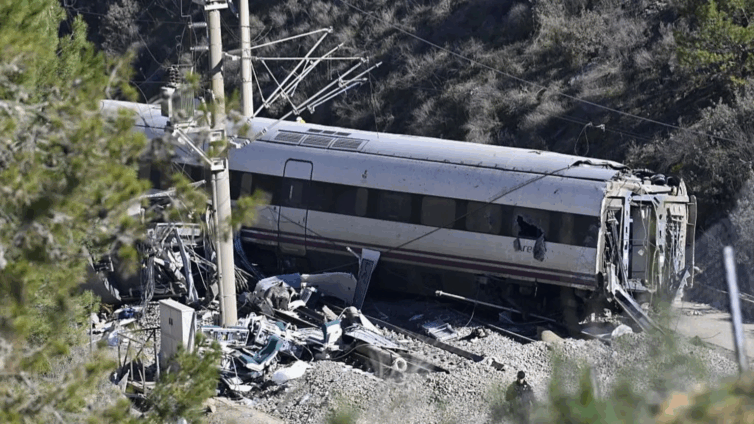
The action follows two fatal train crashes in January, one in Adamuz in the country's southern region, which killed 46 people, and the second just two days later near Barcelona, where a train driver died, and dozens were injured.
The accidents have caused severe disruption for travellers and cast doubt on Spain's much-vaunted rail system.
Semaf, the train drivers' union, is demanding more staff, increased investment, and improved maintenance amid what it has described as "the constant deterioration of the rail network".
Following the two collisions, subsequent safety checks also identified faults and maintenance issues across several routes.
Spain's Prime Minister, Pedro Sánchez, is due to be grilled in parliament later this week about the failures in the rail system.
The accident in Adamuz on 18 January, where a high-speed train derailed and collided with another travelling in the opposite direction, was the country's worst rail disaster in more than a decade.
A preliminary report by the rail accident investigation commission, CIAF, has found that grooves found on the wheels of the derailed train and three earlier trains suggest that a fracture in the track occurred before the train went over it.
Just two days later in Catalonia, a trainee driver was killed and at least 37 passengers were injured when a collapsed wall caused another local train to derail.
Rail officials believe the wall collapsed as the train passed, striking the driver's cab first and causing significant damage to the first carriage, where most of the injured passengers were travelling.
Semaf has previously said the collisions represent "a turning point in demanding that all necessary actions be taken to guarantee the safety of railway operations".
The amount of investment the rail network receives has come under particular scrutiny. The Socialist-led government has sought to dismiss such queries, noting that €700m (£605m) has been invested in upgrading the Madrid-Andalusia line in recent years, with the stretch of track where the accident occurred included in that renovation.
"We're not looking at a problem of lack of maintenance, we're not looking at a problem of obsolete [infrastructure], and we're not looking at a problem of lack of investment," said Transport Minister Óscar Puente.
Latest Stories
-
Manhyia South MP demands PPA board minutes on ‘Big Push’ sole-sourcing approvals
6 minutes -
Today’s Front pages: Tuesday, April 7, 2026
9 minutes -
President Mahama praises GWL MD Adam Mutawakilu over Damongo Water Project progress
11 minutes -
Ghana–China Forum explores zero-tariff trade opportunities
29 minutes -
What is wrong with us?: A quiet truth we can no longer ignore
42 minutes -
What is wrong with us? : When sirens become symbols of power rather than protection and emergencies
1 hour -
Businesses scramble to get noticed by AI search
1 hour -
From perk to performance: Why employee wellness must be a core business strategy
2 hours -
Bank of Ghana’s $1.3bn profit from gold sale could help narrow 2025 losses
2 hours -
Odau Twafohene Baffour Osei Afrifa appointed Regent of Akyem Chia
2 hours -
We are focused on engineering low interest rate regime – BoG Governor assures
2 hours -
How Sporting hero Gyokeres could end European run
2 hours -
The attack on Ghanaian traders in Burkina Faso and the blame game: Why Hybrid Security Governance Holds the Key (II)
2 hours -
Bayern face waiting game on ‘very special’ Kane
2 hours -
The Problem with Nutrition Advice on Social Media – Lessons from a study among University Students
2 hours