

Audio By Carbonatix
Stakeholders in Ghana’s educational sector have highlighted the need for adopting technology (Ed-Tech) to bridge the learning gap created by the Covid-19 pandemic.
All schools in Ghana and other parts of the world were shut down at the pandemic's peak in the first quarter of 2020.
Although schools were opened and learners were allowed to return to the classroom almost a year later, many teachers still struggle to make up for this.
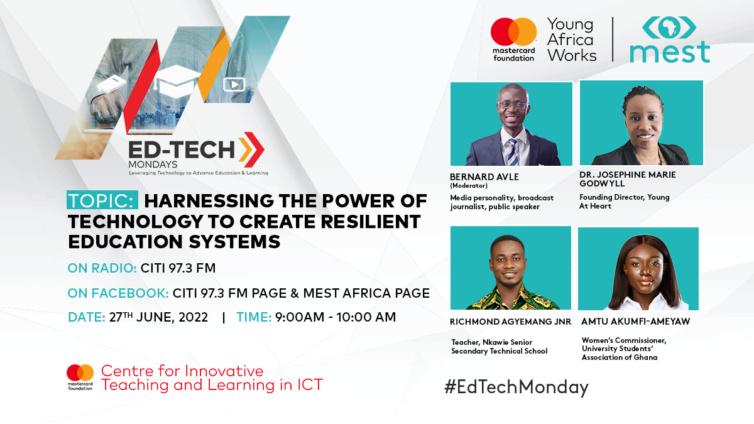
Speaking on the EdTech Monday Show with Bernard Avle on Citi FM, three stakeholders shared their opinions on the topic: Harnessing the power of technology to create resilient education systems.
The programme collaborates with the Mastercard Foundation and the Meltwater Entrepreneurial School of Technology (MEST) Africa.
The panel included Dr Josephine Marie Godwyll, Founding Director of Young at Heart Ghana; Richmond Agyemang Jnr, a teacher at Nkawie Senior Secondary Technical School; and Amtu Akumfi-Ameyaw, the Women’s Commissioner of the University Students’ Association of Ghana (USAG).
Dr Josephine Marie Godwyll said the educational system suffered a massive shock due to the Covid-19 pandemic.
She explained that there was a disruption in the learning times in various schools; in that school, closures reduced the amount of time dedicated to learning.
In her view, deploying the innovative engagement prowess of technology will help make up for the lost learning time without making education boring for young students.
“We lost about two terms due to the closures. The Ghana Education Service (GES) has attempted to compensate for this by increasing hours, especially in basic schools. And that is where EdTech comes in, because you’re looking at young people with minimal attention span, and there’s a limitation on how long you can keep them in the classroom," she said.
“So the innovative engagement prowess of technology comes in; the ways to engage young people to stimulate their creativity and allow them to learn in the extra times that we’re trying to recoup and also ensure that they’re not bored or treating education as a burden.”
For his part, Richmond Agyemang Jnr. said several teachers had to move from traditional teaching methods to embracing technology to teach their pupils.
Citing himself as an example, the Nkawie Senior Secondary Technical School teacher said he usually uses his laptop to project videos in a bid to get his students on the same wavelength.
“When I got the chance to go back to the classroom, I introduced the flip classroom where I ask students to go home and complete the reading, and when they come back to the school, we do the problem-solving in the classroom," he noted.
Meanwhile, Amtu Akumfi-Ameyaw also discussed how education has changed at the tertiary level since the COVID pandemic.
According to her, although there were already systems for online learning, the pandemic forced teachers to adopt and increase technology use.
“We already had the systems in place for online learning, but it wasn’t so efficient because we’re so used to a lot of physical interaction,” the Women’s Commissioner of the University Students’ Association of Ghana said.
EdTech Monday is an initiative of the Mastercard Foundation’s Regional Centre for Innovative Teaching and Learning in ICT and part of the Foundation’s strategy to find solutions to Africa’s youth employment by closing the gap in access to quality education and advancing the integration of technology in education policies and practices across Africa.
To realise this vision in Ghana, the Mastercard Foundation has partnered with MEST Africa, a pan-African technology institution, to bring the EdTech Monday show on the last Monday of every month.
Watch the full conversation here.
Latest Stories
-
The 7-foot giant of Ngleshie Amanfro: Seven-foot Ghanaian Ephraim Saawa dreams of joining the national basketball team
5 minutes -
Government promises support for Kumasi Central Market fire victims
12 minutes -
Vibes The Movie: Big Ghun’s Ghanaian film earns five nominations at 2026 REFFA
42 minutes -
MamaCare CEO warns unresolved conflicts among health workers could undermine maternal and neonatal care
1 hour -
Health professionals urged to translate medical knowledge into practice to save mothers
1 hour -
Conflicts among care providers linked to maternal, neonatal deaths – Expert
3 hours -
GIS marks 10th TIME conference, champions improved teaching practices
3 hours -
BRICS Or Balance? What Ghana’s bid really means
3 hours -
GPRTU wants full TRAFFITECH-GH implementation to start in 2027
4 hours -
Mahama announces plans to import electric wheelchairs for PWDs
4 hours -
KGL U17 Colts 2026: Western beat Prempeh Elite Academy to set up final final with Greater Accra Region
4 hours -
Late Solanke strike salvages 10-man Spurs draw at Man United
4 hours -
Gender Ministry to monitor welfare of Nana Akua Addo’s children amid domestic violence case
4 hours -
Benedict Okyere Yeboah: Ghana’s football problem goes beyond sacking a coach
4 hours -
GPL 2026/27: Darkwah Wiafe’s winner sees All Blacks beat Kotoko
5 hours