

Audio By Carbonatix
The Project Coordinator for the National Adaptation Plan (NAP) on climate change (CC), Dr Antwi-Boasiako Amoah, has lauded the efforts by the government to address the effect of climate variability and change on the agricultural sector while underscoring the importance of agriculture to Ghana's economy.
Dr Amoah, who is also a Deputy Director at the Environmental Protection Agency (EPA), said the government’s commitment was evident in some policy documents, such as the National Climate Change Policy (NCCP), the National Climate Change Adaptation Strategy (NCCAS), the NAP and the Nationally Determined Contributions (NDCs) which describe the country’s vision and plans at addressing the CC menace and guidance for adaptation plans.
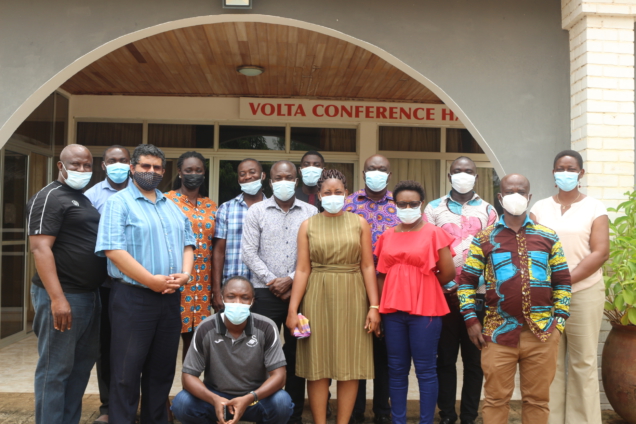
Speaking at a workshop on “Building Agriculture’s Future Scenarios: Climate Change Adaptation and Sustainability Pathways,” at Sogakope, from March 30 to April 1, 2021, he indicated that food security might severely be affected by CC due to the reliance on rain-fed agricultural production.
He stressed the need for adaptation strategies that were evidence-based, cost-effective, and had multiple co-benefits.
Case study
Preliminary finding of a case study on the “Impact of CC and adaptation on livelihoods of smallholder farmers” in Navrongo in the Upper East Region, showed that temperatures are projected to increase by 1.1 to 2.7 °C by 2050 while the direction of change in annual total rainfall amounts remained varied.
A Senior Research Fellow at the University of Ghana, Dr (Mrs) Dilys Sefakor MacCarthy, explained that the results suggested that maize and sorghum productivity would decrease while the productivity of peanut was projected to increase mainly due to carbon dioxide fertilization associated with legumes.
“Overall, the combined effects of CC and projected future socio-economic conditions may offset the negative impact on the cereals and lead to a decline in poverty rates under certain scenarios.”
“An adaptation strategy based on longer crop life cycle offsets the negative impacts of CC on cereals, particularly maize,” she said.
The Deputy Director at the Directorate of Crop Services and Head of Environment and Climate Change Unit of Ministry of Food and Agriculture, Mr Kingsley Kwako Amoako, on his part, highlighted the need for the inclusion of indigenous knowledge, gender and socio-cultural, and land tenure considerations in the selection and promotion of CC adaptation strategies.
He stated the need for capacity building for modelers to develop models for the range of crops and crop varieties grown in Ghana, so as to enable assessment of the impact of CC as well as potential adaptation strategies.
Workshop
The workshop was organized by the Agricultural Model and Inter-comparison and Improvement Project (AgMIP), in partnership with the University of Ghana, under the CLimate and REsilience project (CLARE) funded by the International Development Research Centre (IDRC).
The AgMIP is a network of over a thousand agricultural modelers worldwide with the vision to provide science-based agricultural assessments of CC to enhance sustainable farming systems.
Some of the objectives of the workshop were to; engage with stakeholders in a learning dialogue about guiding priority setting of research and policy for agricultural development at the national level through CC adaptation planning, and identify research and development gaps and needs in the national CC adaptation processes.
A Scientist from Oregon State University, who co-leads the AgMIP’s Regional Economic team, Dr Roberto Valdivia, introduced the AgMIP-CLARE project and the Regional Integrated Assessment (RIA), a protocol-based transdisciplinary approach to assess impacts of CC and adaptation on the livelihoods of farmers.
The workshop was also an opportunity to review three plausible agricultural development pathways or scenarios (Business as Usual, Sustainable development, and fossil fuel-driven development pathways) co-developed with stakeholders in November 2020.
The drivers of these pathways will inform further socio-economic analysis and final results will be shared with stakeholders, media, and the public in a final workshop later this year.
Latest Stories
-
Mobile Money Fintech LTD, UMB train hairdressers and beauticians
1 hour -
Asylum votes show people want help, says Kemi Badenoch
2 hours -
Badenoch welcomes expanded grooming gangs inquiry
2 hours -
GACL MD sues Samuel Buabeng over alleged Facebook defamation
2 hours -
Christa Pike in critical condition after surviving two lethal injections, lawyer says
2 hours -
Kemi Badenoch backs face covering ban at protest
3 hours -
Man City not ‘above the rules’, says No 10 after backlash to Burnham remarks
3 hours -
Real Madrid submit ‘substantial’ dossier in Barca payments case
3 hours -
Messi completes purchase of second Spanish club
3 hours -
Government must engage horticulturists on tomato crisis – GhIH
3 hours -
King Promise’s ‘Can’t Tame Us’ becomes official Chelsea anthem
3 hours -
Afenyo-Markin demands Baffour Awuah’s release from EOCO’s custody, end to alleged political intimidation
3 hours -
Rapper Rick Ross arrested on domestic violence charges
3 hours -
Minority demands security review of Ghana-Colombia visa waiver and port deals
4 hours -
Pursue drug kingpins, not persecute political opponents – Afenyo-Markin tells EOCO
4 hours