


Audio By Carbonatix
The record for the world's hottest day has tumbled twice in one week, according to the European Climate Change Service.
On Monday the global average surface air temperature reached 17.15C, breaking the record of 17.09C set on Sunday.
It beats the record set in July 2023, and it could break again this week.
Parts of the world are experiencing powerful heatwaves including the Mediterranean, Russia and Canada.
Climate change is driving up global temperatures as greenhouse gas emissions released when humans burn fossil fuels warm the Earth's atmosphere.
"While fluctuations are to be expected, as the climate continues to warm, we are likely to keep seeing records being broken, and each new record is taking us further into uncharted territory," says Prof Rebecca Emerton, a climate scientist at the Copernicus Climate Change Service.
The naturally-occurring climate phenomenon El Niño also added heat to the climate in the first six months of this year but its effects have now waned.
Extreme heat is a serious health hazard, with thousands of deaths attributed to high temperatures every year.
In 2000-2019, almost half a million heat-related deaths around the world occurred each year, according to the World Health Organization.
China has issued heat alerts this week, with central and northwestern areas of the country recording temperatures higher than 40C.
Russia has been battling wildfires in Siberia, and Spain and Greece also endured days of high temperatures.
In the US, more than 40 million people on Tuesday faced dangerous temperatures, and wildfires have broken out in western areas of the country.
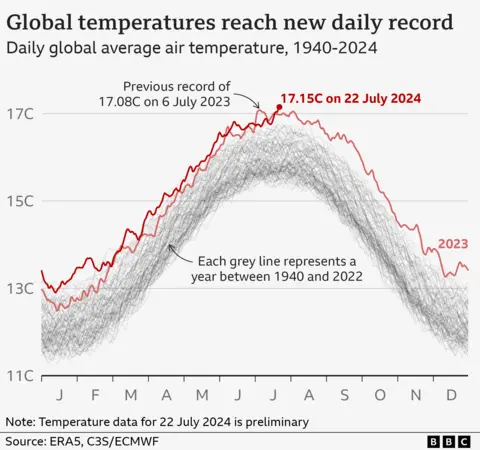
The global average temperature usually peaks in July or August during summer in the northern hemisphere.
The northern hemisphere has large land masses - like the US or Russia - that warm up faster than the oceans that dominate the southern hemisphere.
The recent sudden rise in temperatures is also down to significantly-above-average temperatures over large parts of Antarctica, according to Prof Emerton.
Large swings in temperature are not unusual in Antarctica at this time of year - they also contributed to record temperatures in 2023.
Sea ice in the region is almost as low as this time last year, which also leads to above-average sea temperatures in the Southern Ocean.
“The hottest day record has been broken once again because the world continues to burn huge amounts of oil, gas, and coal," says Friederike Otto, Senior Lecturer in Climate Science at Grantham Institute at Imperial College London.
“Every broken record is a warning that our climate is heating to dangerous levels. These warnings are becoming much more frequent; however, we have all the tools, technology and knowledge to stop things from getting worse – replace fossil fuels with renewable energy and get emissions down to net zero as quickly as possible," she added.
Latest Stories
-
Mobile Money Fintech LTD, UMB train hairdressers and beauticians
1 hour -
Asylum votes show people want help, says Kemi Badenoch
2 hours -
Badenoch welcomes expanded grooming gangs inquiry
2 hours -
GACL MD sues Samuel Buabeng over alleged Facebook defamation
2 hours -
Christa Pike in critical condition after surviving two lethal injections, lawyer says
2 hours -
Kemi Badenoch backs face covering ban at protest
3 hours -
Man City not ‘above the rules’, says No 10 after backlash to Burnham remarks
3 hours -
Real Madrid submit ‘substantial’ dossier in Barca payments case
3 hours -
Messi completes purchase of second Spanish club
3 hours -
Government must engage horticulturists on tomato crisis – GhIH
3 hours -
King Promise’s ‘Can’t Tame Us’ becomes official Chelsea anthem
3 hours -
Afenyo-Markin demands Baffour Awuah’s release from EOCO’s custody, end to alleged political intimidation
3 hours -
Rapper Rick Ross arrested on domestic violence charges
3 hours -
Minority demands security review of Ghana-Colombia visa waiver and port deals
4 hours -
Pursue drug kingpins, not persecute political opponents – Afenyo-Markin tells EOCO
4 hours