

Audio By Carbonatix
The incident is the second occasion in recent months in which police resorted to using water cannons on demonstrators. Recent protests in Thailand have called for government reforms and changes to the powerful monarchy.
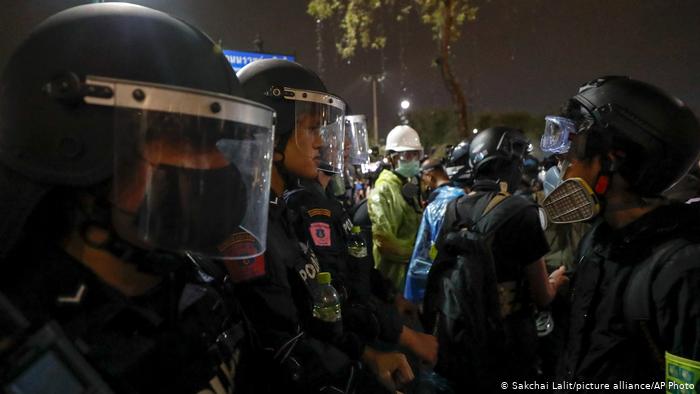
Pro-democracy protesters in Thailand were confronted with riot police and water cannons on Sunday as they attempted to deliver grievance letters to the Grand Palace in Bangkok.
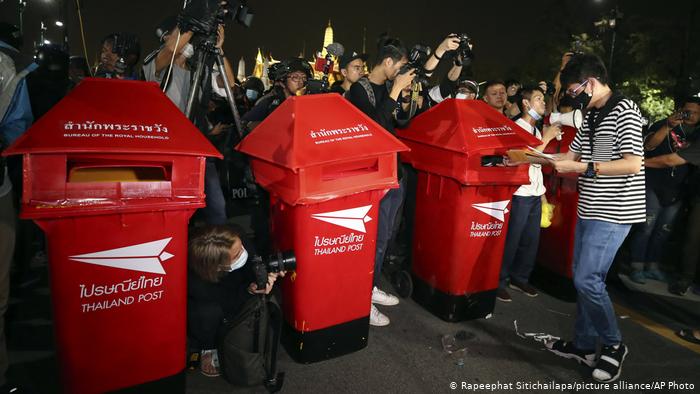
The conflict was brief, and police later allowed the demonstrators to place four red mailboxes near the palace to allow protesters to deposit their letters.
Some 7,000 protesters took to the streets on Sunday, marching from Democracy Monument in central Bangkok to the palace, authorities said.
Police had unleashed water cannons when protesters pushed aside one of several buses serving as a barricade to the palace. For protesters and one police officer were hurt during the confrontation, according to the Bangkok authority's emergency unit.
Police spokesman Kissana Phatanacharoen said the water cannons were only fired as a warning. It was only the second time police used the cannons amid months protests.
The Grand Palace in Bangkok is home to royal offices but is only used infrequently by King Maha Vajiralongkorn.
Pro-democracy protests in Thailand
The southeast Asian country has seen pro-democracy protests since July. The student-led movement has put enough pressure on the government to call for parliament to deal with at least some of their demands.
Protesters have taken to the streets on a daily basis to protest the country's monarchy and demand that Thailand's Prime Minister Prayuth Chan-ocha step down.
Protesters believe Prayuth lacks legitimacy because he came to power during an election in which the rules were set up by the military. Prayuth, a former army chief, led a 2014 coup that ousted an elected government and then headed a junta that ran the country until an election last year.
The junta also instituted a new constitution that the protesters deem to be illegitimate.
The movement's criticism of the monarchy is more controversial. A lese majeste law mandates a prison term of up to 15 years for anyone who defames the king or his close family. Public criticism was virtually unheard of until the protests.
The protesters have demanded curbs on the king's powers and called for the monarchy to be more accountable.
"When the king truly cherishes democracy, all people will find happiness," the protesters said Sunday as part of a prepared statement. "When you hear all the flattering praise from the people, you must also hear fearless criticisms and suggestions all the same."
Latest Stories
-
The attack on Ghanaian traders in Burkina Faso and the blame game: Why Hybrid Security Governance holds the key (I)
2 minutes -
TaxForGalamey: Stop taxing galamsey immediately or face sanctions – Gov’t cautions MMDCEs
5 minutes -
FNB Ghana strengthens balance sheet with higher earnings and improved asset quality
17 minutes -
Stakeholders call for stronger action to advance women’s economic empowerment at UKGCC–British High Commission IWD Event
24 minutes -
Global Network of Export-Import Banks holds 6th exchange programme in Accra
29 minutes -
Prudential Bank Ladies celebrate IWD with candid talk on Love, Life, and Livelihood
30 minutes -
Kejetia Market now a ‘death trap’ – Federation of Kumasi Traders warns
32 minutes -
NDPC DG urges shift to resilient, shock-responsive social protection systems
33 minutes -
New Town building collapse: Enforce existing laws — Architecture Alliance
36 minutes -
Kudus to play under new coach as Tottenham appoint De Zerbi
37 minutes -
Gov’t may review fuel taxes amid rising oil prices – Kwakye Ofosu
46 minutes -
Iran–US conflict pushes fertilizer prices higher, raising food security risks in 2026
52 minutes -
Iran using children in security roles in war, reports and witnesses say
55 minutes -
Evalue-Ajomoro-Gwira MP pledges to safeguard peace in Lower Axim and Nsein
58 minutes -
Global collaboration in focus as Malaysia courts Ghanaian top business executives
1 hour