

Audio By Carbonatix
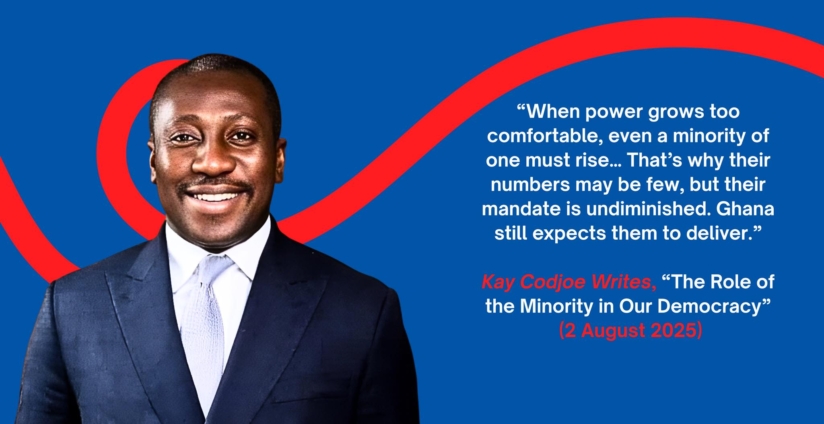
In a Parliament ruled by numbers, Alexander Afenyo-Markin’s opposition style is a curious rebellion. It is not the fiery kind that burns bridges, but the subtle kind that exposes architecture. While many see his tactics as obstructionist, what often goes unnoticed is how his brand of dissent has forced a national classroom into being, one where citizens, journalists, and even fellow lawmakers have been compelled to study the fine print of the law.
Every time Afenyo rises to object, to question, or to quote a statute in full glare of the cameras, he opens the Constitution to public interpretation. His interventions turn parliamentary procedure into public pedagogy. The law, which once seemed remote and ceremonial, now breathes on the floor, debated, challenged, and humanised.
In a supermajority House where government business could otherwise pass like a whisper, his disruptions create punctuation. They slow down the power long enough for the public to read the sentence. This is not noise; it is deliberate resistance. For a minority dwarfed by numbers, obstruction becomes visibility, and visibility becomes power.
It is this paradox that unsettles the supermajority. When the government expects docility, Afenyo offers discipline. When it expects silence, he recites the law. And when the arithmetic of Parliament appears too skewed to matter, he manipulates the grammar of procedure to remind the chamber that the minority still speaks the language of law.
The most recent scene, the vetting of Chief Justice nominee Justice Paul Baffoe-Bonnie, was a perfect case study. Afenyo began with Shakespeare’s Macbeth, but behind the literature was litigation. His words about ambition and consequence were less theatre and more jurisprudence, a moral framework disguised as performance. Even as the Majority shut him down, invoking parliamentary standing orders, the confrontation itself became a civic seminar. Ghanaians learned, in real time, that rules could be both shields and swords, depending on who wields them.
That is the irony of Afenyo’s opposition: every attempt to muzzle him multiplies his meaning. The Majority may win votes, but he wins visibility. And in politics, visibility often shapes narrative faster than numbers can pass motions.
His methods are not flawless. Sometimes his tone veers into theatre; sometimes his timing tests patience. Yet through the commotion, he has achieved something rare in Ghana’s legislative history: he has made the minority matter again. Not by overturning votes, but by overturning complacency.
In Afenyo’s world, law is not a shield for power but a mirror for conscience. And while his critics see a man tilting at parliamentary windmills, the more attentive see a strategist turning debate into education, dissent into institution, and procedure into protest.
For now, the supermajority may still dominate the count, but in the long arc of political culture, Afenyo’s greatest contribution may not be the battles he wins, but the questions he forces us to ask. And in that sense, every time he stands, Parliament itself learns to sit up.
Latest Stories
-
Newmont pays GH¢12.8bn in taxes to gov’t in 2025
2 hours -
I pray against geopolitics – NPA boss warns of crude price shocks
2 hours -
Aspiring female Zambian politicians were asked for sexual favours, official says
2 hours -
Belgium orders ex-diplomat to stand trial for 1961 murder of Congo’s Lumumba
2 hours -
Suicide bombings show resilience of Nigerian jihadists despite years of war
2 hours -
Zelensky calls for Trump and Starmer to meet and find common ground
3 hours -
Nigeria president begins first UK state visit in 37 years
3 hours -
Death of Ali Larijani deepens crisis at heart of Iran’s leadership
3 hours -
Engineering, science, and technology have strong roles in Ghana’s development – Ing Ludwig Annang Hesse
3 hours -
Fuel price crisis may trigger presidential intervention – NPA boss
3 hours -
At $120, we act – NPA draws red line on global oil prices
4 hours -
We’re still studying the market – NPA on rising fuel costs
4 hours -
Ashanti South Police arrest three suspects in Asawase Kusasi chief murder case
5 hours -
Man held over alleged police uniform, pistol theft, robbery
5 hours -
Food vendor jailed 20 days for defying KMA order
7 hours