

Audio By Carbonatix
Artificial Intelligence (AI) expert, Prince Ebenezer Adjei, says effective implementation of artificial intelligence can revolutionize healthcare in Low- and Middle-Income Countries (LMICs) like Ghana.
He believes that using everyday smartphones is an inclusive strategy to integrate AI to support both healthcare workers and health service users.
“The future of healthcare in Ghana hinges on the effective implementation of AI.
“In developed countries, AI in healthcare often employs high-end technology, but in Low- and Middle-Income Countries (LMICs) like Ghana, the approach is more practical and inclusive.
“AI applications are predominantly integrated into mobile phones, leveraging the widespread use of mobile technology to reach a broader audience,” he said
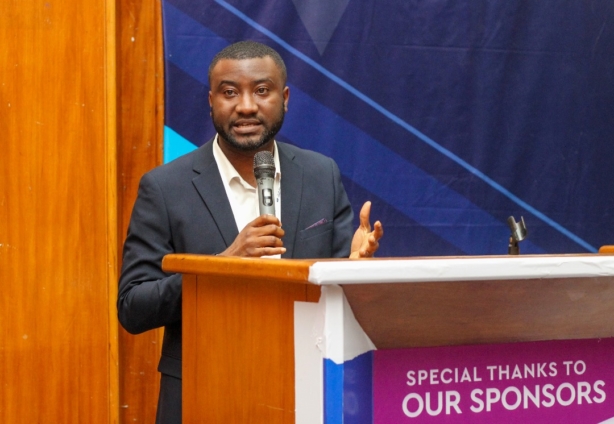
He said this during his presentation at this year’s Future of Healthcare Summit held under the theme “Digital Technology: A Major Booster for Healthcare Delivery.”
The conference, which took place in Accra, focused on discussions centered around the challenges and opportunities that come with the rise of remote care, the evolution of hospitals, healthcare disruptions, and the growth of partnerships.
Prince Ebenezer Adjei is a biomedical engineer and AI researcher specializing in healthcare applications.
He currently serves as a lecturer in the Biomedical Engineering programme at the Kwame Nkrumah University of Science and Technology (KNUST), and an AI healthcare specialist within the Global Health and Infectious Disease (GHID) group at the Kumasi Center for Collaborative Research in Tropical Medicine (KCCR).
Prince explained that AI's impact on healthcare occupations cannot be overlooked, and necessitates redefinition of traditional clinical roles and the integration of AI training into healthcare education.
However, he emphasized that the process of integration of AI into Ghana’s healthcare does not come without challenges.
“Issues of bias, fairness, and accuracy are prevalent concerns.
“To address these, Ghana needs to be actively involved in AI development, ensuring that the technology aligns with local healthcare needs and cultural contexts.
“This will require increased AI awareness among healthcare workers, robust data management systems, and clear policies governing AI use in healthcare,” he said
Prince revealed how various partners from the private sector, the government, and academia through research, are making strides towards this integration.
“In Ghana, this revolution is taking shape through the ‘AI4GH project’, an International Development Research Centre (IDRC) funded initiative with a budget of CAD 15.5 million.
“The project, which focuses on Sexual and Maternal Reproductive Health (SMRH) and pandemic prevention, is coordinated by the Global Health and Infectious Diseases Research Group, KCCR, KNUST through a partnership with the Global Health Network (TGHN), Oxford University.
“This project marks a significant step in bringing in a new era of healthcare delivery in Ghana,” he said.
He added, “KNUST’s Responsible Artificial Intelligence Lab (RAIL) dedicated to advancing AI studies in collaboration with GHID-KCCR is undertaking a vital project with the radiology department at Komfo Anokye Teaching Hospital (KATH) in Kumasi to enhance stroke diagnosis using AI technologies.”
He further highlighted emerging innovative local solutions from the private sector such as ‘Intron Health’ designed to improve patient-doctor interactions by transcribing their conversations; and ‘minoHealthAI’ which enhances the efficiency of medical image examination by facilitating higher patient throughput.
The 2023 Future of Healthcare Summit had a mix of plenary and panel sessions, and interactive workshops alongside social events. This provided a unique opportunity for thought leadership, networking, and business development.
Latest Stories
-
Teachers’ strike: GES targets Monday deadline to submit promotion data to Controller
8 minutes -
Inflation to average 11.3% in 2027 – Fitch Solutions
38 minutes -
I didn’t campaign for NDC to come and do this nonsense – Kpebu on EOCO
40 minutes -
Fitch Solutions maintains its policy rate forecast of 14% by December 2026
46 minutes -
Diaspora Nasara Caucus congratulates Mohammed Ali Suraj, new NPP executives
2 hours -
Dr Antwi-Boasiako’s cybersecurity book showcased at UN crime prevention congress
2 hours -
We will empower the grassroots and protect every vote – NPP’s 1st Vice Chair Kojo Bamba
3 hours -
I do not see myself as better than anyone – NPP’s 1st Vice Chair Kojo Bamba
3 hours -
Police blur the line between invitations and arrests – Reindorf Twumasi Ankrah
4 hours -
Turning invitations into arrests is making citizens reluctant to assist police – Twumasi Ankrah
4 hours -
The Traffitech-GH SMS spot-fine system: The good, the sad, and the funny – Bright Simons writes
4 hours -
Hawa Koomson pledges experienced and mature leadership of NPP women’s wing
6 hours -
Young woman found dead at Kasoa Peace Town
6 hours -
Playback: The Law examined lawful arrest in Ghana
7 hours -
Mahama urges African governments to treat healthcare as an investment, not budget cost
7 hours