

Audio By Carbonatix
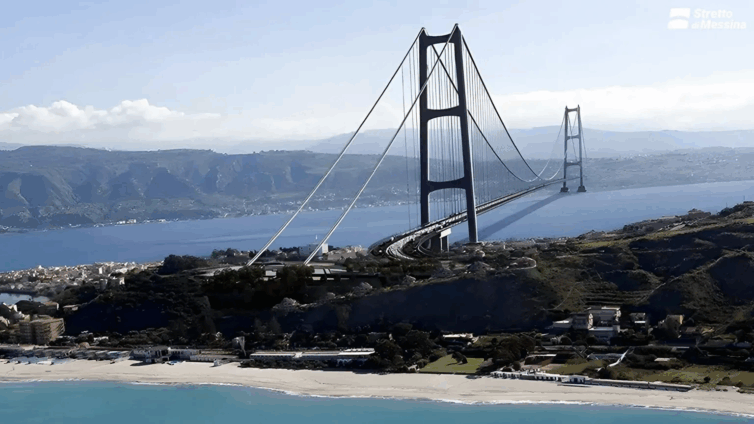
Rome has given final approval to a €13.5bn ($15.6bn) project to build the world's longest suspension bridge, connecting the island of Sicily to the region of Calabria, on the tip of Italy's boot.
The designers claim the bridge, which is due to be built on one of the most seismically active areas in the Mediterranean, will be able to withstand earthquakes.
It is the latest attempt by Italian officials to launch the Messina Bridge project - several have tried over the years, but plans have later been scrapped due to concerns over cost, environmental damage, safety or potential mafia meddling.
Prime Minister Giorgia Meloni has admitted that the most recent project has not been easy.
However, she said on Wednesday that she considers it an "investment in Italy's present and future".
"We enjoy difficult challenges when they make sense," Meloni said.
According to the final project, the bridge over the Messina Strait will span 3.3km (2.05 miles) and stretch between two 400-metre (1,300 feet) high towers, with two railway lines in the middle running and three lanes of traffic on either side.
Rome is hoping to classify the bridge as a military expenditure to make it count towards the Nato target of 5% of GDP spent on defence.
Transport minister Matteo Salvini, the leader of the right-wing Lega party and a government ally of Meloni, celebrated the milestone, saying that the goal was to complete the bridge between 2032 and 2033.
He also claimed the bridge would create 120,000 jobs a year and bring economic growth to the area. The regions of Sicilia and Calabria are two of the poorest in Europe.
However, the project will still need to be rubber-stamped by the Italian Court of Auditors as well as environmental agencies, both at the national and EU levels.
Local residents on either side of the strait whose properties may be expropriated will also have to be consulted and could legally challenge the decision, meaning the construction of the bridge may be delayed or stall altogether.
It would not be the first time that the bridge's building has been held up. Since the first plans for it were drawn up more than 50 years ago, various ideas for it have had to be shelved for various reasons, and it has long faced stern opposition.
This has included concerns that huge amounts of taxpayers' money would be siphoned off by the Sicilian and Calabrian mafias, which have a broad influence over politics and society in southern Italy.
On Wednesday, local politicians reiterated their unhappiness with the government's decision.
Senator Nicola Irto of the Democratic Party (PD) called the project was "controversial and divisive", saying it would divert "crucial resources from local transportation, modern infrastructure, safe schools and quality healthcare facilities".
Giusy Caminiti, the mayor of Villa San Giovanni near where the bridge would be built on the Calabrian shore, said her town would be badly affected and urged more time for consultations.
Grassroots Calabrian committee "No to the Bridge" slammed Wednesday's announcement and said it was a political manoeuvre, rather than the outcome of a thorough technical evaluation.
Local groups that oppose the bridge also say its construction would use millions of litres of water a day, while both Sicily and Calabria regularly struggle with drought.
Currentl,y the only way for trains to cross the Strait is to have the coaches shunted onto ferries and carried over the sea in a 30-minute journey.
Latest Stories
-
Video: Immunity should be exercised without creating classism – Inusah Fuseini on cocaine bust
31 minutes -
Ghana Air Force passes out 293 recruits after six months of intensive training
39 minutes -
EOCO vrs Baffour Awuah: EOCO should have secured warrant before arrest attempt at court – Inusah Fuseini
43 minutes -
Triple fibre cuts disrupt telecom services across Northern, Oti regions – Sam George
46 minutes -
Politicisation could undermine parliamentary probe into cocaine seizures – Dr Osae-Kwapong
52 minutes -
EOCO chases MP: Can Section 41 cure lacuna in EOCO Act? – Inusah Fuseini asks
55 minutes -
GNFS, GWL inspect fire hydrants in Ministries enclave; 23 found faulty
1 hour -
Gov’t directs release of 50,000 bags of grain to ECOWAS
1 hour -
Ghana, Germany deepen cooperation on railways, labour mobility
1 hour -
Huge crowds greet Pope in Paris for open-air Mass
1 hour -
‘I never said I’ll declare a state of emergency’ – President Mahama on galamsey
2 hours -
Bobby Banson condemns EOCO’s attempted arrest of Nana Agyei Baffour Awuah
2 hours -
When Kumasi begins to look like somebody is in charge
2 hours -
Parliamentary probe into cocaine seizure would be a waste of time – Inusah Fuseini
3 hours -
Cocaine seizure: Focus on Ghana’s reputation, not partisan blame – Osae-Kwapong
3 hours