

Audio By Carbonatix
Protests have taken place in Italy after the death of a Moroccan-born man while being forcibly restrained by two police officers in the northern city of Bologna.
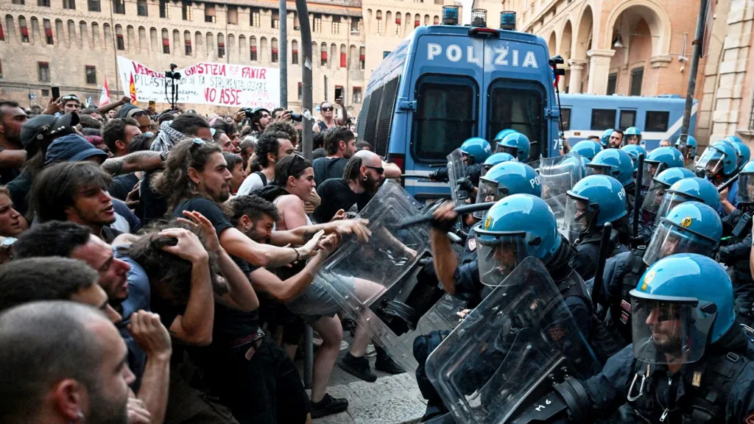
Several thousand people took to the streets on Monday night demanding "justice for Abderrahim Fakir".
A smaller group then splintered off and clashed with police into the night. Prosecutors say 64 police were hurt in the unrest.
Prime Minister Giorgia Meloni said it was imperative that the truth surrounding his death should be investigated but "nothing can justify violence against law enforcement".
Police had been called on Sunday morning after a neighbour witnessed Fakir "behaving erratically" and kicking garage doors in the working class neighbourhood of Pilastro. The officers tried to calm the situation but then used pepper spray.
A video circulating on Italian media shows two policemen sitting on Fakir as he lies face down and cries out for them to stop. A third person who is not a policeman pins his legs down as emergency workers stand by.
About two minutes into the video, Fakir stops struggling. The police officers tie his wrists and ankles and, when one of them realises Fakir is no longer moving, slaps him twice on the cheek. By the time an ambulance worker approaches, it is clear Fakir is unconscious.
Prosecutors in Bologna have opened an investigation into manslaughter against the police officers and the medical workers who were present at the scene.
Several eyewitnesses told Italian media that while Fakir appeared to be in distress he did not threaten anybody and was clearly unarmed.
"You can't die like this," his sister Khadija told Italian media. "They killed him mercilessly, and I want the truth."
Bologna mayor Matteo Lepore told Italy's La Repubblica newspaper that anyone who watched the video was "shocked".
He called for the demonstration in central Bologna on Monday evening and invited Fakir's niece to join him on stage.
"He was my uncle. He wasn't a number, he wasn't a news line... he was loved," Yossra Fakir said. "He deserved to be helped and heard, and he deserved dignity."
While the main demonstration on Monday night was peaceful, about 100 protesters clashed with police into the night and set two cars alight.
Lepore said on Tuesday he had seen "two different squares" in Bologna - "thousands of people gathered peacefully and spontaneously to express their support for Abderrahim Fakir's family" and a smaller group "who think they can respond to violence with violence".
Domenico Pianese, the Secretary-General of the police union, criticised Lepore's decision to call for a demonstration that later descended into chaos.
Calling for a protest "the day after a dramatic event like this one," Pianese said, was like calling "all the pseudo-anarchists and those who are anti-police... to take advantage and protest against the state".
Asked about what police got wrong when they detained Fakir, he said: "Judging from the images we saw, the intervention was carried out correctly."
Pianese argued that the fact the two officers had to use pepper spray and needed the help of a civilian to restrain Fakir showed that the use of force had not been excessive. "The first thing they did [after the incident] was... hand all [bodycam] footage to prosecutors," he said.
Prime Minister Giorgia Meloni called the events "unacceptable".
While Fakir's death should be "thoroughly investigated," she said, "nothing can justify violence against police."
"Those who chose to use this incident as a pretext to set the city ablaze, attack officers, and sow violence... were not seeking the truth: they were seeking confrontation," she said.
According to Italian media Fakir's family arrived in Italy over three decades ago and had been living near Bologna since, where Fakir ran a small logistics and delivery company.
The lawyer who was handling his residency permit request, Barbara Spinelli, wrote on Facebook: "[Fakir] was a hardworker, he was kind... Ask yourselves why he died in the hands of those who had an institutional duty to protect his life."
Some of the signs at the Bologna protest referenced other infamous cases of people who have died in police custody, like that of Stefano Cucchi, who died in 2009 after being held by police for six days.
His sister Ilaria Cucchi, now a senator and member of the opposition Greens and Left Alliance party, criticised the government for the "solidarity" expressed to police.
Others on the opposition benches too criticised the government's backing of the police.
"If the right wants to import the ICE model, this is the wrong country for it," Francesco Boccia of the centre-left Democratic Party (PD) told the media.
Latest Stories
-
University of Ghana postpones October 12 reopening as GAUA strike persists
5 minutes -
Bahass Foundation launches vocational skills training to support mental health recovery in Wa
37 minutes -
NPP orders parliamentary aspirants and their supporters to suspend campaign activities
1 hour -
Techiman unites against child marriage: Joy Impact Makers Awardee leads charge on International Day of the Girl Child
1 hour -
Ghana Psychological Association calls for greater involvement of people with lived experience in mental health care
2 hours -
Ablakwa says Ghana could evacuate more citizens from South Africa if the situation worsens
3 hours -
Violence against girls must be tackled through individual responsibility – Gender advocate
3 hours -
Ghana’s BRICS bid must be guided by national interest – International Affairs Analyst
3 hours -
Journalists look back on a decade of breast cancer reporting in Ghana
4 hours -
President Mahama ends Resetting Ghana tour of Ahafo Region
6 hours -
African negotiators seek delivery of climate commitments at COP31
6 hours -
BoG develops AI rules for financial sector
6 hours -
‘Big Push’: Government assures contractors of prompt payments
6 hours -
Court fines miner for breaking into gold buying shop
6 hours -
Tarkwa court jails labourer for three years over GH¢123,000 theft
7 hours