

Audio By Carbonatix
In the contemporary Christian community, the debate over tithing has become a defining issue, one that many believers grapple with as they navigate their faith in a rapidly changing world.
A new book, "The Unholy Tithe" by Apostle Johanes Vegba, the La Area Superintendent of the Apostolic Church, delves deeply into this contentious subject, raising probing questions and offering insights that aim to guide Christians on their journey of understanding tithes.

Apostle Vegba’s foreword sets the stage for an exploration of one of the most debated aspects of Christian practice today - whether tithing remains relevant in modern-day faith.
The book opens by highlighting the dilemma: Should Christians, in today’s context, continue to pay tithes as a demonstration of their devotion? Or has this ancient practice become an unnecessary burden, akin to what some see as outdated religious customs? In the foreword, Apostle Vegba contends that the rise of secularism and individualism has prompted many believers to re-evaluate practices like tithing. The Bible, he notes, foretold an era where knowledge would increase, and people would become more self-centred, prioritizing personal enjoyment over religious duties.
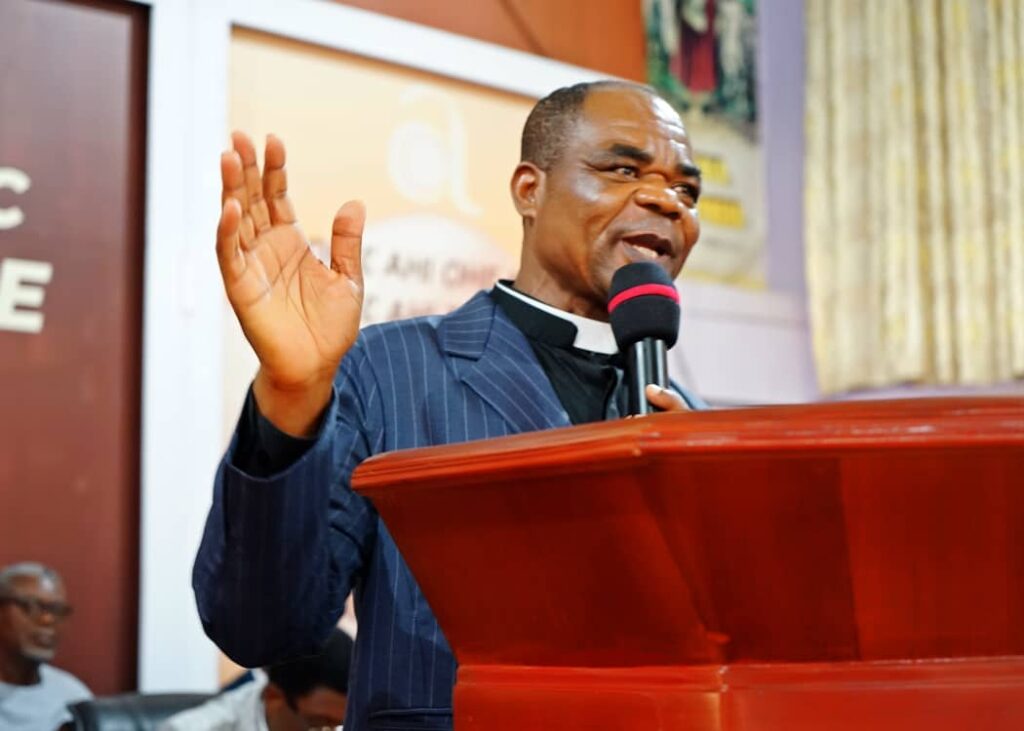
The central question posed by the book is whether a Christian who refrains from tithing is merely a “lover of himself” rather than a lover of God. He contrasts this perspective with the view that modern-day ministers exploit tithing for personal gain, raising the possibility that some preachers may also be more focused on self-interest than on their congregation’s spiritual well-being.
In an unusual analogy, the foreword compares the roles of an apothecary and a perfumery, drawing a parallel between their functions and the relationship between religious institutions and their followers. Just as one cannot be healed without using a prescription from an apothecary, Apostle Vegba suggests that the deeper spiritual benefits of religion might require a commitment like tithing - though whether this analogy fully applies to Christianity remains a point of debate in the text.
The book acknowledges that tithing has roots in Judaism, predating Christianity and even forming part of the religious practice of Jesus and his disciples. The foreword references a crucial biblical passage from Matthew 5:17, where Jesus asserts his mission to fulfil rather than abolish the law. For many believers, this raises a fundamental question: Does Jesus’s fulfilment of the law imply that Christians remain obligated to practices like tithing?

Yet, Apostle Vegba invites readers to reflect on the distinction between the teachings of the Old Testament and the spirit of the New Testament. He points to a famous saying of Jesus - about putting new wine into new wineskins - as a metaphor for the evolution of religious practices, suggesting that clinging to outdated rituals might harm the church’s mission.
The book ultimately aims to provide a comprehensive biblical analysis of tithing. It seeks to answer whether tithes are essential for a Christian's spiritual journey and whether non-payment could carry eternal consequences. At the heart of the book is the intention to equip believers with the scriptural knowledge they need to make informed decisions on tithing.

In his foreword, He emphasizes that his views, though firmly rooted in biblical doctrine, are not binding. Instead, they serve as a guide for those wrestling with the question of whether to tithe. However, he warns that dismissing these perspectives lightly could be perilous, emphasizing the gravity of the tithing decision.
As the La Area Superintendent of the Apostolic Church, Apostle Vegba offers a perspective grounded in years of spiritual leadership and biblical scholarship. His book positions itself as a crucial resource for believers at a time when Christianity faces challenges from within and without. As the debate over tithing rages on, he calls on Christians to choose their path with both caution and reverence for scripture. Through a detailed exploration of tithes, he offers a roadmap for those seeking clarity amidst the controversy, believing that this guidance could provide a much-needed beacon in turbulent times.
As tithing remains a topic that divides congregations and theologians alike, the book invites readers to delve into the heart of the issue, challenging them to examine their beliefs and come to a personal understanding of what it means to be faithful. It is a call to introspection, to weigh tradition against the evolving nature of faith, and to navigate the crossroads with conviction.
Latest Stories
-
‘Not our jurisdiction’ — Mahama breaks silence on Ofori-Atta case
2 minutes -
Mahama pushes for return of civic education to tackle indiscipline, sanitation challenges
4 minutes -
Ghana’s Black Stars fall again as Germany snatch late victory
6 minutes -
Mahama praises Volta Region’s cleanliness, urges national replicati
35 minutes -
Ghana Medical Trust Fund set for launch as Board finalises key systems
54 minutes -
Ghana restores investor confidence through economic reform – Deputy Finance Minister
54 minutes -
We never promised to end sole sourcing, only its abuse – Sammy Gyamfi
57 minutes -
Middle East tensions: Ghana’s current energy resilience thanks to increased domestic gas production – Mahama
59 minutes -
KsTU unveils ‘Nimde3 Hyiren’ Regenerative Electric Vehicle
1 hour -
(VIDEO) Kumasi Technical University shatters EV barriers with self-charging car
1 hour -
Mahama praises JoyNews’ ‘Tax for Galamsey’ exposé, orders end to illegal mining levies
1 hour -
Mahama vows stronger environmental governance, seeks CSO collaboration in fighting galamsey
2 hours -
Anti-LGBTQ bill not Ghana’s most pressing concern, but must be addressed through democratic processes – Mahama
2 hours -
Gender Ministry mourns victims of Accra New Town building collapse
2 hours -
Gov’t will introduce amendment to Procurement Act to limit sole sourcing – Mahama
2 hours