

Audio By Carbonatix
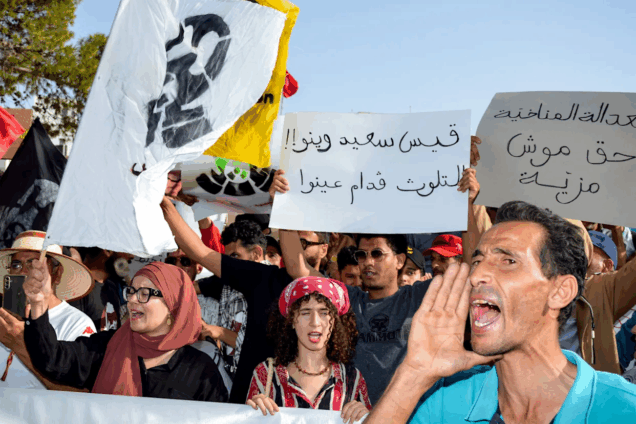
Thousands took to the streets of the Tunisian coastal city of Gabes in a huge march on Wednesday, in an escalation of protests that began last week over pollution from the state Chemical Group’s (CGT) phosphate complex.
The large-scale protests heighten pressure on President Kais Saied's government, which fears the unrest may spread to other regions of the country.
The government, already pressured by a deep financial crisis, needs to balance public health demands with the production of phosphate, Tunisia's most valuable natural resource.
The protesters chanted slogans such as "we want to live" and “Gabes is crying out for help”.
The protesters marched towards Chatt Essalam, a coastal suburb to the north of the city, where the chemical group is located. There, witnesses said that police fired tear gas to disperse them as they approached the headquarters.
In the capital, Tunis, crowds also gathered in support of Gabes, highlighting growing national concern over the environmental crisis and the call for urgent government action.
Residents of Gabes say they are suffering from increased respiratory illnesses, osteoporosis and an increased incidence of cancer due to the toxic gases emitted by the factory's units.
The latest wave of protests was triggered earlier this month after dozens of schoolchildren suffered breathing difficulties caused by toxic fumes from a plant that converts phosphates into phosphoric acid and fertilizers.
CGT did not reply to Reuters' attempts to seek comment on the situation in Gabes.
Khaireddine Diba, one of the protesters, said: “Today, our voice will be loud and resounding until this crime stops immediately."
Saied said this month that Gabes was suffering an "environmental assassination" due to what he called criminal policy choices by a previous government.
He called on ministries to maintain the units to stop leaks as a first step.
However, the protesters reject temporary solutions and demand the permanent closure and relocation of the units.
Tons of industrial waste are discharged into the sea at Chatt Essalam daily.
Environmental groups warn that marine life has been severely affected, with local fishermen reporting a dramatic decline in fish stocks over the past decade, hitting a vital source of income for many in the region.
Latest Stories
-
Fitch affirms Ghana’s LT Instruments at ‘B-‘; assigns recovery rating of ‘RR4’
2 hours -
T-bills: Government records 25% undersubscription; interest rates rise marginally
2 hours -
Vinicius scores twice as Real beat Atletico in thriller
4 hours -
Guardiola’s dance of joy as Man City pile pressure on desolate Arsenal
4 hours -
Kenyans fighting illegally for Russia in Ukraine to be granted amnesty
4 hours -
Hawaii storms have caused $1bn in damage, governor says
4 hours -
Mahama to lead Ghana’s delegation to UN special session on reparatory justice
5 hours -
National blackout hits Cuba for second time in a week
5 hours -
Trump at a crossroads as US weighs tough options in Iran
5 hours -
UDS and UG seeded ahead of 2026 Honda Football Championship raw
6 hours -
GPL 2025/26: Swedru All Blacks edge out Hohoe United in narrow 1–0 win
6 hours -
Carabao Cup: Semenyo wins first trophy with City
7 hours -
Carabao Cup: O’reilly double gives Man City Wembley win over Arsenal
7 hours -
Man City end Arsenal’s quadruple hopes as O’Reilly’s double clinches Carabao Cup triumph
7 hours -
Mahama to attend Africa Energy Technology Conference 2026 in Accra
8 hours