

Audio By Carbonatix
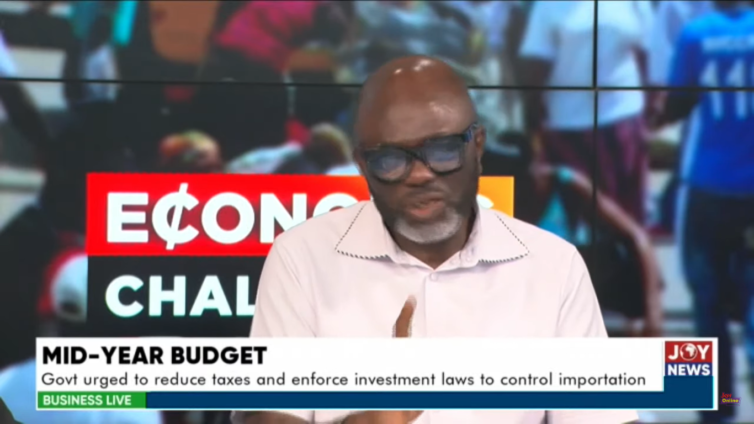
The trading community in Ghana is mounting pressure on the government to use the Mid-Year Budget to cut taxes while enforcing the investment laws to control the rising level of importation into the country.
This will also help control imported inflation and consequently reduce year-on-year inflation.
According to the Ghana Union of Traders Association (GUTA), the economic climate is already not favorable, thus driving most of them out of business.
They contend if the mid-year budget doesn’t address their concerns, most of them will be forced to fold up.
Speaking on the Joy Business Pre-Budget Forum on the theme “What Should the Policy Direction be in the 2023 Mid-Year Budget”, President of GUTA, Joseph Obeng, said the concerns of businesses mustn’t be taken with a pinch of salt.
“We don’t have the space to develop and grow. That has been our main problem. Excessive taxation has put a toll on the private sector, making us uncompetitive. We cannot even sell our produce to the neighboring countries because of the cost of the produce”.
Touching on importation, Dr. Obeng argued that Ghana only owns about 60% of its export earnings which he believes is worrying.
“I have a serious problem with importation. Ghanaians do not own the economy, the export earnings we get only about 60% as a nation. That’s why you always have a problem with foreign exchange”.
“The excessive importation that we do, only about 20% is for the locals and the 80% belongs to foreigners”.
According to the data from the Bank of Ghana, the total import bill for the first four months of 2023 was provisionally estimated at $4.0 billion, down by 13.9% year-on-year. The decline in imports was driven largely by non-oil imports and, to a lesser extent, by oil and gas imports.
Again, the trade surplus improved further to $1.6 billion in the first four months of 2023, driven mainly by import compression. The value of total exports was estimated at $5.65 billion, down by 3.6 percent year-on-year.
The fall in export earnings was driven largely by crude oil exports and to a lesser extent by non-traditional exports, as gold and cocoa exports increased.
Latest Stories
-
Ghana to begin camping with 12 athletes after Accra Open Championships – Bawa Fuseni
15 minutes -
Anthony Joshua declines showdown with Tyson Fury but admits they ‘probably’ clash next
28 minutes -
Tyson Fury dominates Makhmudov, calls out Joshua next
47 minutes -
I have supported highway authority financially to fix roads in my constituency – A Plus
2 hours -
US, Iran fail to reach peace agreement after marathon talks in Pakistan
2 hours -
ECG kicks off Phase Two of transformer upgrades at Lashibi; brief outages expected
3 hours -
Port crises loom as 11,000 drivers threaten four-day strike
4 hours -
A source of excellence across generations – Vice President Opoku-Agyemang lauds Mfantsipim
5 hours -
(Photos) Mfantsipim School launches historic 150th anniversary
5 hours -
Knights and Ladies of Marshall group backs Catholic Bishops’ stance on anti-LGBTQ+
6 hours -
Bright Simons writes: All the Filla in the Ibrahim Mahama/E&P – Gold Fields Saga
6 hours -
Monetise Idiocy In Ghana
6 hours -
The Ghanaian prophet and the mysterious death of his scottish wife Charmain Speirs
7 hours -
Nearly 400 sentenced in Nigeria for links to militant Islamists
7 hours -
Ghana’s recovery supported by gold strength despite global oil price pressures – Standard Bank Research
8 hours