

Audio By Carbonatix
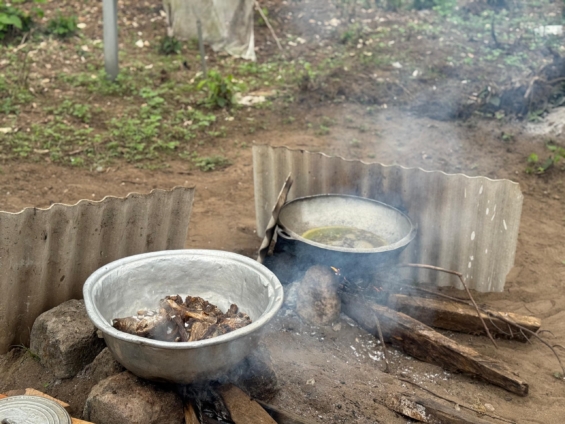
Three stones arranged in a triangle. Firewood stacked in the middle. A flame coaxed to life with scraps of paper or dry leaves.
It is the most familiar kitchen scene in many Ghanaian homes.
Low-cost and widely used, the traditional open cookstove has fed families for generations. But for anyone who has cooked on it, the experience is also familiar — coughing fits, watery eyes, stepping outside repeatedly to escape the heat and smoke. What looks simple and harmless has become one of Ghana’s most overlooked public health threats.
But according to Professor Reginald Quansah of the University of Ghana School of Public Health, this familiar setup is quietly one of the most dangerous places in the home.
“If you really look at what is happening in most of our kitchens, especially the traditional ones, then you realise that the kitchen has become a small toxic waste factory,” he explains.
“People do not see it that way because it is something we have lived with for so long.”
Household Air Pollution, caused largely by cooking with firewood and charcoal in poorly ventilated spaces, contributes significantly to the global pollution burden. Research shows it accounts for about 20 per cent of pollution worldwide, yet it remains one of the least discussed public health threats in Ghana.
Air pollution as a whole now kills an estimated 32,000 people every year in Ghana, according to the State of Global Air Report. A substantial portion of that comes not from traffic or factories, but from inside homes.
Professor Quansah explains that traditional cookstoves are not only smoky — they are also highly inefficient.
“When you use the traditional open cookstove, only a very small fraction of the energy actually goes into cooking the food,” he says. “About 18 per cent is what we call effective energy. More than 70 per cent of the energy is lost as heat, and then about 8 per cent of the energy from the wood or charcoal goes into producing very toxic chemicals.”
Those chemicals include carbon monoxide, which reduces oxygen delivery in the body; black carbon, a fine particle that penetrates deep into the lungs and bloodstream; and carbon dioxide, which accumulates rapidly in enclosed kitchens. Prolonged exposure increases the risk of pneumonia, stroke, heart disease, chronic lung disease and lung cancer.
The danger, Prof. Quansah notes, is comparable to one of the most widely recognised health risks in the world.
“If you look at the evidence carefully, exposure to indoor air pollution is just as dangerous as smoking,” he says. “The difference is that people are scared of smoking, but they are not scared of cooking smoke, because it has been part of their lives for generations.”
Women and children are the most exposed. In many homes, women remain in the kitchen long after cooking is done — talking, resting, or watching children — increasing the duration of exposure. Children, often carried on their mothers’ backs, inhale the same smoke at critical stages of lung development.
Over time, the effects go beyond respiratory disease.
“Household Air Pollution is responsible for about 25 percent of cataracts globally,” Prof. Quansah explains. “And it is more common in women because they are the ones who usually do the cooking and spend more hours in the kitchen.”
Despite decades of research and the availability of cleaner cooking technologies, changing behaviour remains difficult. Prof. Quansah says this is partly because people fear risks that kill instantly, not those that harm quietly over time.
“We are very scared of things like road accidents because they have an immediate effect,” he says.
“But when a risk is something that will happen maybe in five years or ten years, people do not take it seriously, especially when their grandmother used the same method and lived long.”
Cleaner cookstoves, better ventilation, behavioural changes and affordable access to LPG can dramatically reduce exposure. But without sustained education, affordability and monitoring, many interventions fail once initial support ends.
For Prof. Quansah, the message is simple but urgent: air pollution is not only an outdoor problem.
It is burning quietly in kitchens across the country — every morning, every afternoon, every night.
And until it is treated with the seriousness it deserves, the most dangerous factory in Ghana will remain hidden in plain sight.
This story was a collaboration with New Narratives. Funding was provided by the Clean Air Fund which had no say in the story’s content.
Latest Stories
-
I have supported highway authority financially to fix roads in my constituency – A Plus
51 minutes -
US, Iran fail to reach peace agreement after marathon talks in Pakistan
1 hour -
ECG kicks off Phase Two of transformer upgrades at Lashibi; brief outages expected
2 hours -
Port crises loom as 11,000 drivers threaten four-day strike
3 hours -
A source of excellence across generations – Vice President Opoku-Agyemang lauds Mfantsipim
4 hours -
(Photos) Mfantsipim School launches historic 150th anniversary
4 hours -
Knights and Ladies of Marshall group backs Catholic Bishops’ stance on anti-LGBTQ+
5 hours -
Bright Simons writes: All the Filla in the Ibrahim Mahama/E&P – Gold Fields Saga
5 hours -
Monetise Idiocy In Ghana
5 hours -
The Ghanaian prophet and the mysterious death of his scottish wife Charmain Speirs
6 hours -
Nearly 400 sentenced in Nigeria for links to militant Islamists
6 hours -
Ghana’s recovery supported by gold strength despite global oil price pressures – Standard Bank Research
7 hours -
Methodist Church hails Mfantsipim@150; calls for “fresh consecration” to excellence
7 hours -
‘Excellence is our inheritance’ – Nana Sam Brew-Butler hails Mfantsipim’s 150-year reign in leadership
7 hours -
Kwaku Azar writes: A-G vs OSP
7 hours