

Audio By Carbonatix
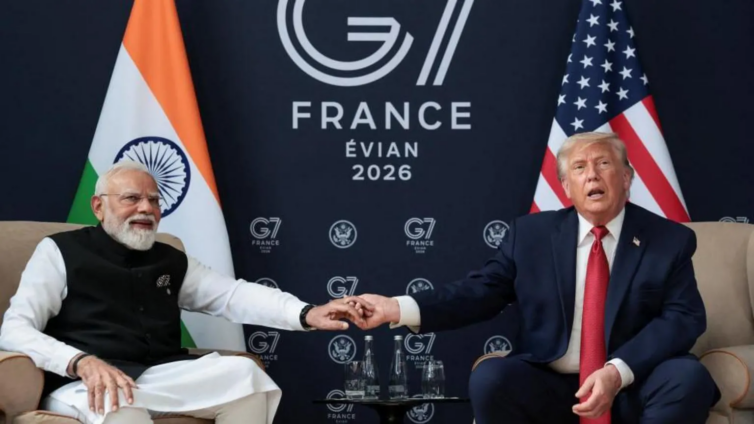
US President Donald Trump promised to visit India during a bilateral meeting at the G7 summit in France, signalling a thawing of relations between the two countries.
Trump said it would take place "sometime in the future", adding India and the US were close to agreeing a trade deal.
Relations between the two superpowers came under strain after Trump announced his plans to impose tariffs on India last year.
The killing of three Indian sailors by the US military last week further complicated the relationship.
The sailors were killed in the Gulf of Oman in a strike after the US military targeted a tanker which it accused of violating its blockade on Iranian ports.
Indian Prime Minister Narendra Modi raised the safety of Indian sailors working in the Strait of Hormuz with Trump during their meeting at the G7 summit.
The pair also discussed their efforts to reach a trade deal - negotiations which were set back by a recent US announcement that new import taxes on countries judged not to be doing enough to tackle forced labour, including India.
Speaking to reporters on Wednesday, Trump called Modi a "tough negotiator", and pledged to visit the country soon.
India has been pressing Trump to visit for several months now, potentially as part of a meeting with Japan and Australia.
Questioned on the US-India defence relationship, Trump said America would "help" India if they were "attacked".
Referencing Modi, he said: "If anybody attacks that man, we're going to be there... Now, if there's a new leader, I'm not sure about it."
The meeting followed a period of heightened tension between the two nations. Delhi summoned a senior US diplomat twice following the killings of the Indian sailors and strikes on other tankers with Indian crew.
Domestically, Modi has been criticised by opposition parties for not directly condemning the US's actions and demanded that he raise the matter with Trump.
In a speech to G7 leaders on Tuesday, Modi mentioned the conflict in the Middle East, adding that "several Indian civilians" had lost their lives and that the safety of seafarers should be ensured.
"Today the world does not suffer from a shortage of resources; it suffers from a shortage of trust. And the future of our partnerships depends on building this trust," the prime minister said in remarks that some commentators in India linked to the meeting with Trump.
India imports about 90% of its oil and has been badly hit by the war in Iran and the closure of the vital Strait of Hormuz, through which about a fifth of the world's oil and gas supplies are normally transported.
Even if the strait reopens soon, global oil and gas supplies could take months to stabilise.
The meeting at the G7 marked a significant tonal shift in the relationship between Trump and Modi.
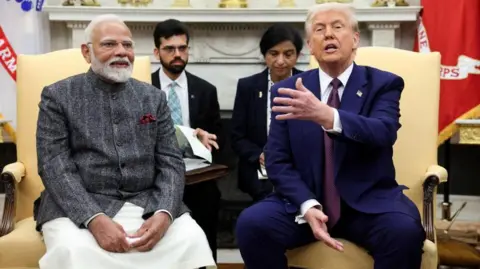
In February last year, Modi travelled to Washington for a frosty meeting with Trump at the White House.
Officials are set to meet in Delhi next week to negotiate the "final touches" to the US-India trade deal, as described by India's commerce secretary.
India was among the first countries to open trade talks with the US last year, but the process has proven complicated.
At one point, the US imposed tariffs of up to 50% on certain Indian goods before reducing them to 18% after the two countries agreed to an interim trade deal in February. The rates are currently at 10% after the US Supreme Court struck down many of Trump's tariffs, ruling them "illegal".
It is not clear when or if the proposed new tariffs concerning forced labour will come into effect.
Over the past year, Delhi was also irritated by Trump's claims that he brokered an India-Pakistan ceasefire after a conflict and his offer to mediate on Kashmir, a disputed region claimed by both countries.
Delhi rejects third-party mediation on Kashmir, and Modi "strongly" communicated this to Trump last year. In the months since then, Pakistan has managed to keep Trump on side, even playing the role of an intermediary between Washington, Tehran and the Arab capitals.
Other sources of tension include the Trump administration's crackdown on immigration and restrictions on H-1B visas that have long been a pathway for skilled Indians to work in the US.
Latest Stories
-
Real-Time VAT on cross-border digital services – not a new tax and does not violate double taxation principle
10 minutes -
Digitalisation, AI key to Ghana’s tourism transformation – GHATOF
22 minutes -
Stronger GTA-private sector partnership needed to grow tourism – GHATOF
32 minutes -
Amazon eyes Ghana for broadband expansion after talks with Mahama
1 hour -
National Investment Quiz 2026: Six schools qualify for quarter-finals
2 hours -
‘Do not let Russia pay for its madness with lives of your people’ – Zelensky to Ghana, 46 other countries
2 hours -
6,079 promotion cases fully processed and paid – CAGD says amid nationwide teachers’ strike
2 hours -
Teacher unions to meet government Monday over nationwide strike
2 hours -
Photo story: Republic Bank-JoyNews Habitat Fair clinic wraps up after three days of housing solutions, expert engagement
2 hours -
National Peace Council urges investment in youth to sustain Ghana’s peace
3 hours -
Afenyo-Markin urges youth to speak up against injustice
3 hours -
CAF annuls Edo Queens victory, orders WAFU B final to resume from extra time
3 hours -
Interior Minister urges traditional authorities to enforce anti-bushfire bye-laws
3 hours -
3rd Republic Bank-JoyNews Habitat Fair Clinic ends on a high note after three days of strong patronage
3 hours -
Ten climbers missing after avalanche hits Himalayan base camp
4 hours