

Audio By Carbonatix
Ghanaian legal luminary Tsatsu Tsikata has proposed a solution to Ghana's recurring Cedi depreciation.
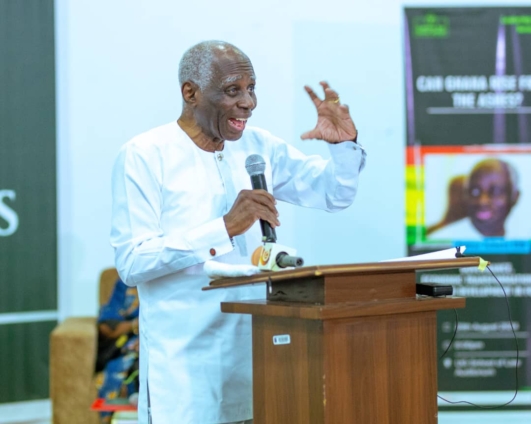
Speaking at the 14th Leadership Dialogue organised by the Centre for Social Justice (CSJ), Mr Tsikata's proposal focused on an approach he terms the “foreign exchange footprint” of individuals, aimed at bolstering the nation's economy and mitigating the impacts of Ghana cedi's devaluation.
The former Chief Executive of the Ghana National Petroleum Corporation (GNPC) began his presentation by addressing pressing issues faced by Ghana, including brain drain and the persistent depreciation of the cedi.
He noted that while many young professionals are leaving Ghana for opportunities abroad, this situation also presents a chance to leverage the economic potential of the Ghanaian diaspora.
"The diaspora and indeed Africans beyond Ghana have a unique relationship with the country that can be economically beneficial," Tsikata explained on Wednesday, August 28, 2024.
Mr Tsikata made the proposal when he delivered the keynote address at the 14th Leadership Dialogue organized by CSJ, a think tank, with support from Friedrich-Ebert-Stiftung (FES-Ghana) and Woezor TV.
The Leadership Dialogue Series is the flagship civic education platform of CSJ, a left-of-centre think tank. For years, the Leadership Dialogue has sought to nurture mass political participation and patriotic values through stimulating discussions with experts and prominent national leaders.
On the issue of dealing with Ghana's depreciating cedi, Tsikata further noted that remittances in foreign exchange from Ghanaians abroad often surpass the revenue from mineral exports, underscoring the financial significance of this global connection.
Forex Footprint
The crux of Tsikata's proposal lies in redefining how Ghanaians approach their consumption of foreign goods.
He introduced the concept of a "foreign exchange footprint," drawing a parallel with the contemporary practice of assessing one's carbon footprint.
"We need to examine our individual foreign exchange footprint. By evaluating how much we depend on foreign products and identifying areas where we can switch to local alternatives, we can reduce our dependence on imported goods and strengthen local production," he explained.
Ghana's perennial forex challenge
According to a paper by the International Institute for the Advanced Study of Cultures, Institutions, and Economic Enterprise, on an annual basis, there has not been a single year when the cedi has not lost value since the country moved from the fixed exchange rate regime to the current floating exchange rate system as part of the economic reform program embarked on in April 1983.
Over the past few decades, the cedi has lost about 99.9841% of its value against the US dollar.
The least rate of annual depreciation of 0.9 per cent occurred in 2005 while the year 2000 saw the highest cedi depreciation of 49.8 per cent since 1984.
On average, the cedi has depreciated annually by a rate of 20.3 per cent in three decades. $1 currently sells for close to 16 Ghana cedis (GH₵15.65) as of August 30, 2024.
The depreciation of the cedi exacerbates inflationary pressures and erodes business capital, thereby worsening the overall economic situation of the country.
A Novel Approach
Tsikata's approach makes a case for a comprehensive review of personal and collective consumption patterns to identify which foreign products can be replaced with locally produced alternatives.
His strategy aims to reduce Ghana’s import dependency, thus alleviating the pressures that contribute to the cedi's depreciation.
"The goal is to drive local production and create a self-sustaining economy that relies less on external factors," Tsikata added.
The proposed solution highlights the need for systemic changes in how Ghanaians interact with the global economy, suggesting that individual actions can collectively impact national economic health.
Tsikata’s call is a shift towards a more introspective and proactive approach to managing Ghana’s economic challenges.
He urged economists and experts to consider his proposal and improve it if necessary.
Ghana needs a great leader
Tsikata also addressed the broader context of Ghana's economic challenges, calling for leadership that is honest, humble, and capable of leveraging the nation’s resources effectively.
He urged leaders who are committed to tackling economic issues with transparency and a willingness to seek external expertise when necessary.
Latest Stories
-
Pamela Bridgewater Project urges stakeholders to join outreach programme on teenage pregnancy
43 minutes -
Shot on duty: A Ghanaian journalist’s five-year struggle for recovery
48 minutes -
Rainstorm rips off Kassena-Nankana West District block
50 minutes -
Fans gather in their numbers for 2026 Adom TV Fufuo Party
51 minutes -
When reporting becomes a risk: The growing digital war on journalists in Ghana
54 minutes -
Pressure mounts on Bogoso-Prestea Mine Divisional Chiefs to withdraw petition seeking to replace Heath Goldfields
1 hour -
NACOC Bono-East Command arrests 6 in ‘Operation Clean Street’ in Donkor-Nkwanta
1 hour -
Bawumia calls for cross-border cooperation to unlock Africa’s AI potential
2 hours -
AI will reshape jobs but offers opportunity if managed well – Bawumia
2 hours -
Bawumia outlines six policy priorities to position Africa as global AI leader
2 hours -
High data costs threaten Africa’s participation in AI revolution – Bawumia
2 hours -
Africa risks missing another tech revolution without urgent AI adoption – Bawumia
2 hours -
No bed syndrome is result of systemic failures, not lack of beds – Aurum Institute Ghana Director
2 hours -
Data costs remain key barrier to Africa’s AI future – Bawumia
2 hours -
Black Stars technical team needs to sit up – Augustine Ahinful
3 hours